Maybe I misunderstand, but I don’t think the ETFs of your two graphs match all your criteria.
Buffett (in one of his letters) made the example of a 1% percent fee applied over his investing time (70 years). It would have meant that over half of his current investment wealth would have been owned by the financial institution. This is very non-intuitive for human beings.
1 Like
As I wrote here, the difference between VT@IBKR and XALL@Saxo are about 1.5% underperformance after 20 years, or less if you aren’t able to get the full US withholding tax credited every year.
That’s the real cost of having a non-US domiciled, non-synthetic ETF by a non-US ETF fund provider with a Swiss broker under tax-wise ideal circumstances.
4 Likes
1% per year and 1% difference after 20-30 years are not the same thing though. 
2 Likes
Thank you. Sorry, did not see it.
Did you use the geometrical mean of the 7% and also compound the difference annually? The compounding is part of investing and usually creates the big differences.
There is also the topic of spreads and 2 x 0.15% stamp duty (did not see it mentionned). The assumed same performance is probably also debatable.
Edit: You used the etfs from the first post? Did you add the swap fee (that is not part of ter)? How did the calculation account for generally the lack of Wertschriftenleihe income with swapper etf?
Edit2: Can we please sell everything after 20 years? The exit should also be included.
Edit3: To be really comparing same to same, VTI+VEA+VWO should probably be taken, which has a lower TER.
1 Like
IBKR is the least simple of …about everythat’s ever been recommended on Mustachian Post.
I’ve long held that a low-cost UCITS fund are the simplest option - that provides returns comparable to VT.
And simplest for both your own tax returns as well as in case you pass away for your loved ones (assuming they’re Swiss-based), if you hold them with a Swiss broker.
Everything else is minor to minuscule optimisation.
Although I’m saying this as someone who has the greatest part of his net worth with IBKR.
…in other words, equivalent of one (maybe slightly above average volatility) trading day. Basically negligible.
3 Likes
I used the FV function. From the 7%, I deducted TER, withholding tax lost and income tax. For lump sums and monthly contributions each, I deducted broker fees, stamp tax and currency conversion.
Spread is difficult to model, as it can vary wildly between different exchanges, times of day, funds etc. Stamp duty is considered of course.
Yes, VT’s index underperformed XALL’s index in the last years. Maybe it stays that way, maybe small cap premium makes a comeback, maybe they perform the same over 20+ years – who knows? So I chose to ignore perfomance differences for this comparison, as I didn’t see a reasonable alternative.
No. As can be seen in the table, I compared VT and XALL. Neither are swap-based funds.
I didn’t include selling costs for multiple reasons: nobody sells their entire portfolio at once, and even if they did, they’d want to transfer the position to another broker where selling is cheaper. Also, calculating selling costs is extremely easy to do yourself.
“IBKR + VT” is in the topic title. So I compared two 1-fund solutions.
Exactly.
5 Likes
It’s the same. Net of costs and fees, holding USD typically has a negative yield in CHF. If your expenses are in Swiss francs, your cash is better off at some cantonal bank in a CHF savings account, with positive yields.
I shared the portfolio earlier, please have a look. The cost difference is virtually zero (in the 0.0x% depending on the time period) and not even in favour of VT.
Any risk not bringing reward is unacceptable. I stated my risk assumption and the reasoning behind it in the very first post, please feel free to read it.
They don’t. These are All-World UCITS funds comparable to VT, meaning distributing and USD-denominated. The purpose of the screenshots is to show that VT is not better than comparable funds.
For my own 3-funds portfolio, I stick to CHF-denominated funds.
May I suggest reading what has already been written in this thread before you started contributing? For example, it was previously noted that funds bought at Degiro, a foreign broker, are not subject to Swiss stamp duty.
1 Like
You seem to think is that there is a swap “fee” that should be substracted from the fund’s NAV ?
No, there isn’t. Everything is reflected in the NAV, therefore comparing NAV of VT with NAV of another distributing All-World fund is perfectly valid.
2 Likes
I guess swap fee should be visible when comparing total return of both funds. To be comparable make sure to use the same index.
Yes, we had a look last month (your contribution around posts 76-78) and it was basically negligible. I totally agree with @San_Francisco and @assemblyrequired on that perspective.


There are none and was never any CHF llisted (Swiss stock exchange) ETFs on the Commission free ETFs list as far as I remember.
Genuine question: do you really see zero risk added by the swap vs full physical replication? I can imagine the swap ETF to suddenly become much less liquid the moment the US really begin going crazy…
3 Likes
It has changed, you can sort by currency here. It’s not crazy but it includes good classics such as XDPU and XMTG.
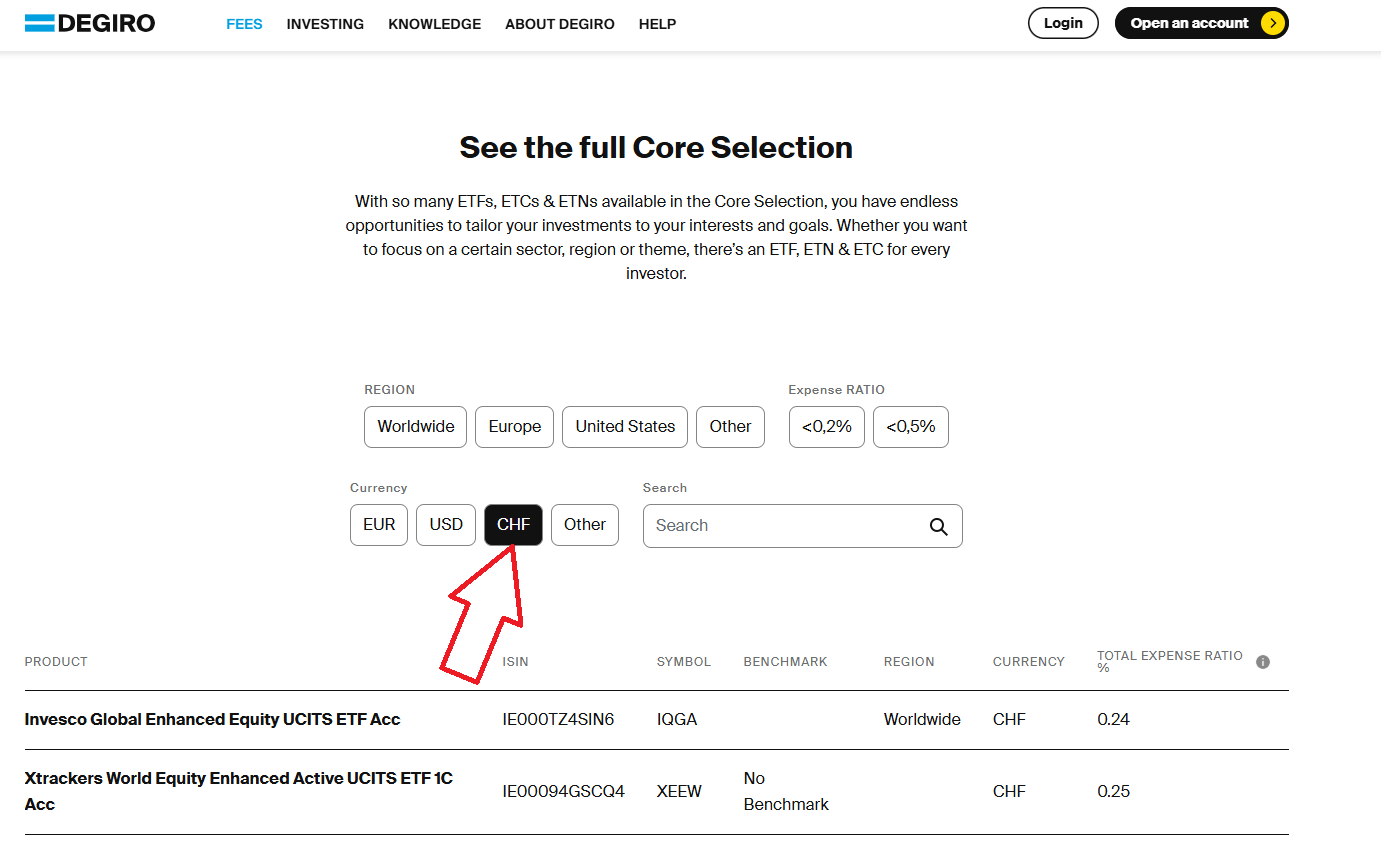
4 Likes
Yeah it depends what you want to mitigate. IMO if you’re anyway going to invest in US assets (through UCITS or direct), the difference in risk seems similar.
2 Likes
No, I don’t see zero risk added, but I don’t see it as significant either, because the counterparty posts collateral (typically G10 government bonds) to the ETF.
I try to imagine a crisis where such bonds do not keep value but it looks like nothing short of a full-blown Zombie world where you and I have other problems than the value of our investments 
Don’t you want to use unfunded swaps where the ETF provider is the one holding the basket? (and the basket will typically a subset of the index, e.g. https://www.ishares.com/ch/individual/en/products/335184/ishares-msci-world-swap-ucits-etf has a lot of US equity).
edit: looks like 97% of the holdings are US equity
Take this with a grain of salt https://www.sciencedirect.com/science/article/abs/pii/S1042443123001531?via%3Dihub
Thank you, that was very interesting to read.
In a world where S&P500 dividend yield is around 1%, I see this as further evidence that quantitative differences between passive approaches discussed here can be frankly negligible, and almost a matter of personal taste.
I am also glad that I am not the only one repatriating funds to this side of the pond. At least, it means that the share of my taxes that stays in Switzerland and serve the Swiss population is higher.
6 Likes