That a major IE-ETF on the biggest US index with 150b in AUM won’t have a big spread?
That you’d rather pay 80 CHF to your bank/broker (+ another 60 hidden in the fx rate + 50 pa on wht)?, when the same transaction would be 20 with a UK-based broker? Or less than 1 when buying the US fund in the US?
It’s clear with all the conviction and arguments that a tiny spread won’t change the argument
Option 1
My point is simply that under normal circumstances, spread is negligible when you buy mainstream UCITS trackers.
Out of curiosity and following @gaijin 's claim that you save on FX fees by buying US-domiciled trackers, I kept an eye on US-heavy UCITS ETFs when NYSE is closed and across the main European exchanges, to see if a currency hedge cost could be detected in the spread.
The result, as the theory predicts, is that no cost is detectable for major pairs at the retail investor level.
It was out of pure curiosity, as I only buy CHF-listed funds on SIX. Practically, I pay zero in currency exchange fees, custody fees, and spread.
Even transaction + handling fees (2 EUR + 1 CHF) are represented as 0.00% at my trade size.
Haha, I did compare fees on paper but I shuddered seeing them black on white.
Wasn’t that point that a CHF-listed ETF somehow needs to get their hands on US stocks (or shares of a USD-listed ETF). You won’t see those as FX cost. And for the fund I’d expect them to be near 0.
Anyway… you might just compare returns or tracking error if they’d use the same benchmark. iShares US S&P outperforms their IE S&P by some 0.3% p.a. on average. At 1.5% dividends, that might be some 0.23% due to wht, another 0.04% from TER difference, and then possibly some 0.03% something else (unless dividend was higher 10 years, I don’t want to check that).
That’s both USD, though, so I guess it’s not quite the point.
I got that point in the starting post. It’s not even new, it’s an ongoing developing development. Sswapping ETFs have been around at least for 15 years and are ab option if you don’t mind the synthetic replication in general.
Fees coming down is welcome, in any case
That latest answer was on the comparison of same ETF content with different domicile, where it’s very valid to theorize about the differences, but also possible to just compare the returns.
Yes - I trade VWRD in USD at LSE (to save on Fees, instead of trading VWRL in CHF). The shown spread is a bit weird, because that just displays traded shares, hence it looks wide. What actually happens though is that my orders get filled within 10’ by what I speculate to be market makers. They can just generate shares and likely do so in batch processing - I completely ignore the spread for all intents and purposes.
Can you please explain your approach for saving on fees? As far as I know, it’s the same fund listed at LSE and SIX, and IBKR fees are 5 bps for both exchanges.
I think they changed the pricing model - as far as I can tell on their website now, they all seem to have gotten much cheaper.
CHF minimum used to be 5 CHF, I wonder if now the USD conversion hassle is worth the trouble. May need to change to SIX then… I am pretty sure however this 0.05% on virtually all european exchanges is quite new.
I think it’s still the same. With fixed pricing, the minimum at SIX is CHF 5 while it’s USD 4 at LSE. With tiered pricing, the minimum at SIX is CHF 3.88 (1.50 is IBKR commission, the rest is the SIX exchange fee) while it’s only about USD 1.90 at LSE.
If you have to convert currencies manually, the total minimum is fairly similar. With auto-fx or using a single currency conversion to buy multiple ETFs, LSE is cheaper for smaller amounts.
For larger amounts, the difference is probably not significant.
I think the reason I did it was the fact that I already had a lot of USD from selling VT shares - since I didn’t want to be bothered to convert back and the fees were a tad cheaper on LSE, that’s what I chose. But you’re right in practice and on my portfolio size it’s almost irrelevant.
I wonder if it’d be worth to request a position transfer and stuff, since VWRD and VWRL have the same ISIN, this should be possible and it’d cost 10$ or so. I don’t want to trigger another capital gains event this year - I already had about 100K in CG by moving from VT to VWRD and it’s probably not necesarry.
It is good hygiene to keep access to near-zero-fee trading.
While TER decrease can happen, ETF providers have little incentive to seriously slash their fees. At 0.20% TER, iShares Core MSCI World was competitive enough to reach 150 billion AuM.
They could in theory align on Amundi Prime’s TER but that would destroy hundreds of millions in fees, with little hope of getting it back: It’s already a huge fund, with many holders locked in because most jurisdictions heavily tax short term capital gains.
There is no such thing as truly passive investing. We all need to clean the house, to cancel old subscriptions and to check insurance invoices every now and then.
I agree with you and I’d rather not summon the pipette conversation; my point is that a cheap trading setup removes psychological friction when it comes to house cleaning chores, and seeing both trading and spread fees displayed as 0.00% for 50k trades definitely helps keeping a clean, modern house.
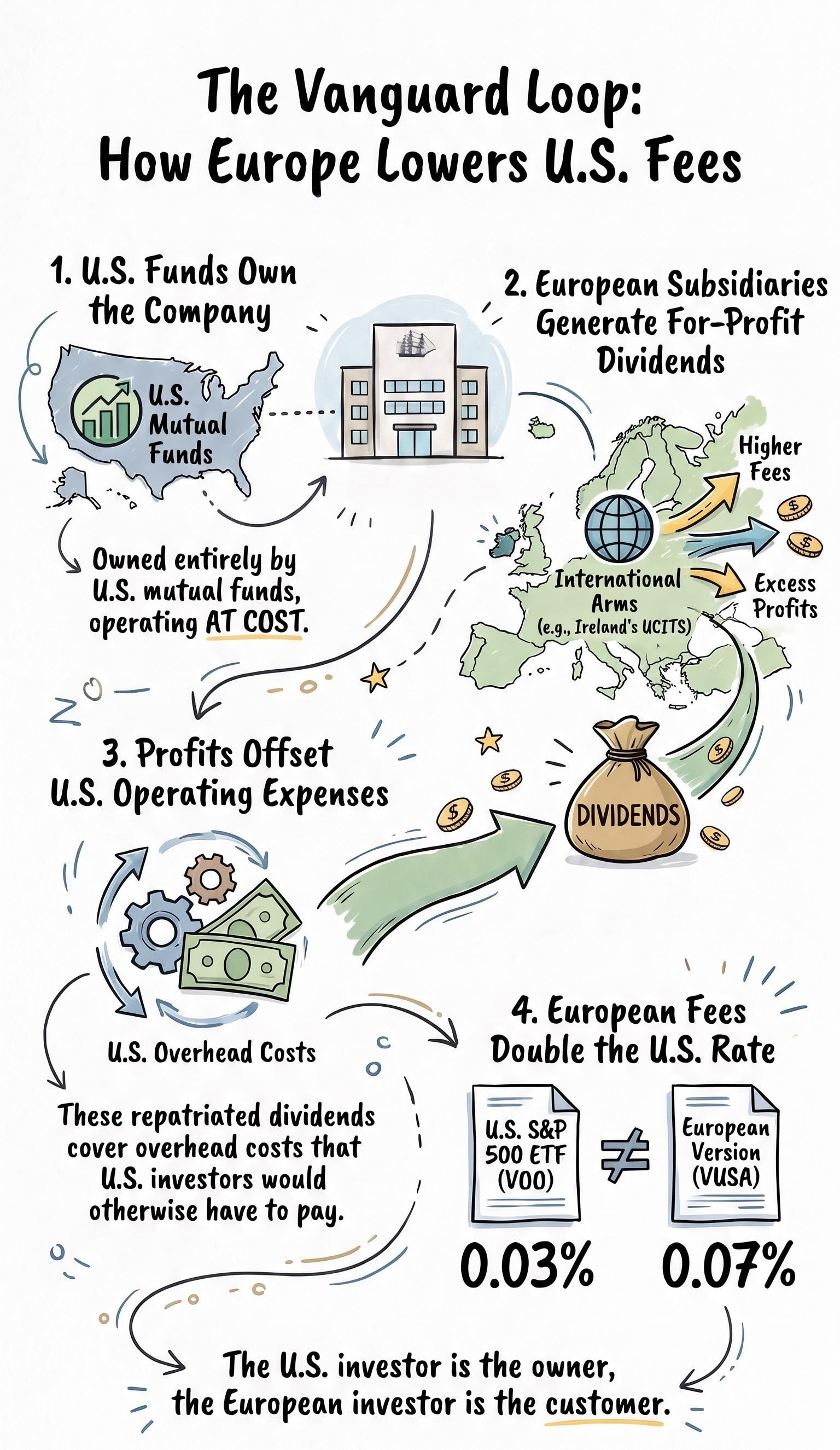
FWIW, Vanguard earns close to ~300M on VOO, vs. ~37M on VUSA. I doubt the EU dividend make much difference, the actual difference is scale (I think ETFs have a lot of fixed costs, so makes sense that if you have 1T of assets there’s less overhead, esp. with SP500 which is pretty easy to manage).
edit: that said I can believe if the pricing in UCITS is market based (depend on what the competition does) rather than “at cost”, but I doubt it’s significantly subsidizing the US, EU investments are just so much smaller.
First, it is true that Vanguard’s European subsidiary is a normal for-profit entity.
Second, Vanguard uses global trading desks. So the costs of trading should be the similar between the EU and U.S. operations.
Where the costs differ is in administration, legal, distribution, compliance, etc.
Vanguard Europe is very small compared to Vanguard U.S. So it has to allocate proportionally more to UCITS-specific issues. On the other hand, the difference in size between the European and U.S. operations is so large that profits from the European side would not make much of a difference. But Vanguard Europe is likely expected to make some profit, simply by the nature of the business.
Arguably Vanguard Europe as the technically best indexer in Europe. I believe U.S. “shareholders” don’t care about the European branch. I also believe that the European branch was something of an orphan within the organisation before Salim Ramji took over two years ago. I believe the culture of Vanguard spills over to the European side, in the form of habits and behaviour, but less so when it comes to costs.
The EU regulation just makes investing needlessly burreaucratic.
You need a KID, a fact sheet, a prospectus - all in X languages, depending on what exchange you want to list it. This prospectus then needs to contain specific info - all minisculy regulated to the point.
EU voters are constantly voting for ever increasing burreaucracy and are then complaining that things are more expensive… In the US you also have that to a degree, but the financial instruments are not demanded to print a flyier with fancy graphics in 20 languages every 3 months or so…
And VWRD / VWRL now costs like 0.12% - sure paying 0.02 would be even nicer, but I don’t consider this a difference that’s worth thinking about. Raising my savings rate by 1% is easier than to think about this - and sadly, because the EU is already so over regualted, it doesn’t look good here.
An alternative would be a Vanguard competitor, that’s both an ETF emittor and a broker for Europeans, but since our countries have very stupid, hpyer individualistic regualtion, this is very cumbersome… look at Austrias taxation or Germany and it’s “Vorabpauschale” - it’s almost like these governments don’t want wealthy citizens
And how is this not a problem of US issuer laziness in this day and age? It’s due diligence to be able to read things in your own language, and the EU is right to demand it in my opinion.
True, they may not want uber rich citizens, and that’s fine, 'though many “socialist hellholes” (as some on this forum and MAGA would describe them) like France, Germany, Italy, Nordics have their fair share of rich people! In (again) my opinion, people can be just fine having 20-100mn, absolutely nobody needs to have 500 billion, especially when you have catastrophic human degradation in places like the US. Edit: off topic as hell, but poverty and human degradation lead to crime, mental illness, drug use, I’m personally happy to have a bit less if it means my neighbours don’t want to shoot or stab me
Vanguard and all its funds are controlled by the 13 members of its self-selecting Board of Trustees. The owners of the funds have no say in this. They can maximally choose to throw these off their own fund, but that is where it stops. This will never happen. That you somehow “own” Vanguard is mostly clever marketing.
The US tax code and regulations run to tens of thousands of pages. Americans collectively spend (as per IRS estimates!) 13 billion hours on tax forms each year. Unlike many countries where the government pre-fills your return, the US makes individuals reconstruct it themselves, because tax-prep companies have lobbied against a simpler system. Let’s not forget the Alternative Minimum Tax, a parallel tax system you have to calculate separately just to check if it applies to you.
Investing, you say? The Dutch family who had to find ways to immediately pay 40% tax on a 7-figures RSU while it was frozen for years is not really an exception. A lot of complexity comes from the maze of account types: 401(k), Roth 401(k), traditional IRA, Roth IRA, SEP-IRA, SIMPLE IRA, 403(b), 457(b) and I’m sure I forget many, each with different contribution limits, income phase-outs, withdrawal rules, and, roulement de tambour, different penalty structures
UCITS regulations are geared towards protecting investors against snake oil sellers. Disclosure of standardized, audited information about a fund in the country’s official language seems like a bare minimum to me. Could you share which part of these protections would you like to get rid of?
When gullible investors are not protected, no one is. I’m sure @Mirager has fun things to say about what happened to Greek retail investors over the past decades. In the end, everyone gets ruined except the financial institutions, who get bailed out - and guess who pays for that?
As a marketing and distribution framework for cross-border retail funds, UCITS is mature enough the be the closest to a global standard, therefore saving money in legal and tax advisory costs. Compliant funds are cross-listed in Singapore, Hong Kong, Mexico, Tel-Aviv, Johannesburg, Saudi Arabia… While there are increasing distribution volumes in Taiwan, South Korea, etc.
Generally speaking, wealth managers in Asia, GCC and Latin America routinely default to UCITS-wrapped products for non-domestic clients because it comes with a recognizable rulebook on diversification, leverage limits, liquidity, and disclosure that regulators outside the EU are comfortable rubber-stamping.
Mit dem Lesen und der Teilnahme an diesem Forum bestätigst du, dass du die Forum-Richtlinien gelesen hast und damit einverstanden bist sowie den Haftungsausschluss auf http://www.mustachianpost.com/de/ akzeptierst.