Because everything else is theoretical speculation.
Is it, though? I agree with Abs_max post above, the process is clear, and you can download and check the forms. The relevant laws are available, too, if you like to go one step further.
That’s practical enough for me.
Someone could write an article concluding it’s easy, or that you totally need a lawyer, but what is that worth, if you can see for yourself.
I’m with you an questioning that a lawyer is required. Maybe for some, just like some people need professional help for CH taxes or some foreign immigration documents.
Personally, I’m fine with US-domicile for US assets, but there’s no point in convincing the UCITS fans or vice versa regarding the estate tax bogey man. 
2 Likes
I can’t find this testimonial but I have read on the poor Swiss or MP articles, the story of a family that share the trouble of this procedure.
It took more than 20 months but you have to pay the inheritance taxes before recovering the assets and be able to sell them.
1 Like
100% agree. The relevant laws do not state that a lawyer is required.
My point is that no law and no official document states that a lawyer is required. Still, the ‘UCITS fans’ state this as fact. All I do is to ask for evidence. Since it’s not written in the law, I see testimonials are the only form of evidence.
Yes, maybe you’re also right on this one 
2 Likes
In that case was RSU vesting on death. (And the issue is that they had to pay income tax on it while it wasn’t liquid yet)
There was no way in that situation to avoid the issue (if you have RSU from a US company you don’t have a choice, just make sure you can free enough liquidity to cover the income tax).
(And I think 2nd Pillar doesn’t help since it’s given directly to the beneficiaries rather than being part of the estate and available to pay taxes)
Edit: also the broker was stricter than IB and would only release the funds at the end (while IB releases once you filed)
4 Likes
That’d be my understanding from previous research: As heir, you’d notify the broker with all required documents, incl. a confirmation that you filed for US estate tax. Account gets frozen and handed over to the heir(s) after a few weeks.
In parallel, the US estate process runs which might well take several months or longer. If no US tax is due, it doesn’t matter.
That’d be for a boring portfolio with some US-domicile assets. No RSU’s, no other US assets that are hard to value, complete and consistent forms, send in on time for an uncontested estate with 1-3 non-US heirs and no shady business in general.
EZ 

Would be interesting to find the exact wording.
@_MP can you confirm/deny?
As for the Poor Swiss, I only find these quotes: (Source)
most investors will pay no US estate
I do not expect to pay any US estate tax.
We are investing in US ETFs because they are the most efficient ETFs available to Swiss investors. Because of the large exemption of the estate tax treaty, we are not worried about US estate tax.
Yeah in the comment they mentioned they had 1 millions + usd in US company share from the employer of the deceased.
I will try to find the testimony and post it here.
Yeah the issue is that those shares were income and taxed at like 40%.
If you can’t sell them and don’t have available liquidity elsewhere it’s tough.
I assume you refer to this story? https://thepoorswiss.com/us-estate-tax-swiss-investors/comment-page-3/#comment-52544
It was indeed the case of RSUs from one of the US Big Tech companies that gave a lot of headaches.
4 Likes
Here is the testimonial which I believe was referred to in above comments
We need to realise that it’s not easy to find testimonials for this scenario. In most cases beneficiaries are not going to write these testimonials and the person who could is going to be dead.
I think if most of the assets involved are listed assets and there is no complicated valuation need, it might not be so complex for beneficiaries to file the required forms with IRS & claim exemption from estate tax. But when people are grieving they might not be in right state of mind to do so. Thus a trusted lawyer or accountant might be helpful
Personally I chose to focus on UCITS.
3 Likes
I agree. I suppose it’s the correct figure for the physical WEBG.
From a tax perspective, the cost (relative to UCITS) decreases if you have a high income and/or live in a high-tax canton.
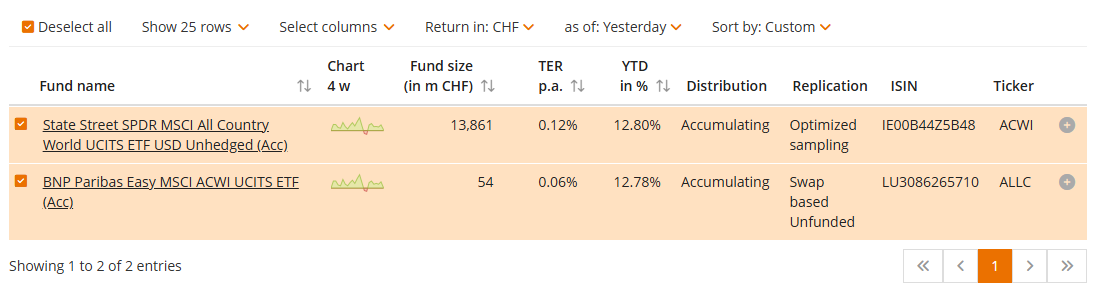
While I follow the path of a 3-funds portfolio, I keep an eye on the synthetic ACWI for at least a full year. I am curious to see if the theoretical tax drag difference actually ends up reaching the end investor. So far, I don’t see it yet.
2 Likes
The number is derived from following assumptions
Marginal tax 25%
US portion of world ETF 62%
MSCI US dividend yield 1.12%
WHT rate 15%
WHT loss = 1.12%*15%62%(1-25%)=0.08%
For higher marginal tax rate , impact is lower
And then I believe VT is 0.01% cheaper in TER versus WEBG.
1 Like
Thanks for finding it, also to @Abs_max . Very useful testimonial and discussion on that site!
One quote:
you’ll see that it really is my story and not even typical for many readers
Again, I am therefore wondering how similar his case is to the majority of VT+chill people in Switzerland.
No problem, I’m happy to have a look at any comparison of numbers (broker+ETFs) that you deem suitable to back your claim. So far, you have not convinced me about ‘cheaper’ 
I was absolutely not trying to convince you, it is plainly obvious since at least 250 messages thanks to @assemblyrequired that in any scenario, we are talking about a piffling amount.
I haven’t seen your analysis, but you seem to insist on examining your own personal case at the fractional pip level. I find it quite original but I am happy to do it here for you, so feel free to put all your details and costs in a column, and my offer to fill the other column still stands.
While I am satisfied with my own calculations for my own portfolio, I cannot share what would allow the reverse calculation of my wealth, and would reveal my marginal tax rate.
But I can share that following @Peppa’s idea, I had a chat with my spouse to understand the most likely scenario if I happen to die suddenly. By coincidence, I also met with my lawyer a couple days later. Both conversations convinced me that the costs involved won’t be in the fractional pip territory.
@assemblyrequired, would you mind sharing your formulas and/or file in order to add Degiro+ALLC, please 
1 Like
No, this is not what my messages aimed to convey.
But that’s ok. I’m happy to end this discussion from my side with the agreement to disagree on our views and interpretations.
That’s fine, I have no appetite for holding you accountable for your claims, and won’t repeatedly demand to see evidence of your analysis for another hundred messages 
But I’d still kindly request from @assemblyrequired to reuse the table with Degiro+ALLC, please and thank you 
I will post the formula here when I have the time to put everything together; not before Sunday though.
1 Like
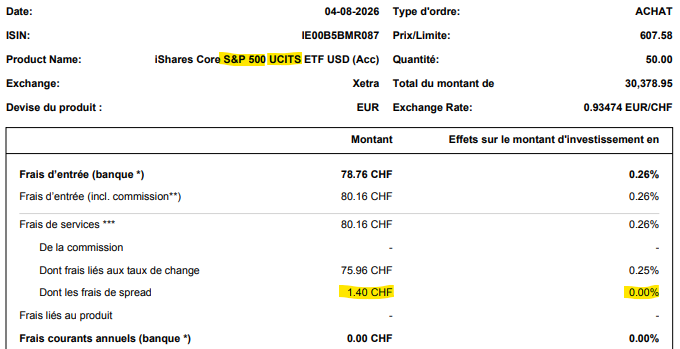
I had a quick look this morning at several mainstream UCITS funds on several European exchanges. There is clearly more than enough liquidity for retail trades in Europe, even when NYSE is closed.
The idea that high liquidity is a privilege of US exchanges became obsolete. We have all we need on this side of the pond 
1 Like