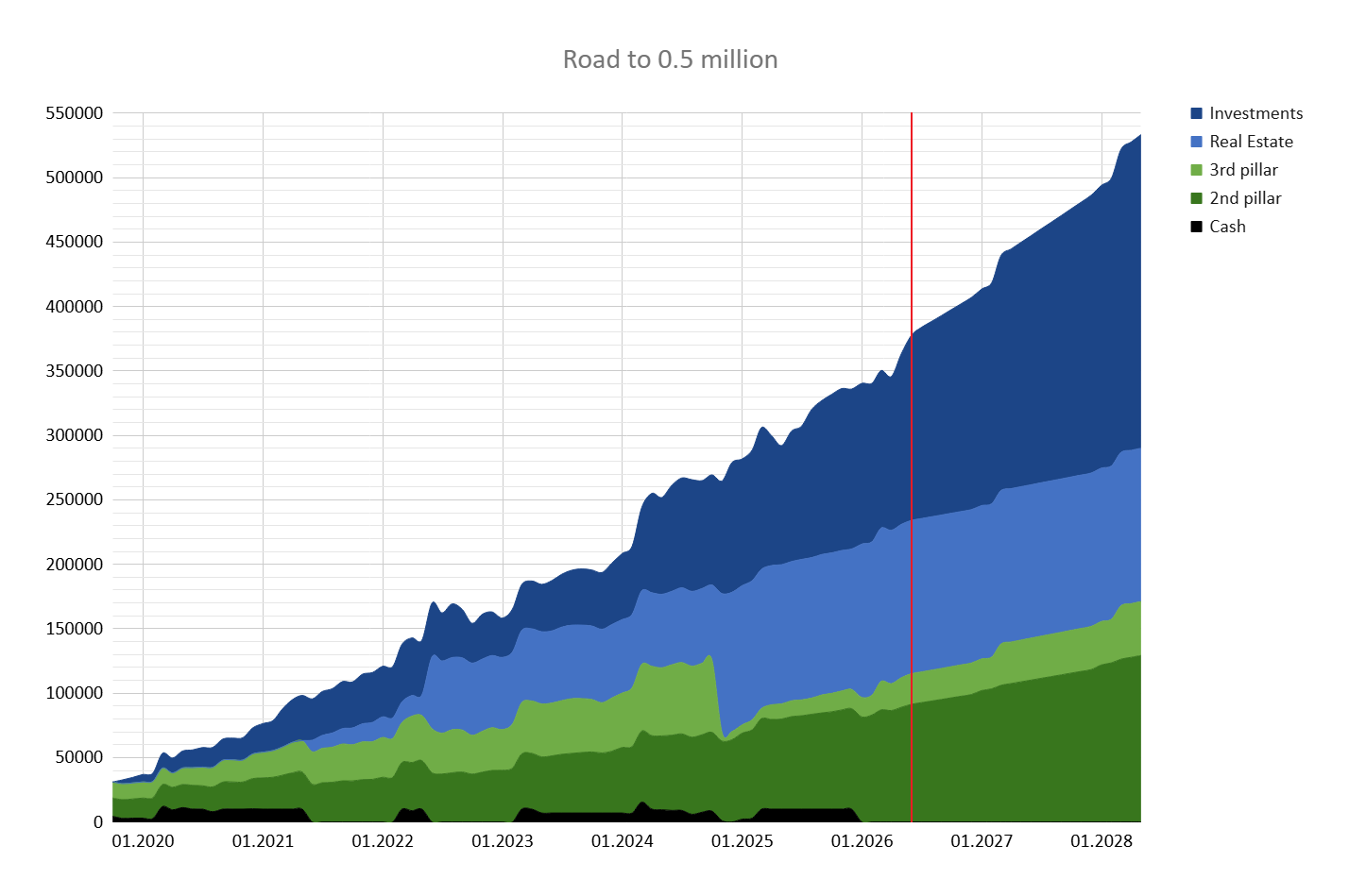
It’s not exactly square one. I’m considering the post I made two years ago as square one. Net worth actually regressed 222.- in two years.
Finally, I am joining the Party here 
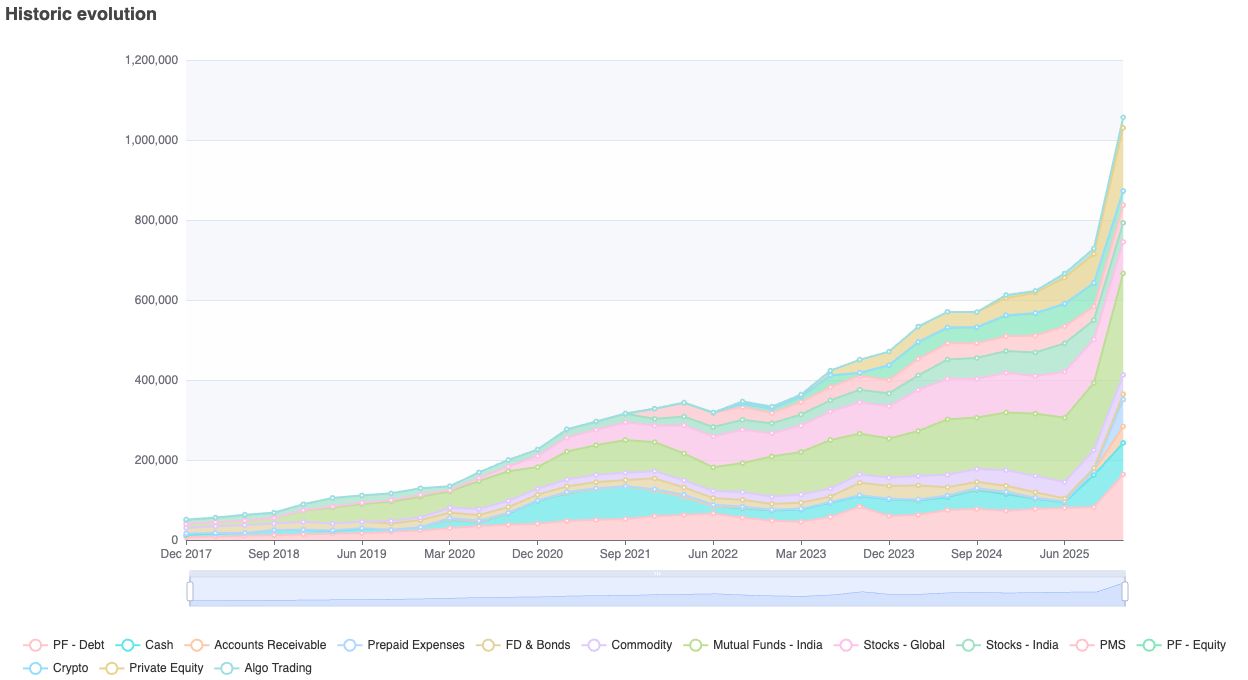
Here is my growth from Dec 2017 to Dec 2025.
Dec 2025 is special because I decided to combine my wife’s portfolio.
Here is the interpretation of the separate components:
PF-Debt - 2nd and 3rd pillar (not invested in the market)
PF- Equity - Market-based 2nd and 3rd pillar
Accounts receivable - Amount blocked somewhere. In this case, mainly from UBS, we just bought a house, and UBS will refund the reservation payment
Prepaid Expenses - Minor component just to keep track of recurring spending like SBB Halbtax Plus
FD & Bonds - Debt-based instruments yielding interests
Commodity - Mainly gold
Mutual Funds - Kind of ETFs (focusing on Indian stocks)
Stocks India - Personal managed Indian stocks
Stocks Global - Personal managed NON-Indian stocks & ETFs
PMS - Professionally managed Indian Stocks
Crypto - Negligible
Private Equity - Non-listed companies
Algo Trading - Money involved in algo-strategies
Current asset allocation:
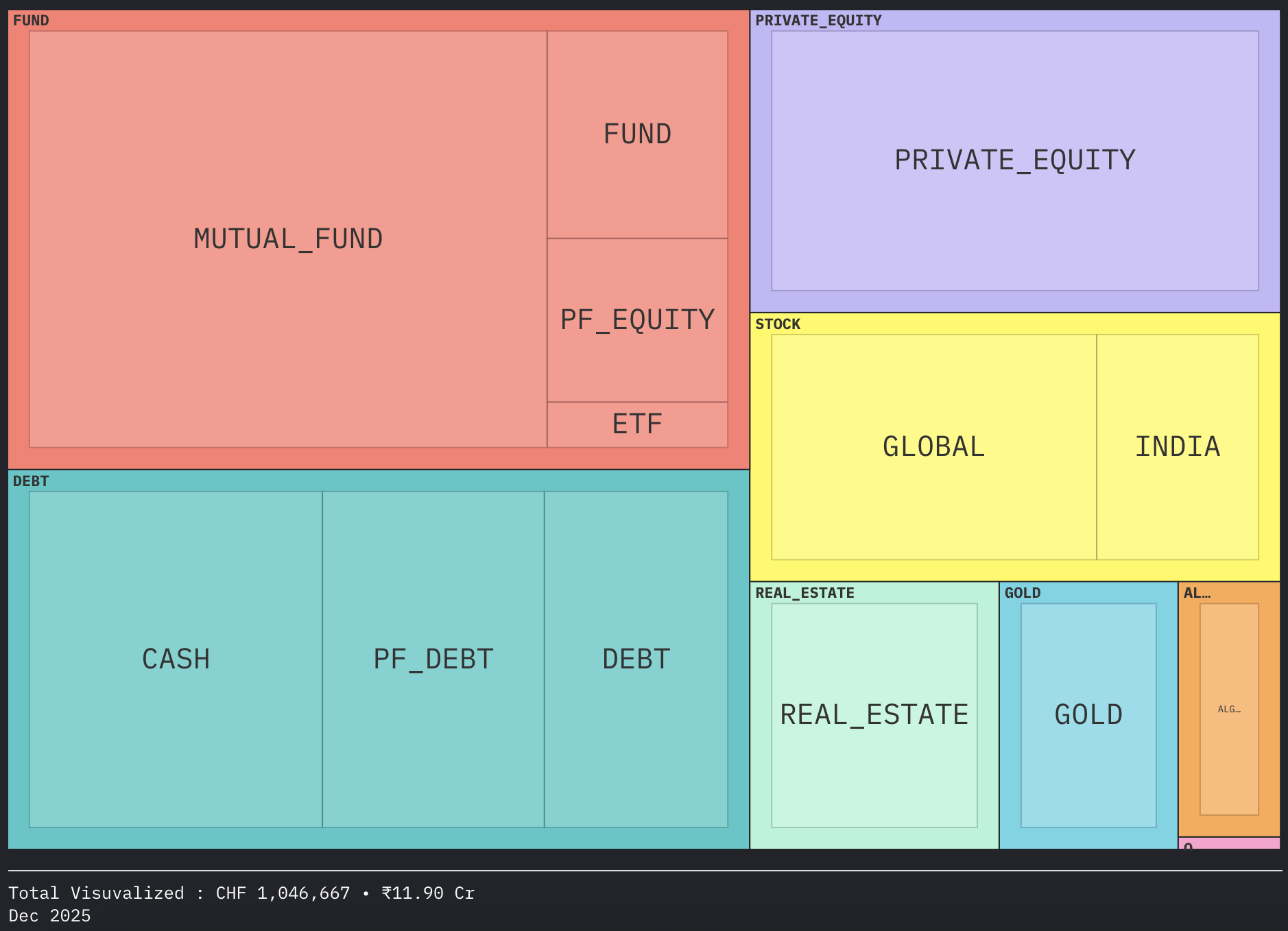
There is still a bit of a naming mismatch, as I did not intend to share when I created them.
Looking forward to your feedback. Happy to share my investment philosophy and other aspects as we go forward! Please also DM me if you have any suggestions/offers/ideas.
4 Likes
It is brand new and Nebenkosten include maintenance costs. Both actual ones (e.g., repair) as well as a Teuerungsfond.
It isn’t perfect, no. But perfect is the enemy of good enough.
I have a 10 year mortgage. I am very happy to sell (if not done so at that point) if I am unhappy with the new mortgage. I will certainly move away when/if I retire early. Somewhere where taxes are lower and I am closer to the mountains. So that point also doesn’t apply.
It is unlikely that anyone buying in the last few years would have a sound investment on a standalone financial basis
Can’t agree with this. Was it optimal? No, what is, but it was very good. My 8% is not even including the increase in value.
Nor does it include opportunity cost of locked capital.
Anyway, I agree it’s tricky how to consider a primary home in FIRE not only on a mathematical side. There’s a huge difference between people “happy to sell, happy to move, happy to “downgrade”, happy to rent if a better deal comes up” and someone tight to a place / location (family, roots, taste, comfort, loving your house) when calculating net worth and FI target.
In that case, your real estate may as well do a x10, either you stay in and it does not make you richer in terms of FI despite your beautiful graphs.
Let’s say my FIRE number is 3M, my debt-free real estate grows from 1M to 3M, here I am with my F-U number, what do I live from?
One could argue that as a renter the x10 (or x3) may as well translate in rent increase and as an owner you’re supposedly protected from this inflation. Thing is, it’s still a 0 cash-flow return you can’t realize living in it, and you have to have some other assets to cover non-housing costs as an owner.
It can be misleading in terms of financial planning. I see a lot of RE/primary home above 60% of total assets among this forum’s millionaires, with huge increase steps “when the bank did the valuation at mortgage renewal, woo-hoo I’m closer to FI”. I’m curious about the early retirement plan, if any.
As owner you may leverage some (more) debt, but that’s another story (how many are ready to take on mortgage debt and interest risk to put that in a portfolio you’re supposed to live from when FIRE’d, also it’s not guaranteed the very concentrated asset value grows forever).
As a renter a well invested portfolio could cover housing cost (and every other cost) even after inflation.
3 Likes
Impressive curve! Makes sense to combine all assets between spouses and plot it. As a whole, the asset allocation looks a bit complicated to me. Every asset class and every single stock needs a bit of mental bandwidth to keep on top of things. Maybe have a discussion, find common ground and simplify things in the future? There are other things both of you may want to consider:
- Cost of instruments: Funds, Mutual Funds and managed portfolio probably have costs of >0.2% (which for me is the current acceptable threshold)
- Potential home bias: a lot of India in the mix.
- Private equity could be a concentration risk, if only consisting of a few companies
- Large cash and cash-like part. Perfect if you are intentionally building a “war chest” to buy into a dip. Otherwise a bit large.
Hope this gives you some ideas!
2 Likes
Thanks for the detailed look and thoughtful suggestions. Really, really appreciate it.
Mental bandwidth: Totally true; in addition, having a concentrated portfolio could yield better returns too. So that’s indeed my plan. Let’s see where I would stand in the next quarter.
Cost of instruments: The main reason I keep in Funds insterd of ETFs is because of the Taxes. It’s a bit in a gray area in Double taxation taxes, I might be able to pay capital gain tax in Switzerland (at 0%) instead of India. For ETFs i have to pay long-term capital gain tax of 12.5%
Potential home bias: That’s very true and also a conscious decision. India is now the fourth-largest economy and will soon surpass it to reach third place. Also, the GDP growth in USD terms is the highest in the world. I believe it would also appear in the top line of the companies and also on the valuation.
Private equity: Very true, too. I didn’t intend for this portion to be bigger; however, the gains in this section are insane. For instance, $7k invested in Anthropic became $50k in about 1.5 years. I don’t want to cut the gains (in the name of re-allocation) as these valuations are going crazy (probably due to AI bubble  )
)
Large cash and cash-like part: That’s mainly due to some locked capital and shift of the 3rd pillar for the mortgage that will start from march 2026. I thought to go in again in equity if there is a dip, but it seems like the equity market is rallying as if there is no tomorrow.
Open questions for me:
-
How do you all account for the mortgage? Would you just add the downpayment in the portfolio and call it the value of the house? Or is it preferable to show the actual buy value of the house and subtract the debt? I feel the first option to be conservative, and also easier to account for.
-
Over the recent years, I started build options portfolio. While the section (pink bottom) is not even visible, its exposure is quite big. For now, I just show the market value of options in the portfolio, but I am wondering if I should show it as an asset for the LEAPS positions at least.
-
What is the overall view of the reallocations? By doing it, are we cutting down the winners or making the portfolio more resilient?
-
How do you all keep track of your learning? Do you store the quarterly networth somewhere with hypotheses and goals, and backtrack it to see what works well and didn’t?
1 Like
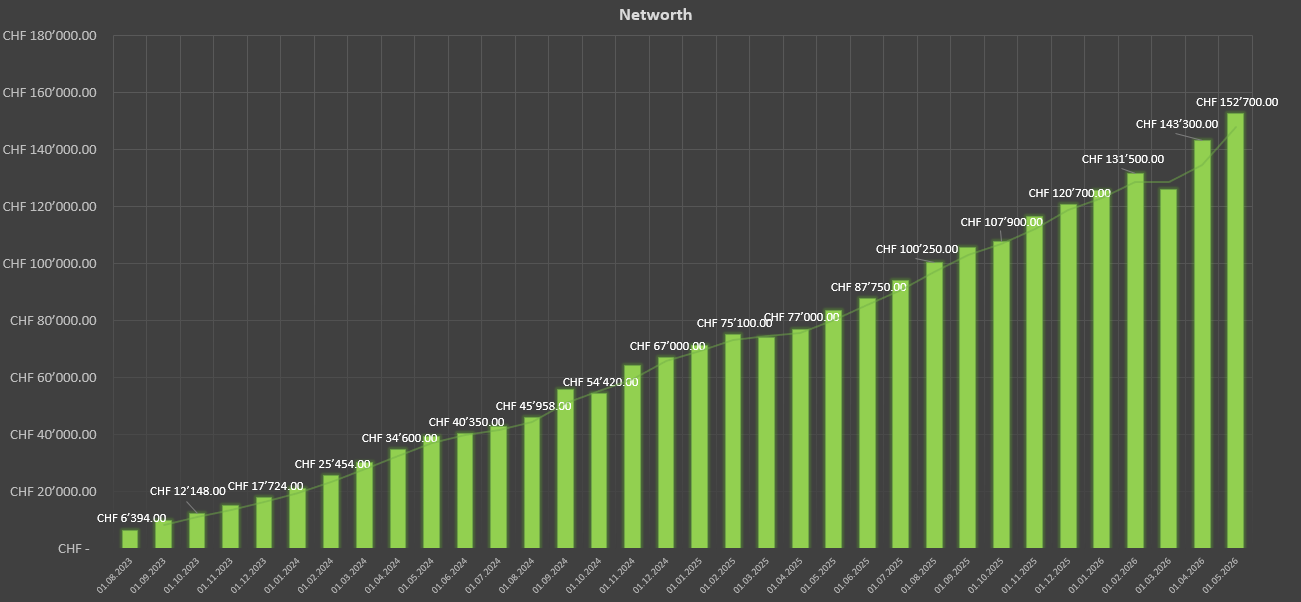
New Milestone: CHF 150’000+ reached!
Thanks to a very strong VT year with stable contributions, I managed to hit 150k earlier than expected (personal forecast predicted 09.2026)
My total net savings rate in this time hovers at around 65-70%, which I am happy with as a 24yo living at home.
This year I will also invest some CHF into Memories (Vacation) 
Can’t wait for the next update at 200k, good chance it’ll happen in 2027!
19 Likes
Congratulations - phenomenal number, especially for your age. Treat your parents well - it’s cheaper to pay for a dinner than to get kicked out of home 

12 Likes
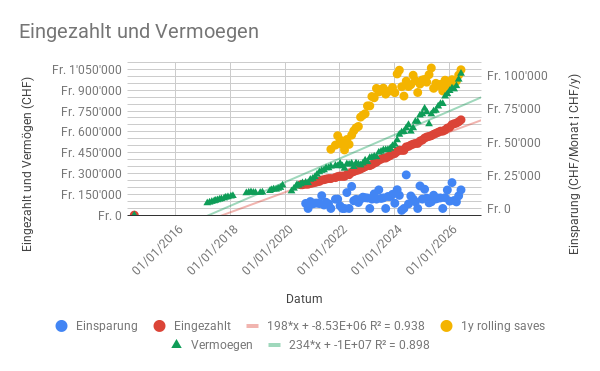
Milestone reached from my side as well, 1 MCHF passed last month and about a year before I planned it thanks to the exceptional returns the last month (someone said war ?)
I would consider that I reached my target number as a single person/no kids. Now, I am getting more into coasting modus meaning to cover for wife (who still works) and eventual kids. Next steps:
-Sabbatical planned for half a year starting in June 2027 (Bikepacking 3 months from Kirkenes, Norway to Faro, Portugal following the European Divide Trail EUROPEAN DIVIDE TRAIL)
-Afterwards, reducing my workhours to 80% and giving up a large chunk of responsiblity.
-No lifestyle inflation planned until then, just happiliy living with what I have but with much less stress.
Disclaimer, this net worth does include everything except 2nd pillar because I am a lazy ass to put it in and consider it as a hidden safety margin. This would add another 100 kCHF or so. 3a is included.
17 Likes
Wait wait wait… you’ve put in 600k in about 10 years that has got to a million, well done. What’s next?
Assuming this is all liquid, and you can withdraw 4% per year and not work too much, what you you gonna do with 3.3k a month?
What if you want to get a family once (wife, kids, a house or a bigger rented flat, a car, horses, courses, vacay in the maldives)? A child costs approx. 1M CHF until graduation (not counting his mother!).
- If you ever get descendants, do you want to leave nothing for them to start their lives with?
- what if there’s a 50%+ stock exchange crash and suddenly your stockpile can only give you 2k a month?
- what if you reduce to coasting, you run the risk of getting unemployable in today’s market, but everything else gets brutally more expensive around you, including housing, food and healthcare?
Not judging, and kudos if you have that mental relax, but I’d be not really releasing life at 1M NW just yet 
1 Like
686 k starting in July 2014 (first day after studies-basically starting with zero. No capital/No debt) - so 12 y. And yes reached the million Franks. Just basic ETFs (and some stupid but not so bad mutual funds in the beginning)
I actually live on less right now and perfectly happy with it. We spend around 60 kCHF for two persons going hiking, biking, brewing beer, traveling (also outside of Europe on the rare occasion). For now, it will be just accumulating while the reduced work is still covering much more than my expenses.
I do not stop working yet. Just taking a career break and focusing back on some more important stuff. Basically I got the freedom to say FU and go look somewhere else. Just slowly getting into a more relaxed stage.
Maldives: They are underwater anyway in a few years and definitely not my style of vacay
Mother: already there (see above). I cannot imagine to spend much more. Actually it is getting less because we already have everything. Can’t wear more clothes, buy more furniture etc.
house/flat: living nicely on 90 sqm right now. With a kid would be still doable (still having a storage/guest room full of shit, but barely used)
car: for what in Switzerland? And with less work comes more time for public transport.
1 MCHF over 25y, that would be 3000 CHF per month. My parents did not spend so much on me. I do not know where that number comes from, but come one, never heard of hand me down clothing ?
leaving for eventual descendants: good advice, good education, the will to do something good. The rest will fall into place while other kids brains will be dumbed down by AI and Tiktok.
I am managing a wastewater treatment plant. As long as people shit, I am needed. AI can still not manage repairs and human interactions on a plant site, as well as renewal projects. My company looks out for inflation adjustment right now (of course nothing guaranteed). On the other hand, I am so specialized and the market so dry, not much hassle there.
EDIT: btw already have some sideincome : Firefighters (another 3 kCHF/y which is extendable and tax free), giving classes how to handle a wastewater treatment plant, (3 kCHF/y for a week of work)
11 Likes
Confirms the old adage: “where there’s muck, there’s brass”.
4 Likes
It can cost that much if you have the money, but it can also be 3-4 times cheaper.
1 Like
I “just read this” somewhere in the past:
Swiss Life means it’s closer to 400k until 20yo (1666 CHF per month)
https://www.swisslife.ch/en/individuals/future-provisions-assets/guide/child-cost.html
- Extra room forever (4-800CHF per month)
- Kita, Hort costs (0-3000 CHF per month, depending)
- Hobbies and extracurricular interests (very flexibly "depends)
- More expensive summer trips (due to mandatory school breaks)
- General costs (food, healthcare, clothing, etc. - ~500 CHF)
#offtopic sorry, let’s get back to NW
2 Likes
I just became a millionaire, I realize sitting here taking a dump. As absurd as it sounds.
This includes second pillar and investments, so it’s not the full truth. But nice to believe a milestone just happened in a way or another.
20 Likes
TMI
5 Likes
Was it a nice dump?
Username checks out.
3 Likes