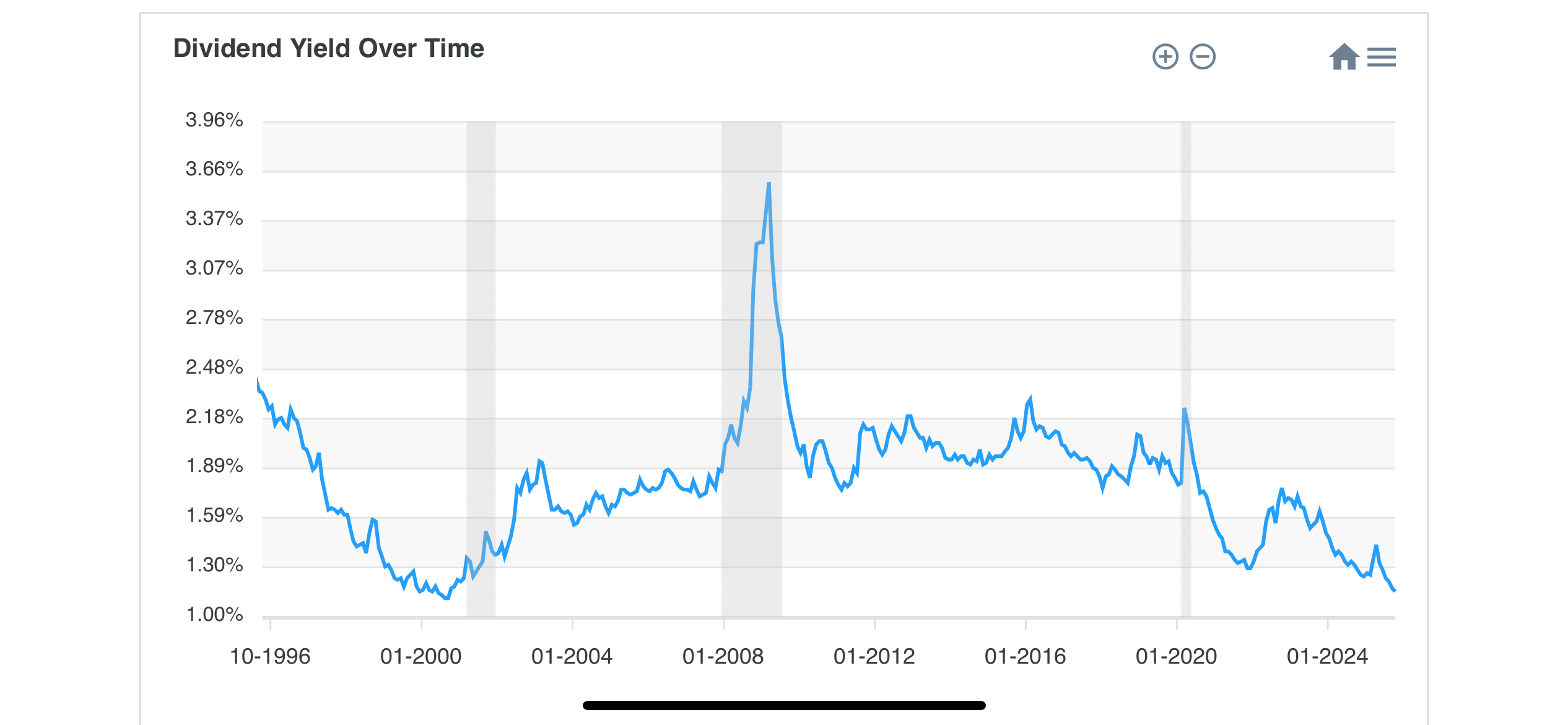
S&P 500 dividend yield is now 1.17%. I think the advantage of US ETFs is slowly reducing because S&P 500 is getting concentrated in mag7 which are low dividend stocks anyways
Hmmm interesting food for thought. First gut reaction is that yield doesn’t contain much useful information, it can go up and down but the cash value, which is more practical, can also go up and down.
What’s interesting is your suggestion that as VOO get concentrated in the mag7 it’s very possible that the cash value goes down because the fund is collecting fewer dividends, and yield goes down as well as the ETF’s share price goes up. I hadn’t thought about it that way, I guess we’d need to compare in a year’s time.
I am looking at dividend yield because if we buy S&P for 100 USD and get 1% dividend then that’s what we would get as investor. The actual payment number (USD / share) might be increasing but for people looking for cash flow the comparison is against bond coupons or rent from RE
For Swiss investors (inventing in global stocks) this number mainly matters while comparing effective difference between VT & WEBG. The whole idea of buying US ETFs and subjecting to IRS jurisdiction was to save money on dividend WHT. If this dividend keeps going down then IE ETFS are becoming more competitive
chart below is interesting - last time dividend yields were so low was during dot com mania
1 Like
And it makes sense, it inversely mirrors P/E, add on top that some tech bros don’t believe in dividends, and young growth companies don’t typically have cashflow for dividends and it all lines up.
1 Like
Do you know what ex-US is per chance?
For EXUS ETF (Msci world ex USA), accumulating, ictax reports 0.758/28.17=2.7% for 2024, but that’s price at 31.12.
There’s a distributing alternative but this share class has not lived a full year yet and is
distributing several times a year.
VXUS announces 2.67% so that’s consistent.
1 Like
What about XMAG ? Or there are other similar ETF ? sp500 ex mag7
No idea. I don’t really invest in such ETFs
I couldn’t find it. Normally it’s easy to find data on dividend amount but to plot dividend (trailing twelve months) divided by price at that moment is a different exercise.
1 Like
I was fetching all kinds of historical data from investing.com . Was surprised myself by the versatility of the data available. You will need to login, I think I used Google account to keep things simple.
Well, Google finance might be even easier to fetch data for specific tickers and dates. Or Microsoft office  .
.
Claude Deep Research has produced this document, which says it’s about 2.8% for DM ex-US and 2.6% for DM ex-US + EM
1 Like
VWRL peeve: 3-weeks between declaration, ex-div and pay date, and then 1-2 days more until the holy divvies show on the account. Pay date is the 31st, yet I knew they won’t show, they’ll show on Friday 2nd most likely.
My autistic brain wants to reinvest and close the books for 2025 cleanly but alas will need to happen in 2026.
It’s an ETF problem, not an account problem, divvies from US ETFs always show on the pay date and never later.
1 Like
“Content is user-generated and unverified.”
Yes, isn’t that already clear from the explicit mention of the specific AI tool used to generate it at the start of the post?
Cheers, will just leave it for Friday, it’s just that my autistic mental accountant would have liked to be done and dusted with it this year. (Though technically it’s the ex-div date that matters anyway).
The money arrived on my saxo account early this morning. But as always the dividend booking will take some time to be visible in the statement.
Right, then it’s PF’s issue - I thought it wasn’t because as I wrote above US ETFs are always on the dot.
I hate to disappoint you, but you’re not even on the spectrum, man.
Portfolio managers sailing or having to sail close on the wind will place their new trades (using the cash of a dividend arriving on pay date X) on trade date X-1 – or X-2, X-3, … in markets with settling time T+1, T+2, T+3, … – as they either don’t want or can’t have – by dictate of the prospectus of their product – cash sitting around in the portfolio idly.
They would never wait until pay date X for placing an order, let alone wait until the next business day after pay date X when the cash finally shows up in the broker/bank statements.
Intermezzo for the traders new to the game:
Trade Date (TD) versus Value Date (VD) for buying securities with settlement timeline T+2:
Trade Date T: You trade on date T, i.e. you place an order to buy a number of securities, an agreed on price, and fees as necessary. Only the contract is formed. No cash or security shares are exchanged. Your broker/bank might display something different on your app/web interface – the numbers on that display are irrelevant.
The broker “earmarks” (aka freezes) the funds in your account so you cannot spend them elsewhere, but the money is technically still yours.
T+1: The clearing house (Central Counterparty Clearing – CCP) matches your buy order with the seller’s order. They review the contract. They prepare the paperwork. If things are, er … clear, the clearing house allows to move to the Settlement Date aka Value Date.
If things somehow don’t match up, the order is not cleared. Your broker gets notified, the seller’s broker gets notified. Your cash gets unfrozen, the seller’s shares get unfrozen.
Settlement Date (T+2): The settlement institution executes the Delivery vs. Payment (DvP). The money is pulled from your broker’s account and sent to the seller’s broker, while the (seller’s frozen) shares are moved into your name.
In a simplified – I am not even exaggerating – version of cash management it’s roughly like this:
- On days leading up to day X check the holdings on ex dividend day and add/substract the expected cash flow for day X to the cash account for the corresponding portfolio
- Day X-3+: look at buy / sell plans in “exotic” markets/holdings that have settlement time with 3 days or more; place the order for the cash balance available for day X on trade date X-3+ such that the trade is settled on day X when the cash is available for buying or the cash is needed when selling.
Hedge as necessary for your share classes if your product is available in different currencies. - day X-2: look at buy / sell plans in markets/holdings that have settlement time with 2 days (e.g. CH, EU, UK); place the order for the cash balance available for day X on trade date X-2 such that the trade is settled on day X when the cash is available for buying or the cash is needed when selling.
Hedge as necessary for your share classes if your product is available in different currencies. - day X-1: look at buy / sell plans in markets/holdings that have settlement time with 1 days (e.g. US, Canada, Mexico?); place the order for the cash balance available for day X on trade date X-1 such that the trade is settled on day X when the cash is available for buying or the cash is needed when selling.
Hedge as necessary for your share classes if your product is available in different currencies. - day X: your order(s) from above from days X-3+, X-2, X-1 get settled, your cash from ex dates prior arrives in your account and at the end of day X your broker/bank updates their books and tells you on business day X+1 what cash balance is left in your account.
All of this happens on a rolling basis, of couse, and if you have any hedging, I don’t even know what the settlement times are. For spot FX transactions they’re still T+2, for FX forwards … huh, maybe instant? Dunno, man.
Either way, it’s a fun business.
Autistic?
Maybe in an accountant way …

(Trade Date looking at Value Date)
3 Likes
PF is run by Swissquote, and Swissquote has yet to credit the dividend for VWRL. It is of course not helpful that Vanguard went with the pay date of the 31st, but that should still work. And it did work with the other Vanguard ETFs I own, so this is indeed a bit odd and annoying. I am sure they will correct it next week.
Not just PMs! I sold my USD to CHF settling on the 31st, included the expected dividends. Now I miss that one dividend, and Swissquote just sent me an account statement claiming I am negative in USD at year end 
1 Like
VWRL divvies never came to me on time, always 1-2 days after the official pay date.