Totally agree, I have TDIV since now a a couple of years and very happy about it. On the contrary I also wonder why CHDVD gets so much traction (or simply said mentions) on this forum, the yield is mostly around 2.5% which is really not interesting in my opinion. One could do better buying a handful quality Swiss stocks (e.g. some mentioned by @anon17469660).
2 Likes
What’s the equation for IE and NL?
For world ETFs that are not US focused?
(I think IE is good in the UCITS space for its IE/US tax treaty but I may be wrong).
Dividends from what country?
Not an expert, I think there is a difference between reclaiming withholding tax from an NL stock dividend, and from an NL ETF distributing dividends from world stocks it holds, isn’t it?
Isn’t all the fuss about US ETF mainly to recover dividend from US stocks and get a better deal than IE / US for US stocks only? Mainly?
I’ve even read somewhere here that UCITS IE EXUS might be more efficient than US VXUS (for ex-US stocks).
Edit: otherwise I would think that an ETF can easily be a tax evasion wrapper having its domicile in whatever country it’s optimized for a defined target audience, whatever it holds, even with “physical replication”.
according to justetf CHDVD gives 3.72% dividends. I also thought it was lower.
Have you managed to reclaim any WHT from it?
CHDVD (3.30%) as home bias… I prefer it overs SPI or SLI… (performed better since the last 10 years)
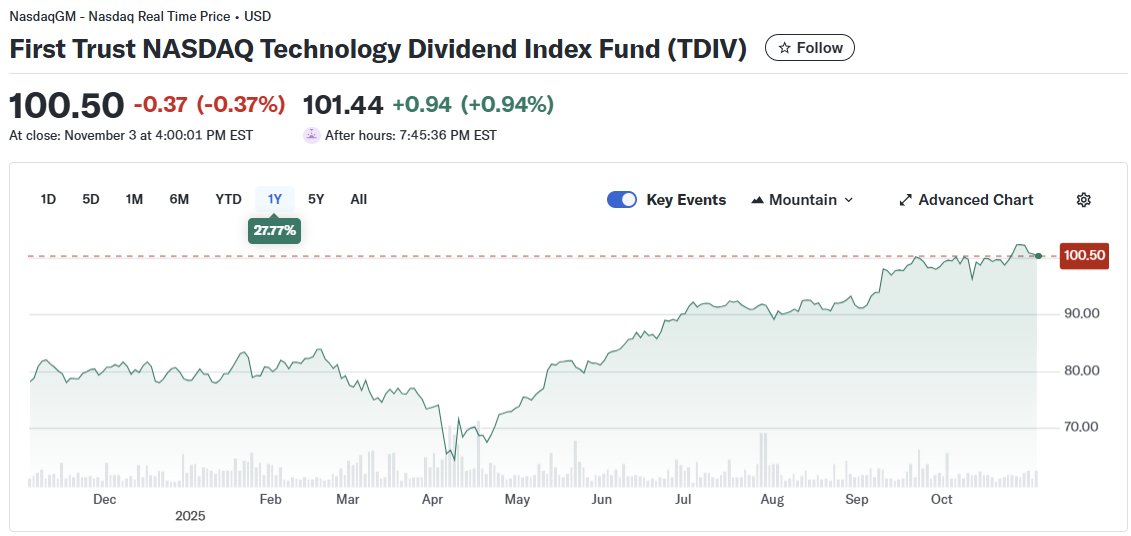
TDIV (4.5 - 5 %) … Just starting this year …
Have excellent performances since the last 10 years (equivalent to vwrl in total return) and provides some outside US shift to my VT and VWRL.
(Strangely, it is the only ETF following this index: Morningstar Developed Markets Dividend Leaders)
Sorry for the off topic… Just jealous that everyone has single stocks portfolio… And keep posting … And not me 
2 Likes
EDIT: Looked up the wrong ETF.
Old post
The top 10 holdings make up 55% and 92% of the weighting, respectively — both ETFs (CHDVD and TDIV) also include, in my opinion, some positions that could easily be left out. @anon17469660 once made an excellent overview of this, which I fully agree with.
What I mean is: with such a simple structure, featuring few holdings and extremely high concentration, it can definitely make sense to pick individual stocks instead and save the TER.
@cubanpete_the_swiss even works through the Dividend 100 Index (which, personally, would be too much effort for me — that’s why I just stick with SCHD, which doesn’t happen to have 83% technology companies like TDIV).
But I can absolutely understand your choice — in my opinion, there’s no right or wrong here; you just have to go with the approach that makes you feel the most comfortable in the long run. I also thought for a while that I could go all-in on VTI 
Absolutely no difference: a stock, ETF or a mutual fund. The withholding tax is levied by the country of security’s domicile and depends on the type of income - dividends or interest, sometimes capital gains. Some securities may distribute a mixture.
According to my knowledge,withholding tax levied by NL can be reclaimed completely using DA-1.
1 Like
So when you have VT or VXUS you can reclaim 100% of the dividend as a US-dividend because it is US ETF? Great.
Edit: but there might be taxes within the ETF that can’t be reclaim, right?
I’m really noob with this tax structure, what’s paid by the ETF, what’s taxed when distributing to ETF holder, what can be reclaimed.
Edit 2: may the lord gpt help my ignorance.
 ETF domiciled in the Netherlands — overview
The Netherlands used to be a common domicile for ETFs (especially older iShares and SPDR funds), though most new UCITS ETFs are now in Ireland or Luxembourg for better tax efficiency. Still, several Dutch ETFs exist, so let’s unpack the structure.
 1. Three taxation levels
| Level | What happens | Typical tax impact for CH investor |
|---|---|---|
| 1. Inside the fund | The ETF receives dividends from underlying holdings (U.S., EU, Asia, etc.). These may be taxed at source. | Yes – underlying withholding taxes (e.g. 15% U.S., 15% France, 10% Japan) are applied at the company level and generally not reclaimable by you. |
| 2. When the ETF distributes to you | The ETF pays a dividend (or reinvests it if accumulating). NL might withhold Dutch dividend tax unless exempt. | Normally 15% Dutch withholding tax, but exemption or refund applies for non-residents like Swiss investors. |
| 3. When you sell the ETF | You realize a capital gain. | Switzerland does not tax capital gains for private investors (if you’re not a professional trader). NL does not withhold any CGT for non-residents. So: no tax at sale.  |
 2. Inside the fund — taxation at source
Example:
The ETF holds:
- 40% U.S. stocks
- 30% European stocks (France, Germany, UK)
- 30% Asia-Pacific
Here’s what happens:
- U.S. dividends: 15% U.S. withholding (NL–US treaty) → fund receives 85%.
- European dividends: taxed at local rates (15%–30%, depending on country and treaties).
- Asian dividends: similar withholding by source countries.
 These withholding taxes are paid by the ETF and reduce its net asset value.
They are not reclaimable by you, because they happen at the fund level.
However, the ETF itself may reclaim part of it if treaty benefits apply.
3. When the ETF distributes to you (Swiss investor)
By default, Dutch dividend withholding tax = 15%.
BUT:
- The Netherlands–Switzerland tax treaty reduces this to 0% for most UCITS funds if you hold through a qualified intermediary or apply for refund.
- Many large ETFs already apply zero withholding for non-residents when held via a Swiss broker or custodian.
- If 15% is withheld anyway, you can reclaim it from the Dutch tax authorities (takes ~6–12 months).
So, the Dutch layer is usually reclaimable or avoided entirely if structured correctly.
 4. Swiss tax treatment
For a private CH investor:
| Type of income | Swiss tax treatment | Comments |
|---|---|---|
| Dividends (distributions) | Taxable as income at your marginal rate | You declare the gross dividend (including any reclaimable foreign tax). |
| Capital gains | Tax-free for private investors | Unless you qualify as a professional trader. |
| Foreign withholding tax | Can often claim partial credit for unreclaimable taxes (like U.S. 15%) via DA-1 form. |
So, in Switzerland, you’ll typically be taxed only once on income, and capital gains remain tax-free.
 5. Reclaim summary
| Layer | Typical rate | Reclaimable by CH investor? | How |
|---|---|---|---|
| U.S. withholding (inside ETF) | 15% |  No (fund-level) No (fund-level) |
Already netted in NAV |
| European withholding (inside ETF) | 15–30% | No (fund-level) |
Sometimes fund-level reclaim |
| Dutch withholding (ETF → you) | 15% | Yes (via refund) |
NL–CH treaty or pre-exemption |
| Swiss income tax | Marginal rate | N/A | Declare income, no double taxation |
 6. Practical implications
Advantages:
- No capital gains tax in CH or NL
- Dutch withholding tax reclaimable or avoided
- Double taxation mostly mitigated via Swiss DA-1 credit
Drawbacks:
- Underlying withholding taxes (U.S., EU, Asia) drag on performance
- Irish-domiciled ETFs often have slightly better treaty efficiency (especially for U.S. equities)
 7. Comparison: NL vs IE domicile for a Swiss investor
| Feature |  Ireland ETF Ireland ETF |
Netherlands ETF |
|---|---|---|
| U.S. dividend withholding | 15% | 15% |
| Dutch/Irish withholding on distributions | 0% | 0–15% (reclaimable) |
| Capital gains tax | None | None |
| Fund-level efficiency | High | Moderate |
| Best use case | Global or U.S. equities | European-focused ETFs |
Bottom line:
For a Swiss investor, a Netherlands-domiciled ETF is fine, but an Ireland-domiciled ETF is usually slightly more tax-efficient and operationally easier (no reclaim paperwork).
1 Like
Do NL funds only have WHT of 15% for US assets? I thought it’s 30%, that’s why IE funds are so popular when containing US assets.
1 Like
@afstand , please?
Maybe counting 30% with what’s withhold by NL at dis (reclaimable).
But I can’t vouch for gpt, it’s likely to mess things up as well.
The Netherlands has a tax treaty with the US, so we do pay 15% WHT. By the way, a 15% rate is not that rare — many countries have that rate with the US. If you can reclaim in Switzerland the 15% Dutch tax paid by the Dutch fund, it would be fantastically tax-efficient for you.
Here’s how it works: suppose the fund receives a $100 dividend. For a world fund, it pays an aggregate of about 13% WHT (15% in the US, less somewhere else), so the fund nets $87. However, it withholds $87 × 15% = $13.05 from the investor. The fund then pays $0.05 to the Dutch tax authority and retains $13. So, $100 remains in the fund.
What happens next is:
- Dutch investors get $13.05 from the Dutch tax authority (we are heavily taxed on equity, but through other mechanisms).
- Swiss investors get $13.05 from the Swiss tax authority, I assume
In the end, you (almost) don’t pay any dividend WHT. Wonderful?!
No — because we don’t have any good NL-domiciled funds. It all remains purely theoretical. All NL funds are ESG.
The only funds that are closet indexes are NT funds, but they’re distributed only via large Dutch banks. You may check their availability on Saxo, though. Still, they come with ESG overlays and don’t really make much sense compared to Vanguard VEVE / VHVE (TER 0.12%) or SWRD / SPPW from SSGA.
1 Like
Although TDIV says that it employs an “ESG filter” I see Rio Tinto, known to literally rape the land wherever they go, in top 10 holdings.
I don’t understand this calculation. Anyway, I don’t own TDIV because the dividend growth is not as picture-perfect as SCHD’s, but could do in the future for having distributions in EUR. Perhaps at that time there’d be something equivalent to SCHD for Europeans.
1 Like
I did my best 
The thing is that NL funds are more tax efficient than VXUS and VTI (and surely VT). This is because they return not only US dividend WHT, but also other countries’ WHTaxes. The US funds are cheaper on TER and it more than compensates the tax advantage, at least while valuations are high and the dividend yield is low. And of course ESG screens make them for many a no go.
1 Like
ESG – Everything Sounds Good[$]
$ But with higher fees.
3 Likes
How is that possible if NL funds still pay 15% US WHT? In the best case, we get a full tax credit in Switzerland for all WHT, but that would at maximum be as good as VTI, not better.
To my knowledge, the only options for Swiss residents to beat the tax efficiency of VTI (for US stock funds) are to use synthetic ETFs (no US WHT) or special pension funds as available in pillar 3a.
The 15% treaty rate is indeed not rare for individual shareholders. However, in many treaty countries (including Switzerland) the 15% rate doesn’t apply to funds domiciled in the treaty country. Ireland is a well-known exception but there could be others (NL, according to you).
It already paid about 13% foreign WHT (15% for a US stock), how can $100 remain in the fund?
1 Like
You are right, for VTI it does not matter. For all non-US stocks (VXUS) it matters, as VXUS leaks internally.
The fund withholds 15% tax on distributions. But it does not pay it to the tax authority. The tax authority gets what remains after compensation for all WHT paid within the fund. You pay tax to yourself first, and then get the tax back from the tax authority.
Never, as I don’t even know how one would do that… I just declare it in my taxes along with other ETFs and stocks. If anyone has instructions on how to do that I could always give it a shot for the 2025 taxes and report back.