Very interesting post and I follow myself the curves of many countries in order to understand the dynamic of the pandemic. The answer comes from the following effects:
An epidemic is a non linear process. The probability to get infected is related to the care to protect yourself but also to the number of cases in your environment.
Forced confinement does not work well! In order to work the confinement has to be made on a voluntary basis. Countries with forced confinement failed for reasons lying outside of the confinement rules. For example in United-Kingdom people with clear symptoms of covid-19 went at work because otherwise the get no money for sick leave.
Herd immunity works! New studies (see my previous post 7 days ago) have shown that if we take into account the in-homogeneity of the population a herd immunity can be reached with as few as 15% of the population with previous infection.
Discipline and clear public health works! Singapore had good practice but failed to address the problems of foreign work force.
If you combine all these effects you find the curves of the different countries depicting individual situation. Switzerland got very fast rise of cases at the beginning due to high mobility within but also in and out of the country. Singapore is an Island which made early control easy until the migrant workers revealed infectious centers. Poland did quite well but does not benefit today of herd immunity. All this combines to get quite different curves.
I guess the important thing to note is that there’s a really thin line between a country having growing or decreasing case numbers. These graphs suggest that most countries are hovering somewhere around a reproductive rate of 1 [with switzerland potentially most significantly deviating from 1].
I’m curious to see how it develops in the next 4-6 days. My impression that discipline has only significantly dropped the last 2-4 days. One large confounding variable might be the changing temperatures/humidity [but I don’t know what the newest research suggest about the effect of climate].
I don’t know anything about their specific situtation.
But my first thought would be that singapore is incredibly densely populated.
Also, as the first outbreak in South Korea suggests, countries could sometimes just be unlucky, when an outbreak happens a community that has higher transmission rates.
Bad Institutions might play a role?
Also, citizens typically having a larger social networks could facilitate the spread of the virus [but I don’t know if that’s the case].
Thanks for your ideas, guys. I can only really compare Switzerland and Poland, as I only know these in detail. I think in Switzerland we saw the lockdown pretty late and people anyway still went out without restrictions. In Poland the lockdown happened faster and there were fines for leaving home, police cars driving around and shouting through the speakers to stay home. So maybe we really reached herd immunity in Switzerland? Maybe that’s the difference?
Seems very unlikely, even @bamboo’s link would estimate it to require 17% of people with immunity. Current estimate for Switzerland are 10% (and very a lot between cantons, extrapolating based on number of fatalities, Zurich would be only about 4%).
Most likely it’s the result of having distancing and other measures giving an R0 small enough to stop the spread (Zurich has only 2-3 cases per day for more than a week, so there isn’t much circulation at this point).
There’s a good chance the warmer weather helps as well (so far there’s little evidence of significant outdoor transmissions). The fall season when people go back indoor could be problematic, but aggressive contact tracing similar to SK might be enough to contain it (with keeping reduced densities of people + masks when distancing not possible).
I’m really curious about that one, what’s different about this virus that we don’t get the same results as other respiratory illnesses? In the case of Sweden, there still were some measures and people’s behavior’s likely changed, it’s possible there’s an R0 at or below 1 without having herd immunity.
Haha SP500 needs to go back to 3300 so that I’m even. Which it probably will this year, at least it looks that way.
I’m still glad I started investing a couple of months ago, despite the once in a lifetime opportunity in March…which I couldn’t really use as I didn’t have much dry powder. Imagine the stress of looking at the market everyday and wondering when to buy. Maybe I would still sit in cash today waiting for a new low point because I missed March 23rd.
Thanks to regular contributions in between, I went back to even last week already.
But let’s keep in mind it can very well go back to negative in the next weeks/months/years.
TUI might be another of those exceptions to my “I never try to beat the market” strategy. I am kicking myself now that I bought so little. But I never buy a lot when gambling, most of my money went into VT.
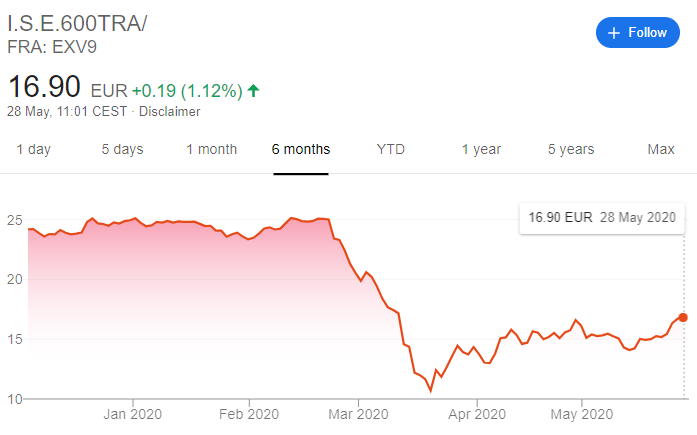
Same here… but I never bet on individual companies, just sectors or regions via ETFs like EXV9… The travel and hospitality industry still has a long way to go for recovery, but I think the pessimism during the crash (which, by the way, might not be over) was a bit extreme when taking a long term view.
Edit: I should add that I don’t really like this ETF (too much food/conference suppliers, too little airlines/travel bookers, and has some gambling companies that I’d rather avoid), but the only direction I could see it going was up… and I only have access to european ETFs with Degiro so the choice is limited.
What do you know, eh? I convinced my father to buy NVDA stocks back in 1999 when GeForce 256 was all the rage. Too bad he chickened out and took profits too early ;-). That would have been a 23000%+ gain
Mit dem Lesen und der Teilnahme an diesem Forum bestätigst du, dass du die Forum-Richtlinien gelesen hast und damit einverstanden bist sowie den Haftungsausschluss auf http://www.mustachianpost.com/de/ akzeptierst.