Not sure I get it.
US market is already priced for perfection. Aren’t we already bullish?
Are we? I understand priced for perfection to mean - as we saw in 2024 where any time nVidia was beating but not smashing it’s estimated earnings and the stock would slide 5-10%, only to rebound 2 days later - that any hitch will send prices tumbling. There were constant bears on social media about valuations, debt, etc etc for years, now it’s all forgotten and the current bear case/narrative is Trump, tariffs, debt again etc. That’s not so bullish!
My point is more about a bull case for when Trump, his 4D chess, tariffs, Putin etc are out of the picture. Anyway, one good thing about Trump is I stopped looking all that much.
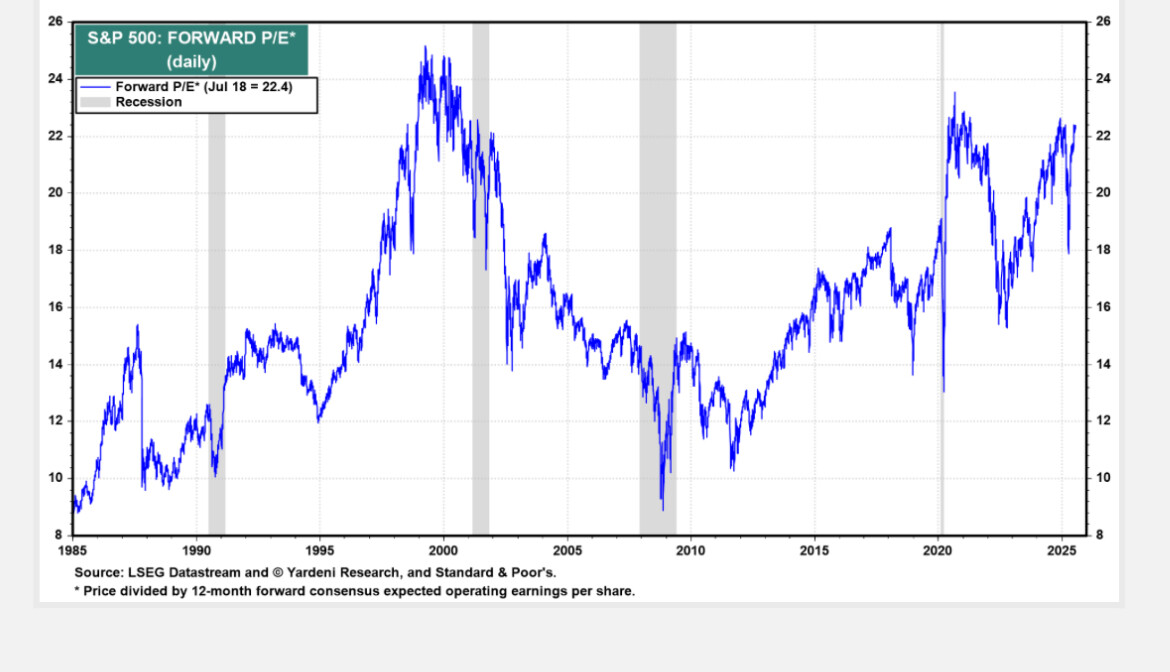
Well S&P 500 is at ATH, Forward PE ratios are only lower versus post Covid & dot.com.
So I don’t know what else bullish market can do. I hope we will not start paying 30 PE just because Trump lost mid term
2 Likes
The main question is: will you or are you using these data for any investment decisions? I recall you’ve tilted away from the S&P500/US (I have tilted towards, not now, from the start of my investing “career”).
1 Like
No I don’t use any specific data to decide investments. Just do regular DCA.
My portfolio is 65% Equities and ~50% of that is US. Rest 35% is other assets (cash, bonds, gold, Swiss RE funds)
My comment was not about changing any plans. It was mainly about not expecting any huge returns in a highly priced market. Whatever the reason for future bullishness might be.
1 Like
And there would certainly be a lot of investor money ready at an isntance.
1 Like
US Philippines trade deal concluded
Summary so far -:
Tariff on exports from US to
- UK -: 0
- Vietnam -: 0
- Indonesia -: 0
- Phillipines -: 0
- China -: 10%
Tariff applied for exports to US
- UK -: 10%
- Vietnam -: 20%
- Indonesia-: 19%
- Philippines -: 19%
- China -: 30%
It seems the general trend is one sided deals where US is applying tariffs to everyone and getting zero tariffs in return. So at least the economic and military leverage is working so far
I think Switzerland would end up closer to Asian deals. EU might be between UK & Asia
What’s your view?
Who is actually benefiting from these deals?
- I would say winners are -: US companies and customers in other countries . And losers are -: US customers and companies from other countries
2 Likes
From the latter category:
2 Likes
GM also reported lower profits due to Tariffs.
It seems automakers on both sides are getting hit due to complex supply chains
GM stock down 7.5%
I’m just curious as to whether the EU will chicken out or play hardball like China.
I think EU will try hard behind the doors but would not publicly fight. I am pretty sure US is going to put NATO / US troops in EU / Ukraine etc in the mix if they have to.
White House needs to show a WIN. Doesn’t matter blackmail or not
1 Like
Tariffs, subsidies and tax are always bad for anybody, for any trade. But obviously there are winner and loser. Consumers are always on the losing site, but politicians are not…
Wonder how long the EU waits to impose a digital tax.. Yippie, 5 cents for every google search!
3 Likes
It becomes clear that the political profile needed on the other side is publicly sucking up without limits, making concessions that sound impressive but in the end are fairly meaningless. Voila, ‚deal‘!! (See that NATO guy a few weeks back)
(Until the next round of extortion attempts starts).
Wondering whether that was used to ‚negotiate’ away section 899.
My guess is that EU might not care about it. The impact of section 899 is mostly on the dollar system (because treasury have historically been exempt from withholding, adding some tax adds a lot of friction to the USD-based financial system which was very scary, the amount of things that rely on short term USD debt flowing around is huge) and likely some reduction on US-based investments from foreign investors.
1 Like
Based on the negotiation approach, I hope that Switzerland will land closer to the UK, while EU gets something like China. But, yeah, hard to predict…
Actually UK has trade deficit while CH has trade surplus. That’s why I was thinking CH might be „punished“ more
Tariffs story is getting more interesting
Japan deal announced
15% tariffs on Japanese imports into US.
No changes on tariffs from Japanese side for US imports. Some restrictions removed.
They said something about Japanese investments in US but I think this is what was already in plans.
——
India - US , No Deal , no more talks this month. More talks in Aug
because US wants same one sided deal like Vietnam & Indonesia.
———
Let’s see what happens with EU.
I observe that BICS countries so far has been toughest.
Does anyone understand what exactly Japan has agreed for this 550 B uSD investment
Based on what Howard Lutnick said. Let’s say US want to have a plant in US, Japanese will finance it and then give the plant to local operator. And then the profits from this local operation will stay 90% in US.
If 90% profits from investments would be staying in US, does it simply mean that Japan has agreed to pay cash to US to get a lower tariff rate.
To me it doesn’t make much sense. Thus I think maybe it means something else.
This is what Perplexity thinks. It seems like a theorhetical “maybe, somehow” investment with a twist, but for sure there is price increases in the US paid by Average Joe.
The Reality: Investment vs. Tariffs
Investment Side
The public statements describe a $550 billion “investment” from Japan, but no official documentation or concrete details have been made public about how this investment will be structured, what sectors it will involve, or whether the figure represents direct financial investment, state bank loans, or other forms.Some financial reporters note the $550 billion figure appears to be an upper limit for potential Japanese government-backed loans, guarantees, or commitments that are not the same as immediate cash investment.
Japanese officials and independent analysts have not confirmed this as a direct cash infusion or physical project investment. The exact nature—whether foreign direct investments (FDI), project finance, or new corporate headquarters—remains unclear.
Tariff Side
What is clear: the U.S. government will now impose a 15% tariff on goods imported from Japan, replacing higher rates that were previously threatened.Tariffs are import taxes paid by U.S. importers, not by Japanese exporters or the Japanese government. These costs are typically passed on (at least in part) to American consumers and businesses who buy these goods.
There’s no evidence that tariff revenue collected by the U.S. Treasury is then earmarked or redirected as “investment” by Japan in any formal sense.
Analysts and trade experts view the 15% tariff as a conventional tax that increases the consumer price of Japanese goods in the U.S.; it is not itself a Japanese investment.