Yes, I get that. My question is: how much are you investing (percentage wise) of that amount, and which buy prices to you have? E.g. let’s say VT goes down to 90 USD. Are you investing 10% at 93, 92, 91, 90? I’m curious about your targets.
Only like 10% of investors (private and professional) beat the market over the last 100 years.
So even if VT falls, the likelihood is quite high that you would underperform VT when picking stocks / adjusting accordingly.
3 Likes
You misunderstood my question  I was more interested in his approach about when and how to invest in VT. I’m not talking stock picking.
1 Like
Basically what you are saying is that you don’t need the extra profit and would welcome avoiding downturns.
You seem to have a high risk tolerance and a high risk capability, so the discussion is indeed not about risk tolerance. It’s about the risk profile of your asset allocation being out of sync with your investing goals.
Market timing.
2 Likes
since i would fail at timing the market i DCA from here so that i invest my sum over the span of a year (so about 8-10% each month?)
1 Like
study the dotcom bubble and the 2007-2009 crisis, especially duration and recovery times before you start to buy in into a long-overdue recession with a 10% monthly amount.
Well my allocation (Based on my NV excluding RE) at the moment is somewhat 70% cash.
The amount i planned to invest/i got represent 12% of my NV. So the 10% monthly represent 1% of my NV. This will not change much at my cash allocation, and i start to feel bad having that much cash lying around with no “plan”.
It’s actually not lying around. Its value is being reduced by inflation.
4 Likes

2 Likes
You can discuss it as much as you want. What I personally don’t like is when there are some statements about “active investment” being made and when people are being asked about some quantification of outperformance of their strategy (if talking about past) or how their desired strategy would perform historically, people start to get insulted. Granted, last 10 years or so it was top of S&P 500 that outperformed everything else, so it was difficult for an active investment to outperform. Surely it may change in the future, but don’t tell me that you or any “expert” can predict anything.
4 Likes
True for consumer price inflation but not house price inflation
exactly. property prices (as well as that of stocks, gold and commodities) have appreciated due to near-zero interest rates and QE for years, but this is not the definition of inflation.
QE caused inflation in consumer prices (mostly outside of Switzerland, soon to be within CH as well), but you can still buy a loaf of bread for 3 CHF just as 10 years ago.
2 Likes
Talking of asset price inflation: QE has affected not only real estate, but also stocks to a massive extent, hasn’t it?
Permabear Jeremy Grantham’s talking of an “everything bubble”, doomsday’s looming  My take on that: If everything’s in a bubble, it’s a perfect equilibrium, and that’s the exact opposite of a bubble.

3 Likes
Any opinions on the Vanguard VAW ETF? I’m considering different scenarios, including investing in commodities as a hedge against inflation.
1 Like
You do that before inflation starts hitting (i.e. make a plan and set allocation when “times are good”), not after…
3 Likes
I totally agree with the principle, but is it really too late?
The pressure on interest rates, the FED which is going to communicate the implementation of its first rate hike on Wednesday, the use of electricity which is constantly increasing (and therefore the use of copper among other things), the Russo-Ukrainian conflict which seems to be going to last for a while…
I have the impression that there is still a significant upside potential, but it is true that I do not know enough about this asset class…
4 Likes
I know nothing of commodities, but it seems viable if you need a justification for an investment. 
I am not looking for a justification to place an investment. I am looking for understanding and information, from people who have more experience, if my thinking is right or on the contrary totally wrong. The goal is still to make money, not to lose money  .
I guess one of the most important things is to first get clear on your goals. After that, you can check which instruments you want to use.
Do you want to protect against inflation? If yes: you already have some sort of inflation protection by investing in world-wide passive ETFs. If inflation gets more serious, the companies in the the index will also raise their prices.
If your goal is mainly to not lose money, then you might want to look at your asset allocation. Or, if you really want to deep dive, you can check the Swensen/Yale story. I only know it very superficially, but he implemented a strategy to protect against downturns. Hint: is not as easy as buying VT and defining your risk/“risk-free” percentages of your portfolio 
1 Like
So, did anyone lose their patience yet in the last 20% slow-crash?
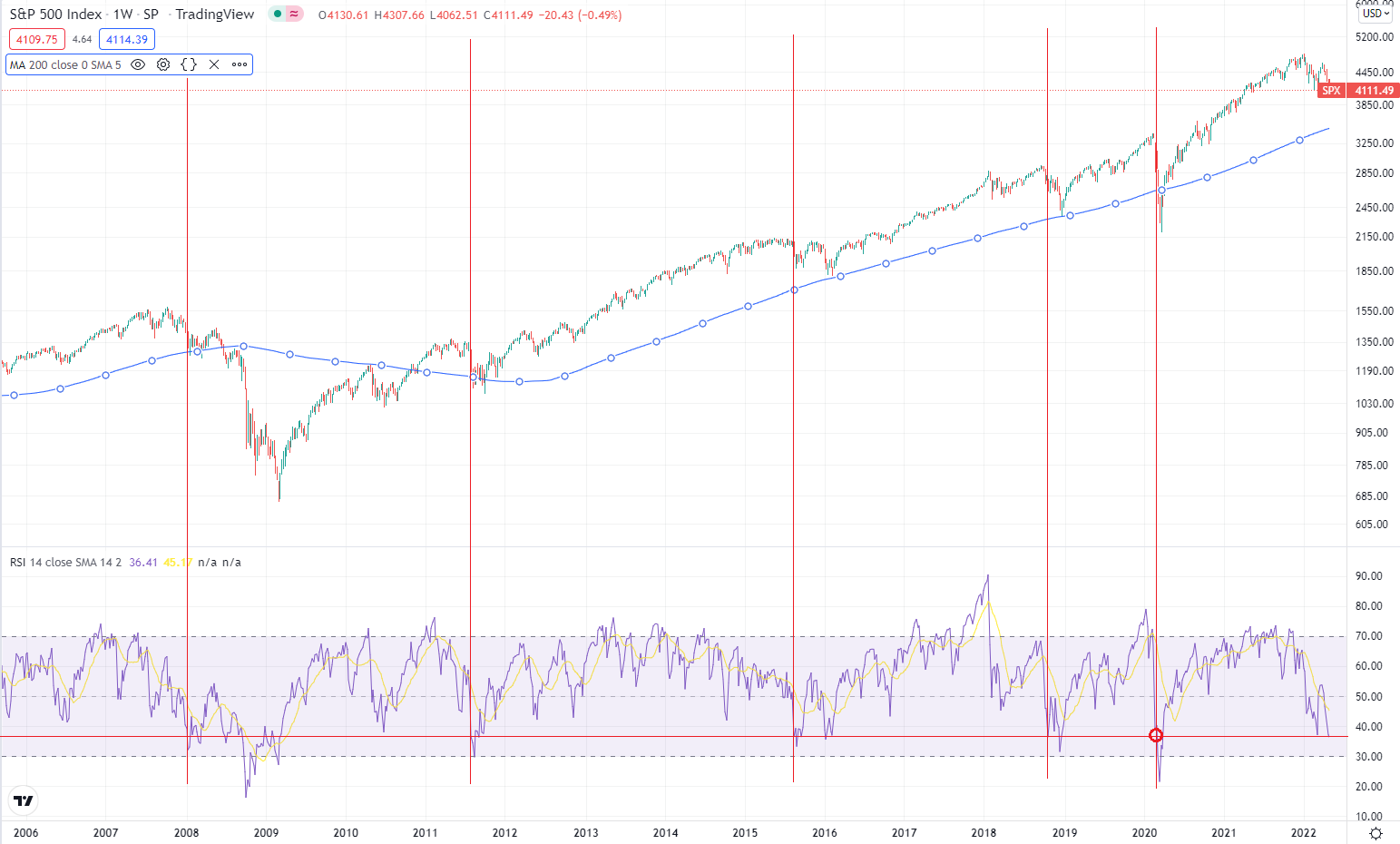
I have looked at an interesting chart lately, weekly SPX, which seems to have touched the weekly 200MA every single time during a larger dip (current trendline coming around 3550), and in crisis mode dipped 50% below that (~1800).
Will you keep buying the dip monthly?
2 Likes