It does. But only € hedged on the bond side. Which makes perfect sense for their european customers. Hence why I have my german mother in the 60/40 lifestrategy.
5 Likes
That’s very true, but then ALLC or SCWX become the only way to achieve L1 tax optimization while sticking to a one-fund UCITS portfolio.
I imagine than one can still build discipline with a portfolio of no more than two or three funds.
From a tax drag perspective, only the US sleeve can reliably benefit from synthetic replication. While Scalable uses synthetic replication for China as well, I don’t believe there is that much money to be saved this way.
In theory, a swap counterparty could pass through a gross total return of 100 to 200 bps a year for MSCI EM. In practice, it doesn’t seem to reach the end investor, and I am not even accounting for the two funky cases we had in the past years, Russia for MSCI Emerging and Nigeria for MSCI Frontier.
For EM, the withholding tax is fragmented across dozens of countries (Taiwan 21%, Korea 22%, India 20%, China 10%, etc.), so there’s no single clean arbitrage a swap desk can cheaply replicate. The benefit (if any) seems to get absorbed into the swap fee/spread rather than passed to the fund.
I saw that one of the best performing large EM passive funds had a tracking difference of +0.02% per annum (meaning it tracked slightly better than net index despite physical replication) and over-performed comparable synthetic funds regardless of the tax drag.
Therefore, on top of the emerging markets, we would only need a synthetic US sleeve, while the rest of the world could be replicated physically.
With a slight ESG tilt, that could be done (for example) via Invesco Scored & Screened at 9 bps and BNP MSCI World ex-USA Min TE at 8 bps (for now).
Didn’t swap cost like 10-20bps? Which is roughly equal to the tax drag on IE UCITS.
If going for UCITS is your objecive, not sure if it’s worth optimizing for that last 10bps (variation in indeed choice will have more impact).
Maybe depends if you’d rather have your money go to a bank or to the US gov 
2 Likes
That’s what I thought as well, but I assume it’s a figure for highly liquid markets only.
At the end of the day, it should be baked into the NAV. It turns out that (from trackingdifferences.com’s live table) I don’t see an obvious edge of synthetic EM funds.
| Fund | Replication | Domicile | TER | TD (avg) |
|---|---|---|---|---|
| Amundi Core MSCI EM | Physical | LU | 0.18% | 0.20% |
| Amundi MSCI EM | Synthetic | LU | 0.20% | 0.28% |
Yes, I totally agree.
But again I am uneasy about one-fund synthetic solutions, especially now that Scalable MSCI AC World Leveraged Daily Swap UCITS has been registered with Luxembourg regulators 
It is actually a good question. Ideally, money ends up in my pocket but otherwise, in order of priority, I’d rather see it reach the Swiss tax system, then EU tax systems, and eventually foreign private companies as long as they do not blatantly contribute to killing people.
In any case, I do not want my money to be thrown over the middle east while increasing Lockheed Martin’s dividend yield - and burning human flesh 
Gerd Kommer’s ETF can be a one-fund solution if the things he’s incorporated are similar to one’s own preferences: 1% cap for a single stock, country weights based on 50% market cap / 50% GDP, delayed inclusion of IPOs, small caps, multi-factor. Only thing that hurts is the TER of 0.45%.
I like the idea, but 45 bps is indeed hard to justify given costs of roughly comparable products: The newly launched L&G WTW Global Equity Diversified is 19 bps.
I learned from this table that the maximum fee, after promotion period, cannot be higher than 0.12% as shown in the sub-fund prospectus.
I like this table because it also shows very cleary the measurable voting behaviour and responsible investment practices of Asset Managers.
As expected, European providers score incomparably better than American ones.
Interestingly, for me the way how Vanguard votes (conservative, shareholder first) is a non-financial preference for them.
I know. For other people, Amundi’s strict group-wide mandate banning companies linked to cluster munitions, landmines, biological/chemical weapons, or nuclear weapon components outside the Non-Proliferation Treaty plays on the asset manager’s favour.
These are legal obligations under French law. I believe they apply to every Amundi or BNP Paribas vehicle without exception, including standard index trackers. Excluded issuers are flagged in the portfolio management system with pre-trade blocking in the compliance tool.
Interestingly, women seem to be overrepresented in this category of retail investors. Coincidentally, Amundi’s CEO is a woman.
Many people don’t want to be involved in, or benefit from, trade of weapons banned by international treaties for being particularly inhumane. Norway’s sovereign fund, the largest shareholder in the world, also excludes nuclear-weapon producers such as Lockheed, Northrop and General Dynamics.
The effects of social norms on markets were explained in this paper: Journal of Financial Economics.
Europe can be a massive player in the financial industry, and move the needle in a significant way at the global scale. For example, and following a pull back from ESG across US financial institutions, State Street was bruised by this 35bn divestment:
https://sustainabilitymag.com/articles/why-state-street-lost-us-35bn-to-amundi-invesco-over-esg
I maintain that the most useful way to deploy capital on the public stock market for ESG purposes is to concentrate it in the sinners and get a board seat. Then force the rest of the capital to implement low-cost, high-ESG-return measures, and use the proof of concept to lobby for laws forcing competitors to do the same.
See:
1 Like
Imho what Amundi is doing is borderline fraudulent and this very much feels fishy. If you have an ESG tilt towards a political ideal, then so be it - just market it as an ESG fund or even just ESG tilted fund. I for one prefer a neutral index, without any judgement or bias.
And on a personal note - call me heartless - the only thing I care about is return on investment, not ESG criteria.
1 Like
FYI many parts of ESG are about return on investment. (depending on the flavor)
E.g. governance and adaptation to climate risk are very much impactful.
1 Like
They have to respect laws and regulations.
Knowingly providing direct or indirect financial support to the manufacture or trade of cluster munitions would constitute assistance, encouragement or inducement caught by the criminal provisions.
See Code de la défense, Partie 2, Livre III, Titre IV “Armes soumises à interdiction”.
I do care about my return on investment, and it served me very well, so far 
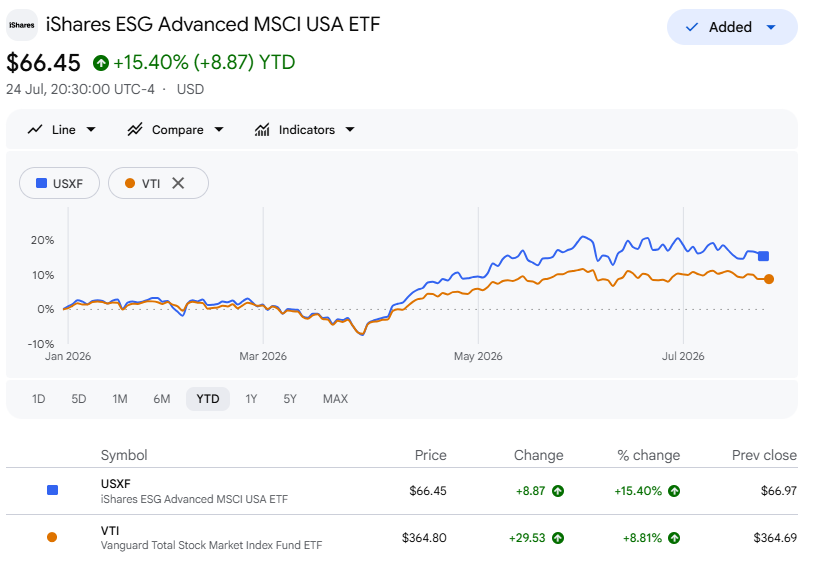
(Note: I am indeed moving away from US ISINs like USXF to UCITS equivalents)
For me WEBG is totally fine. It serves the objective of investing in a large bunch of companies located globally at low cost. If they omit certain companies , it’s not the end of the world for me.