Your post feels heavily co-written with AI, making some statements a bit hard to interpret. A few short comments:
Just note that there is a swap fee and a (small) risk of counter party.
Swap ETFs are also discussed in detail here:
If you are bullish on Asia, this is a good implementation. I personally prefer all-world ETFs since I don’t consider myself professional enough to predict market trends.
Before we jump back into the structural debate, I want to address the elephant in the room regarding my writing style .
Yes, I absolutely made use of an AI assistant for my previous messages. French is my native language, so I used the tool primarily as a translation bridge to articulate my financial arguments cleanly in English. The AI also helped polish the prose and suggested a few stylistic phrasings to make dense blocks of text more scannability-friendly. However, the underlying logic, the strategy, and the calculations are entirely mine.
The Core Dilemma: optimization vs. Peace of Mind. Reading through all your insights, it is clear that we are debating the ultimate investor trade-off:
The Math of the Triptyque: For those focusing strictly on compounding efficiency, avoiding the 15% irrecoverable Level 1 withholding tax drag on US dividends via a synthetic UCITS setup offers a clear, predictable mathematical edge over 15 to 20 years.
The Price of Simplicity: On the flip side, managing a three-fund portfolio and accepting the theoretical counterparty risk of a swap contract is the “cost” of that optimization. For many, accepting a slight tax drag for a physical, single-fund solution like VWCE is simply the premium for total tranquility.
My goal with this post wasn’t to declare a single “winning” formula, but to challenge the long-held assumption that the traditional US-broker and US-ETF setup is an unassailable default. The regulatory and fiscal landscapes are moving targets, and risk management is an evolving practice.
Whether we prefer to optimize for tax leakage or shield our heirs from the IRS administrative maze, the great news is that the European UCITS ecosystem now provides competitive alternatives, allowing each of us to pick our preferred compromise.
May be i was to optimistic on emergent markets and i’am looking into it more deeply before buying my first lines.
Or don’t Some maybe 15-20 years ago, EM were all the rage in some message boards, and (or because) both the economies and stock market outgrew dev. markets.
In this forum, you’d probably find more posts under-weighting them. Might be related to a decade of under-performing.
Guess they are doing ok again, but that might be rather concentrated on single sectors or even companies. Likely, the development of high-income EM will look different to the less developed countries.
Thoughts and feelings on the internet aside, simple finance theory would argue the expected development is all priced in already
There’s some specific threads on EM with US vs. UCITS instrument, so the goods news is for those as well that there are decent options for both (independent of your individual %).
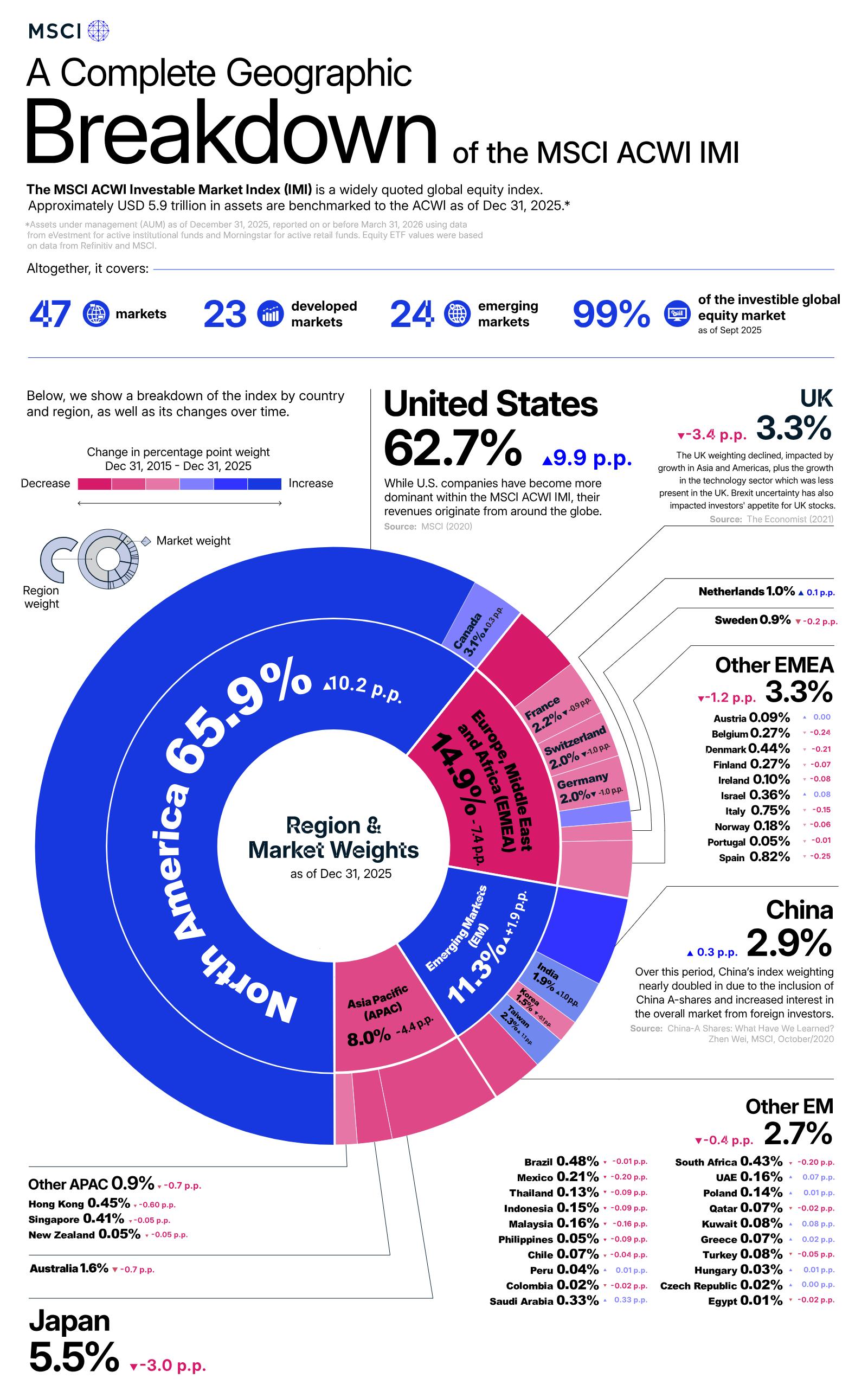
I think emerging markets comprise of a large set of population and also serious global GDP weight (more than 50% when measuring PPP). But the market cap weight ETFs have low exposure to EM because of lower floats and lower shares of public companies in those markets.
So in the end the question is always about how do you decide your exposure and what reason you use. 2021 paper from Morgan Stanley have some insights
Some people only invest in US which basically means overweight to US. There is also no logic to it except past performance. Similarly some people underweight EM because of past performance too. There isn’t right or wrong . It’s just a decision you should be able to live with . One way or another
And if we are being serious, emerging is an outdated term. China is not emerging by any standard. It’s 2nd largest economy in the world winning in almost every sector that matters. India is #6.
From a global investor perspective, China’s stock market is restrictive compared to other countries. E.g., there are foreign ownership limits (which I think is the main reason for the adjustment factor in global indices), capital flow restrictions and insufficient transparency.
This doesn’t mean that China has a low GDP or low living standards but those are not directly relevant to a global index investor. That said, China is still behind Western Europe in the HDI and very clearly in the Economist Democracy Index, so ‘emerging’ may still be applicable also outside the stock market, depending on what criteria you want to include and where you define the cut-off between emerging and (highly) developed.
I think that term emerging was actually coined as a positive term to replace „third world“ and make investments in these markets more attractive
The idea was that these countries need to industrialise and that could be source of higher returns.
I think that time has passed at least for China. The returns from China are not going to be because it has potential to industrialise. It’s going to be because it’s already industrialised and can grow its market globally in latest tech.
Among other things, limited convertibility of the Korean won remains the main barrier. It isn’t deliverable offshore, and even during extended trading hours, onshore liquidity remains too thin to support the tight execution standards expected in developed markets.
Taiwan is grouped with China, India, and Indonesia at the lowest tier for clearing and settlement, largely due to restrictive rules on omnibus accounts.
Both are treated as “advanced economies with not-yet-advanced stock markets” in the sense that it’s a plumbing problem (currency access, custody, clearing rules) that makes investing from abroad more difficult and more expensive.
That was a very interesting read, thank you. Moving away from a single-fund portfolio might be an opportunity to reassess VT’s all-investable-world, cap-weighted approach.
There are three elements of this approach I’d consider reviewing, as a matter of theory (in a potential core-satellite portfolio) but also of personal taste:
Low EM exposure
No ESG exposure
Small caps exposure
Index providers sometimes have to make arbitrary choices, that vary from a provider to the other by a lot. How to approach emerging markets is indeed up for debate, knowing that on a PPP basis, they account for roughly 50% of the global GDP.
If we are fine with some ESG and less small caps, Solactive indexes give us more portfolio construction options. From the top of my head, L&G Global Equity plus L&G Emerging Markets Equity can be a WEBG alternative for those like @Idanel who want to diverge from ACWI’s ponderation of Developed and Emerging markets.
Some (I believe @Tony1337 maybe?) don’t think highly of Amundi, because of switching to indexes that add some ESG bias.
I know they have an ESG bias for active funds, but use Solactive GBS for their Prime range. There is an ESG bias on Solactive Core (used by L&G) but not on Solactive GBS (used by Amundi).
I am fine with an ESG bias though: There is evidence of large divestments impacting negatively the market value of polluting companies and the largest stakeholder in the world is following this path.
I’m also curious about hearing the opinions of those who prefer sticking to funds that include small caps (@assemblyrequired maybe?)
We have been seeing overperformance of S&P 500 compared to MSCI USA for some years now (I still hold Invesco’s S&P 500 Scored & Screened UCITS). Of course, the small-cap risk premium in academic finance was about compensation for illiquidity, volatility, and distress risk. The underlying rationale doesn’t disappear just because AI temporarily favours capital-heavy giants. But don’t you think that capital intensity is a legitimate moat in this specific phase, that might last for some time?
Generally their commitment to funds in the past as well. They have shown to abandon and merge funds more frequently and do these kind of arbitrary decisions.
I don’t know why you think I prefer SC? I’m actually undecided, which is why I prefer FTSE All-World over MSCI ACWI, because the former includes the top third of small caps (90% vs. 85% of the investable market).
I think a single ticker portfolio can have a huuuge psychological benefit. As soon as you have more than one ticker, you need to have very hard diecipline with yourself, regarding relabalancing and keeping regional allocations as you set them. Maybe you start hesitating putting more into an underperforming region, just for that to start outperforming again?
I think the majority of people would be best served with a single allocation fund, that outweighs the cost savings of splitting it up. A shame that we don‘t have stock/bond allocation funds. As I also think a big chunk of people can‘t handle 100% stocks and would be better served with a classic 60/40.
Mit dem Lesen und der Teilnahme an diesem Forum bestätigst du, dass du die Forum-Richtlinien gelesen hast und damit einverstanden bist sowie den Haftungsausschluss auf http://www.mustachianpost.com/de/ akzeptierst.
 Some maybe 15-20 years ago, EM were all the rage in some message boards, and (or because) both the economies and stock market outgrew dev. markets.