Of course some used ICE car that you pay 20k for can’t be beaten by a Tesla, which will cost at least 40k, even a used one. I think if you look after your Tesla and charge it exclusively at home, you can get down to 0.10 CHF/km.
But you know, I recently rented a 2018 Corolla and man, is the difference in quality big…
I had 0.12CHF/km pure petrol cost, running cost with everything around 0.45CHF/km on a petrol car.
But just think about putting a wall charger into your basement/garage could set you back 2-3000 CHF, that’s about 2 years of petrol for me
I’m not arguing that a Tesla is a fantastic, next-level, super appealing vehicle (it is!), it’s just currently pretty damn expensive. (Renault Zoé, Nissan Leaf, Hyundai Ioniq5, KIA EV6 are cheaper, but generally also the same problem). And we as mustachians should not pour our money into a rapidly depreciating asset, while trying to optimize 0.1% TER on fees
In the Corolla, I was put off by the way the steering wheel feels, like it was a bit loose. The same applied to gas & brake pedals. Acceleration was a joke. The audio system was awful, I had to put radio very loud to hear. Heating took a long time to make the inside warm. The plasticky interior feels like a travel back in time. The display is small and lets you do almost nothing.
If you’ve driven a sturdy, responsive, minimalist model 3/y, getting into a corolla or similar is a bit of a shock. It’s like switching the macbook for some laptop for under $1000.
You can calculate “the cost of everything” divided by “the number of kilometers”, but in truth most of the costs associated with a car are fixed, regardless of how much you drive. So I like to look at “cost per day” and “cost per km” separately.
For the Tesla, I calculate:
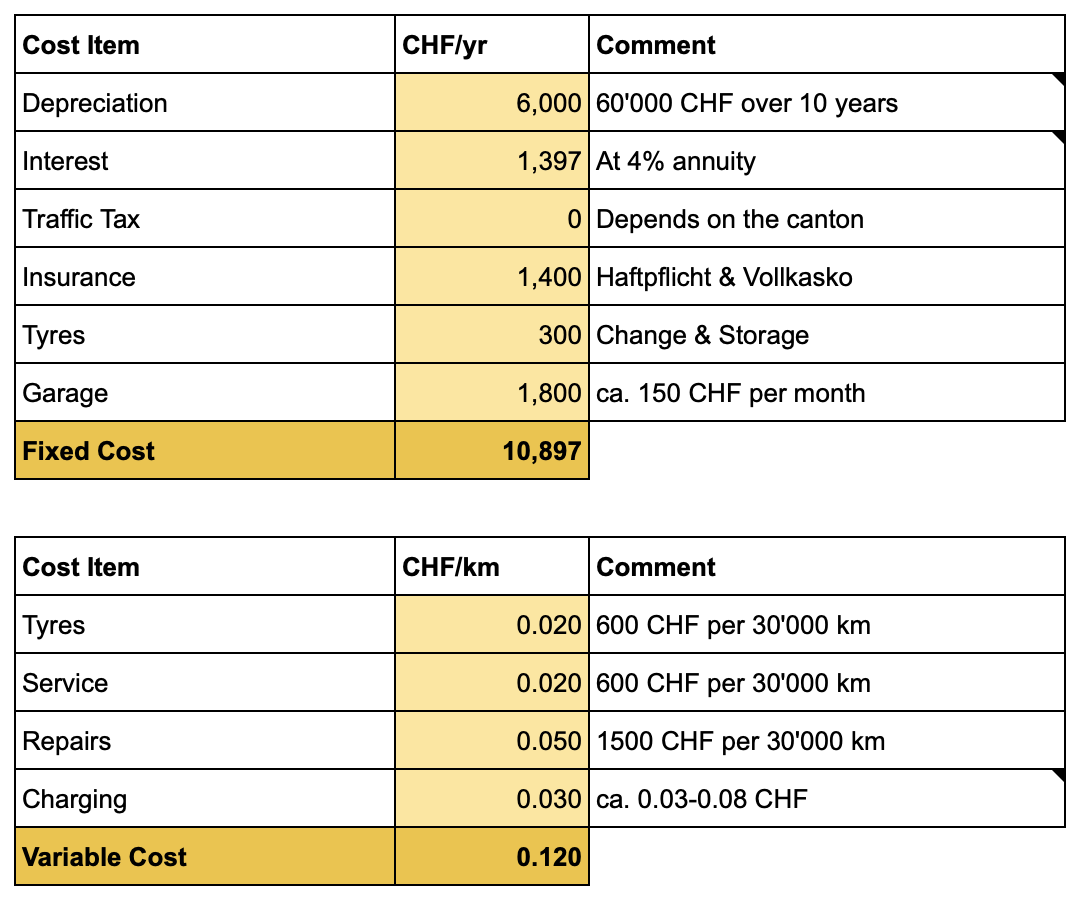
tyres: 600 CHF per 30’000 km
service: 600 CHF per 30’000 km
repairs: 1’500 CHF per 30’000 km (1)
home charging: 0.15 CHF/kWh * 75 kWh / 375 km = 0.03 CHF (2)
(1) repairs are tricky to estimate, I heard of a case where the underbody was hit by a big rock and they had to replace the whole battery for $19’000. So I just gave it a big budget that hopefully can cover the average repairs.
(2) formula: * charging: price_per_kwh * battery_size / range = price_per_km
So yeah, if you gonna buy a Tesla for $60’000 using a 10-year loan at 4% interest (currently only up to 7 years is possible), you’re looking at $11’000 fixed cost per year where the car just sits in the garage. Then if you make a respectable 25’000 km in a year, add $3’000 variable cost. If after 10 years and 250’000 km your car is still worth something, let’s just consider it a bonus.
But if we imagine in a few years you buy a used Tesla for $20’000, using the same assumptions, the annual fixed cost goes down from $11’000 to $6’000, saving $5’000 per year.
that’s a first no-go (not a real issue as I buy cars I can afford by paying cash)
that’s a second no-go (not a Tesla issue, all cars have this, Teslas actually less)
… you might as well add another 20k “security buffer” for buying a new battery to it as well.
Batteries tend to age exponentially, and while the first 8-10 years should be okay, noone knows if they detariorate beyond repair by year 15, which makes the car basically a write-off. That’s the biggest risk in a big-ticket EV.
Tesla should regularly update the battery and maybe sell a 1000-mile battery in some years for the initial Model S as well, to keep them technically relevant and not go to the scrapyard. Talk about sustainability and all.
Last time I checked a german car the lane control didn’t stay in the dead center of the lane and follow bends etc. Even the Mercedes EQS seems to only have “Traffic Jam Pilot” which only works up to 30km/h which seems like a bad joke to me.
the Merc is a SAE3 in traffic jams, which is a where they accept the legal consequences of the car driving itself. It’s a huge thing for systems certification and legal stuff with close to zero practical impact.
Adaptive cruise control and lane hold should work in all German cars by now.
Well then only the other cool features like Spotify, TuneIn, Google Maps Navigation and OTA updates remain for Tesla (And no, Apple CarPlay or Google Auto are still annoying as most/all? cars require a cable connection for that to work)
This is a mistake in my opinion. 4% interest rate is really not a high cost of capital. It’s better to use that money for investments. Unless you believe your average rate of return is under 4%, in which case…
what no go, I don’t understand what you’re writing. You wouldn’t spend $11’000 per year? OK, who cares?
that’s just speculation, we don’t know how it will be… the technology is improving, though and costs are definitely going down. So maybe that new battery will be less than $10k when the time comes.
I had a look at the Audi website for comparable cars to the Model 3. Audi A4 has a catalogue price of 64’000 CHF and the S4 is 84’000 CHF. Let’s compare apples to apples. If you say “I don’t buy a new Model 3 because a used VW Golf is cheaper” then this is a laughable argument.
Let’s be generous and take that Audi A4, even though it has much less power than Model 3. So all the fixed costs are the same. $11’000 per year for both. Now if you drive 25’000 km per year, that’s $3’000 in Model 3. How much is it in the Audi? $0.02 for tyres, $0.03 for service, $0.08 for repairs, $0.15 for fuel. That’s $0.28 per km, or $7’000 per year. So the Audi costs the same to purchase, yet an extra $4’000 to operate.
Don’t be so offended, we’re just discussing stuff.
My argument is I don’t buy new cars, cause it’s a waste of money (for my lifestyle and requirements) - that is regardless of brand.
Dropping additional interest on an overpriced and quickly depreciating asset is just as silly (compare to margin trading Tesla stock at 150 PE, to stay on topic ).
If I were to drop 60k+ on a car I’d definitely buy a Tesla. I’m not doing it as the opex is just too high.
If I were to buy an EV (or any new car), I’d love to see a 5-door or a station wagon under 40k new. That doesn’t yet seem to exist, but is getting closer on the Ioniq5.
I’m not offended, I’m annoyed when the focus of the discussion is shifted. I was giving you my estimates for km cost, and added the fixed cost for completeness. It’s up to personal taste if you want to buy a new car or a used one, and not the point of this ICE vs EV debate.
When the demand for Teslas has saturated and used models become cheaper, this difference becomes even more pronounced. If you buy two used cars for $20’000, you’re looking at the annual cost of $9’000 for the Tesla and $13’000 for the Audi, or $0.36 vs $0.52 per kilometer.
My VW bus has CarPlay, BMWs have them since 2018(?) as an option, it’s pretty much standard by now. Cabled though. No cables need an aftermarket adapter or some more money dropped at automakers.
„Mit einer Mängelquote von 10,7 Prozent fällt jeder zehnte Tesla Model S durch die erste Hauptuntersuchung und würde ebenfalls im letzten Drittel der 128 Verbrenner landen.“
I heard that people often brake too little in EVs, due to regen brakes. Some maintenance tips recommend hard braking from time to time. It could also be that the first models had some quality issues, which can happen to a new carmaker. Some Model S built in Fremont in 2015 will be a very different car from the Model Y built in Austin in 2022.
Would be easily solvable with software changes. If brakes have not been used for x time or x km disable or at least lower recuperation for some time and then enable again after some braking.
+1 on that. I only use the brake pedal if something unexpected happens, otherwise the regen brake is strong enough. I think these are some infancy problems of EVs and not an insurmountable obstacle. But something to keep an eye on.
Mit dem Lesen und der Teilnahme an diesem Forum bestätigst du, dass du die Forum-Richtlinien gelesen hast und damit einverstanden bist sowie den Haftungsausschluss auf http://www.mustachianpost.com/de/ akzeptierst.


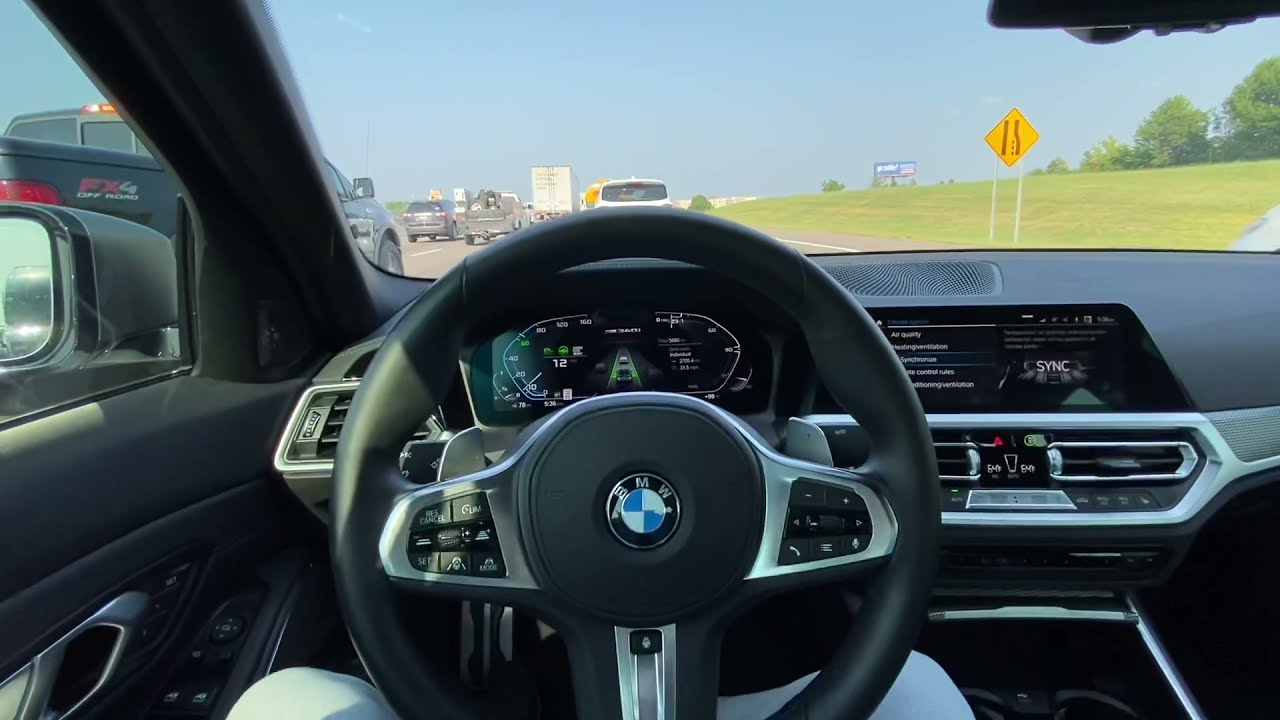
 (And no, Apple CarPlay or Google Auto are still annoying as most/all? cars require a cable connection for that to work)