Tangem, no good.
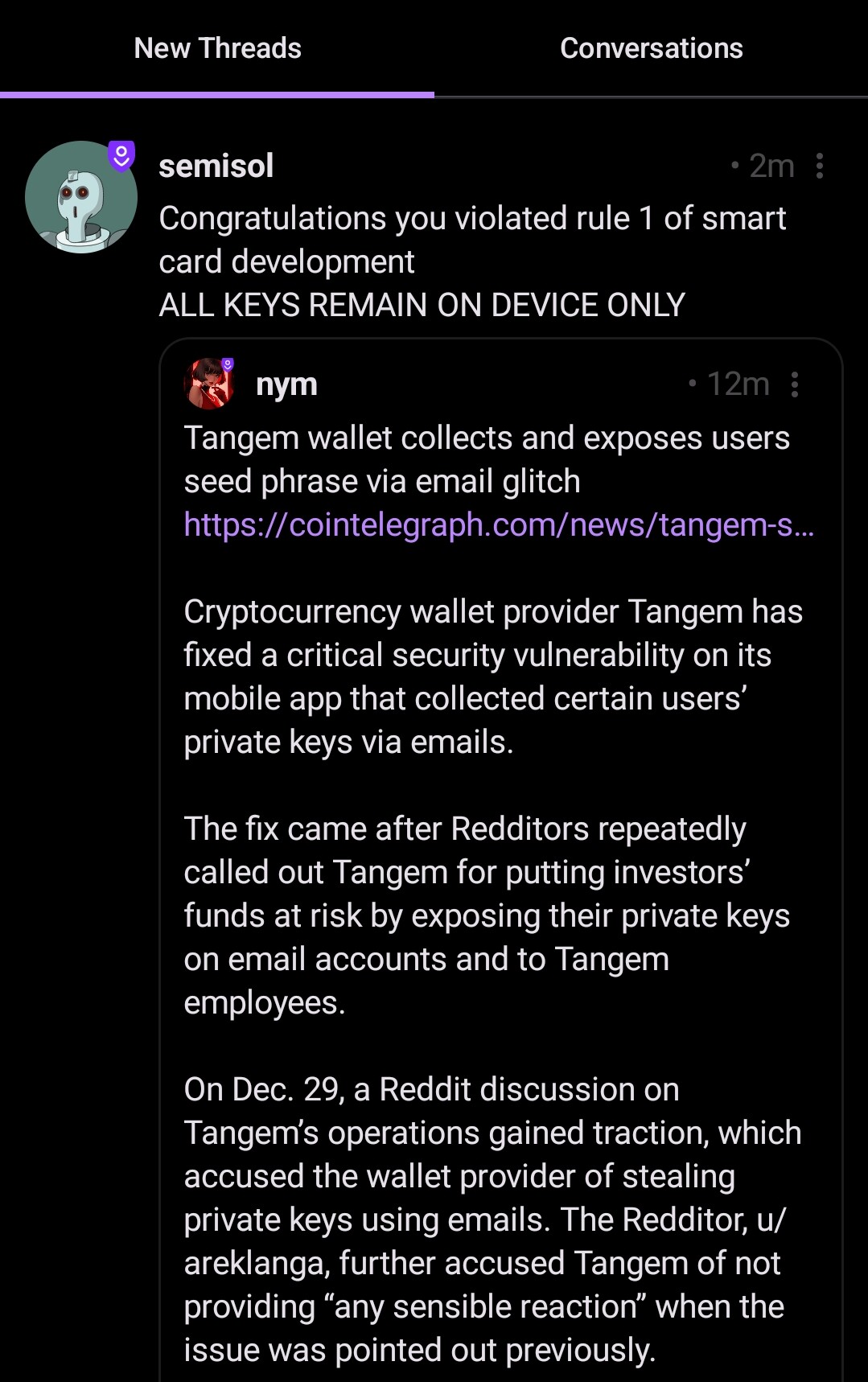
6 Likes
Thanks for the info! Looks like it’s time to throw away (literally) the Tangem cards and find another solution!
2 Likes
Bitbox02 bitcoin only edit is highly recommended.
Swiss company btw…
https://forum.mustachianpost.com/t/future-of-bitcoin/3750/1426
Lightning support in mobile Exodus wallet is gone.
2 Likes
Just had a bloody terrifying half an hour with my Exodus wallet. 
Opened it after a while -
BTC funds were there,
but ETH completely at 0.
Seemed like it made its own Exodus  ,
,
but without any visible transactions.
Started googling/redditing and saw that some folks apparently got compromised (but my 12 word key definitely didn’t leak anywhere, and I only have it installed on my mobile, where I auth with a fingerprint).
Only after several attempts at refreshing the network (feature of the app) have the funds ultimately showed up.
Anyone had a similar experience with Exodus?
Makes me rethink whether I need to change the asset location, but I’m still resisting hardware wallets (for not so huge funds that I got).
2 Likes
why would you do that?
I would like to refresh our discussion about crypto wallets, in particular software ones. Even if you use a hardware one, you still need some kind of software to use it.
As a note, I only consider software wallets that can be recovered from a seed phase. I came across few where the secret key was on a server and protected by your password, and others where the wallet backup was a long file, and rejected both types.
So far I was using:
- Exodus desktop software in a “Linux on a USB stick” installation:
I need this software only to generate crypto addresses and from time to time to check the setup and eventually transfer out coins that dropped out of my crypto index (see elsewhere). These addresses are my long term crypto storage, as described above.
The associated software data are only generated temporary from a seed phrase that I have memorized and also wrote down in an obscured way.
- Exodus app in a mobile phone:
Some temporary holdings, USDT, small holdings that might soon drop out of the index.
- Exodus extension for Chrome on a desktop computer:
I use it in a dedicated Chrome profile for DeFi swaps.
All Exodus apps are multi-coin wallets, all addresses are generated from the same seed phrase. All in all it is a good software.
A little con: only one wallet can be active at a time. To switch wallets, you have to delete the existing one and restore a new one from a recovery phrase.
- Trust Wallet app in a mobile phone:
I use it for some coins that are not supported by Exodus.
An advantage of this wallet is that you can have multiple wallets, and switch between them in the interface. There are multi-coin wallets, where all addresses are generated from the same seed phrase. There are also single coin wallets which I didn’t really looked into, but probably I should.
I have a feeling that Trust has less (or just a different set of) networks than Exodus, but more tokens per network. Also the interface is s bit too flashy for my tastes.
-
MetaMask mobile app: for DeFi swaps.
-
SideSwap mobile app: temporary Liquid Bitcoin holdings, which I accumulate before withdrawing BTC to the long-term storage address on the base net.
3 Likes
Well, I have restarted this topic not only out of altruistic reasons, but because I also want some feedback from the community.
I was actually looking for a wallet for Monero XMR and came across some interesting wallets:
-
There is Monerujo that I have used some time ago. Still looks like a solid choice for a mobile device.
-
Cake Wallet, for mobile and desktop platforms
https://cakewallet.com/
Multiple coins.
- Stack Wallet
https://www.stackwallet.com/
Open source, available for all major desktop and mobile platforms, privacy features, seems to create a separate seed phrase for each coin.
Thoughts and feedback?
Is a bit clunky, but it works. Seems a resonable choice. I don’t know if multi coin wallets will make good use of XMRs features. But maybe that is not required. For the highest requirements cli is probably the way to go, anyway (you could run it on an Android).
1 Like
I’m still using the good old Ledger for BTC/ETH (90%) and Binance/Kraken for my S*** coins (10%). Unless you are a real trader I would feel comfortable using the big exchanges as long as the value of these coins is small.
I went with Cake Wallet for XMR. It seems to be better supported and longer developed, and the team is better integrated in Monero community.
1 Like
Probably the coldcard users already heard it. Seed generation from mk3 and newer were kaputt. Move your btc away, except the generation did occur with 50+ dice rolls. Other major HWW not affected.
my key generation quite ok… though reconsidering my setup… multisig and dedicated offline computers
2 Likes
I feel for all the victims. These people did their research, got genuinely interested in the orange coin, and believed they were doing everything right.
Sadly, it shows that the “Not your keys, not your coins” mantra is only truly valid if you generate your seed phrase using a reputable open-source tool on a laptop that’s kept permanently offline and dedicated solely to that purpose.
1 Like
Nah, even that they did right and still failed:
And seeds generated by that program are vulnerable without ever touching the internet in any conceivable way.
Not like reputable open source tools (debian ssh iirc) didn’t have key generation issues in the past.
One major difference is the impact, the money if for anyone to grab ok the blockchain, which is more easily monetizable than getting access to a server.
1 Like
Well, Google AI search…
“Coinkite changed its firmware license to block commercial clones, which inadvertently introduced a critical random number generator bug. This licensing shift reduced open-source code scrutiny, leading to a silent software fallback that critically lowered wallet seed entropy”
soooo… go away from reputable foss and get rekt. greed led to this fiasko.
but agree… issues and pull requests increased dramatically e.g. for debian and other foss. thank to the newer ai models and billion of tokens spent finding bugs (but the criminal minds have the same if not better access to that vulnerabilities). Anyway, at the end the software will be less affected and stronger.
PS. strong generation + passphrase + separate on 10 wallets will let me sleep better.
1 Like
Wouldn’t really trust Google AI for that, license change is before the migration where they switched to libngu.
(to be fair libngu is a bit of a red flag, it’s like open source but only for Bitcoin users )
1 Like