With all the enlightened geo-political insights in here, one could almost forget that Iran is ruled by a religious rogue regime that has been a menace to the whole region and its own people for decades 
3 Likes
I’m leaving here a translated version of an email I got from a Romanian newsletter, describing the current situation and potential risks. Apologies if not correctly translated, I used AI but didn’t have time to correct.
_____
‘‘In normal mode, regional wars do not cause serious losses to international stock markets. On the contrary, after an initial drop, new all-time highs usually follow.
However, there are exceptions, such as wars that affect global supply chains, which can produce worldwide crises.
The world’s economies are still largely based on oil. We are dependent on oil for transportation, plastics, construction, and many other needs of a modern economy.
Thus, any significant reduction in the quantities of oil delivered leads to an increase in oil prices to a level that causes significant economic disruption.
Large increases in oil prices can produce 2 simultaneous phenomena:
-
High inflation, both directly because petroleum-based products become more expensive (fuels, plastics, bitumen for asphalt and construction, etc.), and indirectly, because transportation and energy used in production for anything—from food, clothing, appliances to real estate and infrastructure—become more expensive.
-
Economic recession—due to supply problems with petroleum products that affect production, but also due to higher interest rates that affect companies.
Thus, we have a lethal combination of 2 negative factors affecting the global economy: high inflation and economic recession (or economic stagnation).
This phenomenon is called stagflation and is the nightmare of any economist, entrepreneur, and investor.
It is quite rare because, normally, you can’t have recession and inflation at the same time. Why? Well, if you have an economic recession, then you have a decrease in consumption and thus companies naturally lower prices to continue selling.
In the case of stagflation, you can’t lower the prices of finished products even if consumption decreases because raw materials, transportation, electricity, gas, plastics, and many other raw materials are very expensive. Thus, entrepreneurs either sell at a loss and go bankrupt, or they raise prices.
Stagflation and Oil Crises
Stagflation is a state of the economy characterized by high inflation, anemic economic growth or even economic stagnation, and high unemployment.
The last time we had a period (or several successive periods) of stagflation was in the years 1973-1982 (approximately) in the USA, a period characterized by high inflation rates, even over 10% for the dollar, periods of economic decline, and fairly high unemployment (between 5% and 10%).
To counter high inflation, interest rates were raised to 20%. Can you imagine a 20% interest rate on the dollar?
Also in the 1970s, the stock market had a very bad period in 1973-1974, when it lost approximately 50% in two years and then recovered, but at a slower pace, needing 7 years to reach the old 1973 highs.
Middle East Wars - Main Causes of Severe Stagflation Periods
The main cause of these severe stagflation periods were the wars in the Middle East.
-
1973–1974 Oil Crisis (First Oil Shock)
Period: October 1973 – 1974
Main cause:
During the Yom Kippur War, Arab oil-producing states imposed an oil embargo against countries supporting Israel (USA and allies).
What happened:
The Organization of the Petroleum Exporting Countries (OPEC) reduced production.
The price of oil increased approximately 4 times (from ~$3 to ~$12/barrel).
Impact on stock markets:
S&P 500 fell approximately -48% between 1973 and 1974.
The global economy entered stagflation (high inflation + economic stagnation).
The energy sector grew strongly, while the rest of the market collapsed. -
1979–1980 Oil Crisis (Second Oil Shock)
Period: 1979 – 1980
Main cause:
The Iranian Revolution led to the collapse of Iran’s oil production.
Subsequently, the Iran-Iraq War began.
What happened:
Global oil production declined.
The price of oil nearly tripled, reaching over $35/barrel.
Impact on stock markets:
Inflation in the USA exceeded 13%.
Paul Volcker (Fed) raised interest rates to nearly 20%, triggering the 1981–1982 recession.
S&P 500 fell approximately -27%.
In the table below, we see how these two major bear markets driven by oil crises compared to other bear markets:
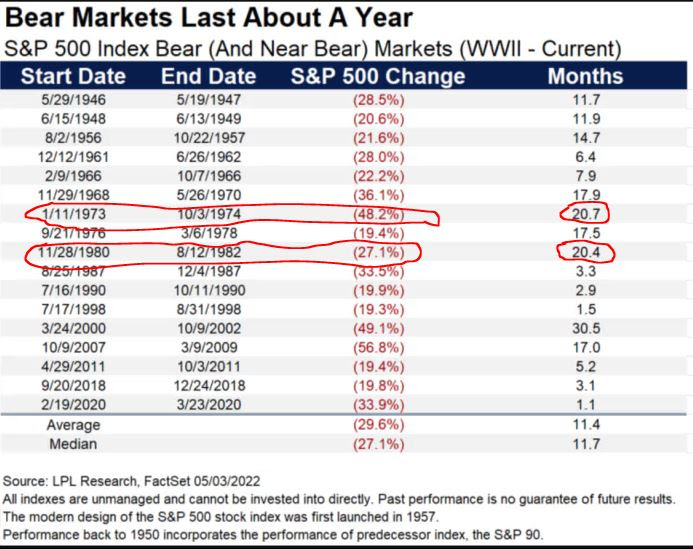
Important!!! These bear markets were even more severe not only because of the percentage decline (48% and 27%, respectively), but also because, in parallel, money was massively devalued through inflation, so there was a double decline, both nominal and due to inflation.
Also, note that they were long—almost 2 years each (20 months).
The good news is that the economy has become much more resilient to oil prices in recent decades, and oil crises have no longer caused severe stagflation.
We have had other oil/energy crises:
1990-1991 - Gulf War (Iraq invaded Kuwait and the USA invaded Iraq)
2003 - US invasion of Iraq
2022 - Start of Russia’s invasion of Ukraine
These events generated large increases in oil prices, but did not generate severe stagflation.
Are We Heading Toward Stagflation?
At this moment, we have reasonable inflation, both in dollars and euros, but if the price of oil continues to rise for a sufficiently long period, inflation will enter an upward trend again.
Economies are not yet significantly affected by oil prices because… it has only just started to rise.
In principle, we don’t know now if we are heading toward stagflation, because we don’t know how long the war in Iran will last.
If it ends quickly, we return to our usual problems (AI, microchips, technology, etc.).
If it drags on, we have a risk of stagflation, but not as severe as in the '70s and '80s. Today, the economy is much less dependent on oil and even less on Middle East oil producers. For example, today, the USA is the world’s largest oil producer, ahead of any Middle Eastern country.
What to Do?
What we can’t do is certain: guess the future. There are so many variables and unforeseen events that, realistically, even great financial analysts cannot accurately estimate what will happen in the economy in the coming years.
We see this uncertainty in the variations in oil prices. We have days with spectacular increases and other days with spectacular decreases.
What we need to know is that if inflation reignites, we will have declines pretty much everywhere, both in the stock market and in the government bond market.
In this case, commodities, oil and energy producers, and possibly gold would rise.
As a strategic investor, I am not inclined to “bet” everything on stagflation and significantly change my asset allocation. I have a high chance of getting burned. It depends on events completely beyond my control.
Thus, without going full “gambler mode,” there are few moves we can make to protect ourselves from a “stagflation” scenario.
The big problem is that we don’t know if we will enter such a scenario… everything is too unpredictable and depends too much on what happens in the Middle East.
However, we can do a few things to prepare and get through well, even profit from whatever comes in the future.
We start from the premise that there is a significant possibility of stagflation, but it is not probable at this moment. That is, we still have under 50% chances of stagflation, but the longer the war lasts, the higher the probability.
What we investors have to do:
-
First of all, we should get our personal finances in order: use a budget, optimize expenses, diversify savings across major currencies (especially EURO and USD);
-
Maintain our sources of income: perhaps the most important thing in such periods;
-
Government bonds: I would only use ETFs on short-term US bonds. I would avoid anything with a term longer than one year and avoid Fidelis for now;
-
Stocks on corrections at certain thresholds: investments in stocks are actually the best viable alternative for any scenario, even in case of inflation, because in the short term, inflation hits stocks, but in the medium and long term, it favors them. See how inflation hit the stock market in 2022 (12 months of suffering) and then three years of excellent gains followed. Here you need a well-made investment plan that you are willing to follow, even in less pleasant periods;
-
Real estate: the best protection against inflation, because it incorporates a lot of raw materials that become more expensive, but to exploit them profitably, you already need to manage them professionally or with professional help. Due to high prices, it has become unprofitable to exploit them (through rental) without a well-established system. Rents are too low vs. property prices in Romania. I expect rents to rise in the near future, but it still won’t be profitable to manage them haphazardly, without a well-established system;
-
Keep some cash/deposits for possible future corrections: we accept some loss of purchasing power through inflation to have ammunition in case of corrections, as there have been recent ones;
-
And we make the most important investment we can make: in our own education. It is the only investment that helps you successfully fulfill the first 6 points. The era of easy money made by any amateur is over.
-
Assets have inflated too much and you can no longer make money buying tech stocks haphazardly (because they have potential). The AI bubble has burst, and now we are entering an era where profitability of these things is pursued, not just potential;
-
Investing on a passive strategy done by ear no longer yields results. It no longer works to occasionally-constantly buy some ETFs in bulk and make money, without knowing how to build a coherent portfolio, without knowing how to enter on correction steps, without knowing how to rebalance;
-
In real estate, it is no longer profitable to buy any property and rent it out. Without a well-established system for selection, financing, furnishing, and tenant management, you will find that it’s no longer worth the hassle.’’ - text by Valentin Nedelcu
6 Likes
edit: Off-topic, apologies, I stop.
I agree with a lot of what was said. As you see from my stock portfolio above. I am somewhat positioned for a stagflation scenario.
1 Like
I am mostly in cash and BOXX (because our home acquisition last year), with orders to buy VT at every -5% correction 
I agree mostly, but the problem is execution.I do not agree regarding education, because of AI it is very hard to predict which eduaction has still value. Just saying Translator
1 Like
Isn’t that how the saying goes - “We broke it - you own it!”?
And “by the way we are not finished breaking it”:
Donald Trump said on Saturday that the United States may carry out more strikes on Iran’s vital Kharg Island oil export hub “just for fun”, rejecting the prospect of a swift peace deal with Tehran.
1 Like
Exactly. One rogue regime terrorised its people. Another rogue regime terrorising every nation at will.
Seems like its very noble to burn down a country to save it from its regime.
Exhibits -: Afghanistan, Iraq and now Iran.
Back to topic, I believe equity might be best option in current days. Because I see a high risk of inflation which can deteriorate value of cash and bonds
2 Likes
Intersting read! Focussing on the previous oil shocks, there are 2 important changes.
- Additional producers have emerged: US shale oil, Guyana, Venezuela, Brazil, Norway.
- Back then we used oil for everything while today it is more and more used just for transport.
Unfortunately, the global population has doubled since then. That’s why the world still cannot lose 20 million barrels of oil per day (the amount passing through Hormuz) without a catastrophic global recession if the street remains closed for an extended time.
Seems now we have moved on to threats. And this might not be a good sign. Because this means US cannot contain Iran by themselves and want to drag Europe. I don’t think Asian countries are going to be dragged in especially China.
Strait of Hormuz: Trump tried to allay concerns about the effective shutdown of the Strait of Hormuz, saying that “hopefully, China, France, Japan, South Korea, the UK and others” will send warships to help secure the vital shipping lane. He warned that NATO faces a “very bad” future if US allies fail to assist. So far, Australia and Japan said they are not planning to send any ships. When asked by CNN if they’d send ships, the United Kingdom said it was discussing options, and China called for an immediate end to hostilities. Meanwhile, Iran’s foreign minister said Tehran is open to holding talks with countries wanting to safely access the strait.
Let’s look at what the effects were in the past in similar situations:
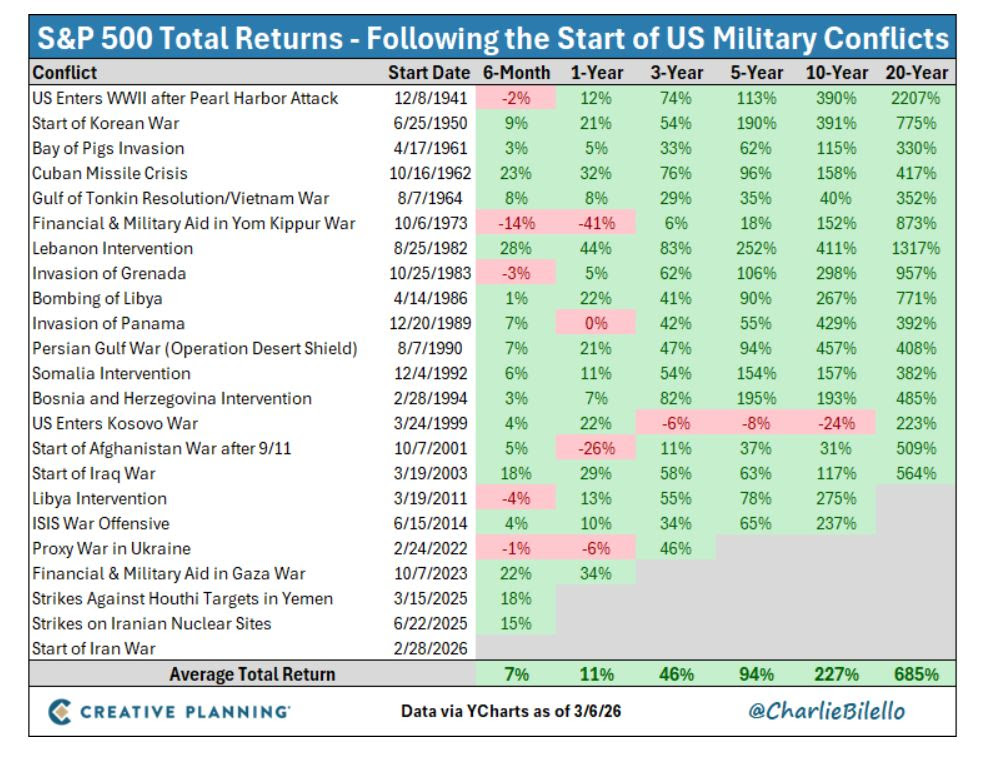
source: https://bilello.blog/
- most regional wars had minor effects on the S&P500 stock index in the first 6 months, 1 year, and even longer
- over a 3-year period, in all cases, the stock market was up
And below the S&P 500 chart in which various regional wars are noted:
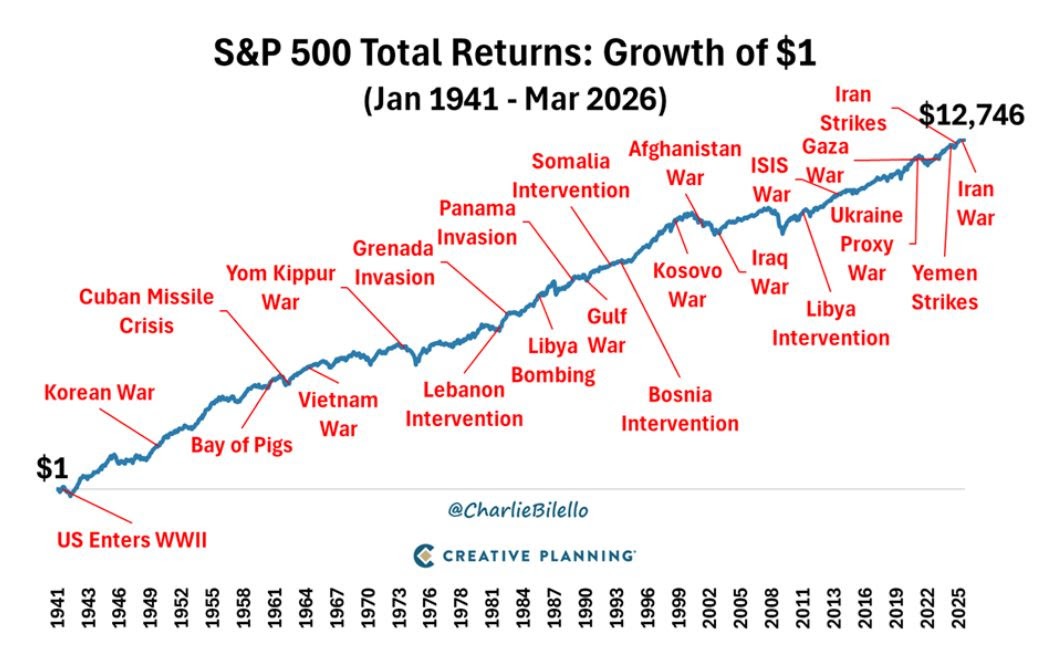
source: https://bilello.blog/
- the S&P 500 was not really hampered by any such war and in the medium and long term it continued to grow
- the problems with the supply of raw materials/various goods have an impact on stock markets in the short term, but in the medium and long term, solutions/alternative sources/alternative routes, etc. are found and the impact disappears or is greatly reduced.
4 Likes
Wars are not the issue.
A better thing to look at would be comparison with past oil disruptions.
5 Likes
Morning, this is insightful but could also be the basis to look at SORR (sequence of returns risk), specifically the stagflation of the 70s and dot com bubbles and GFC.
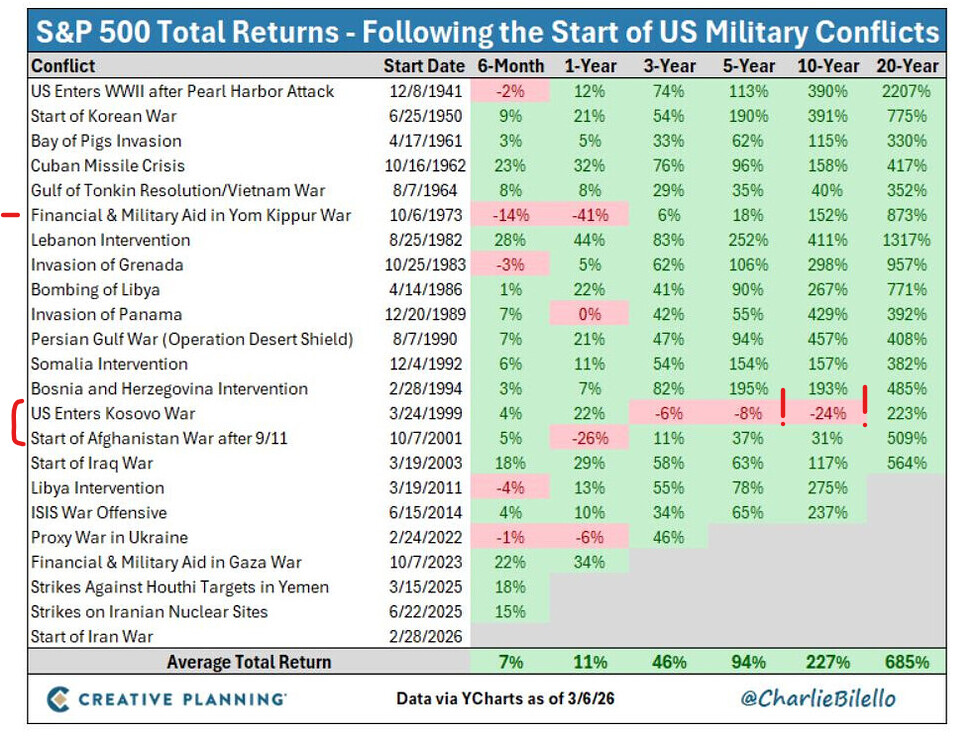
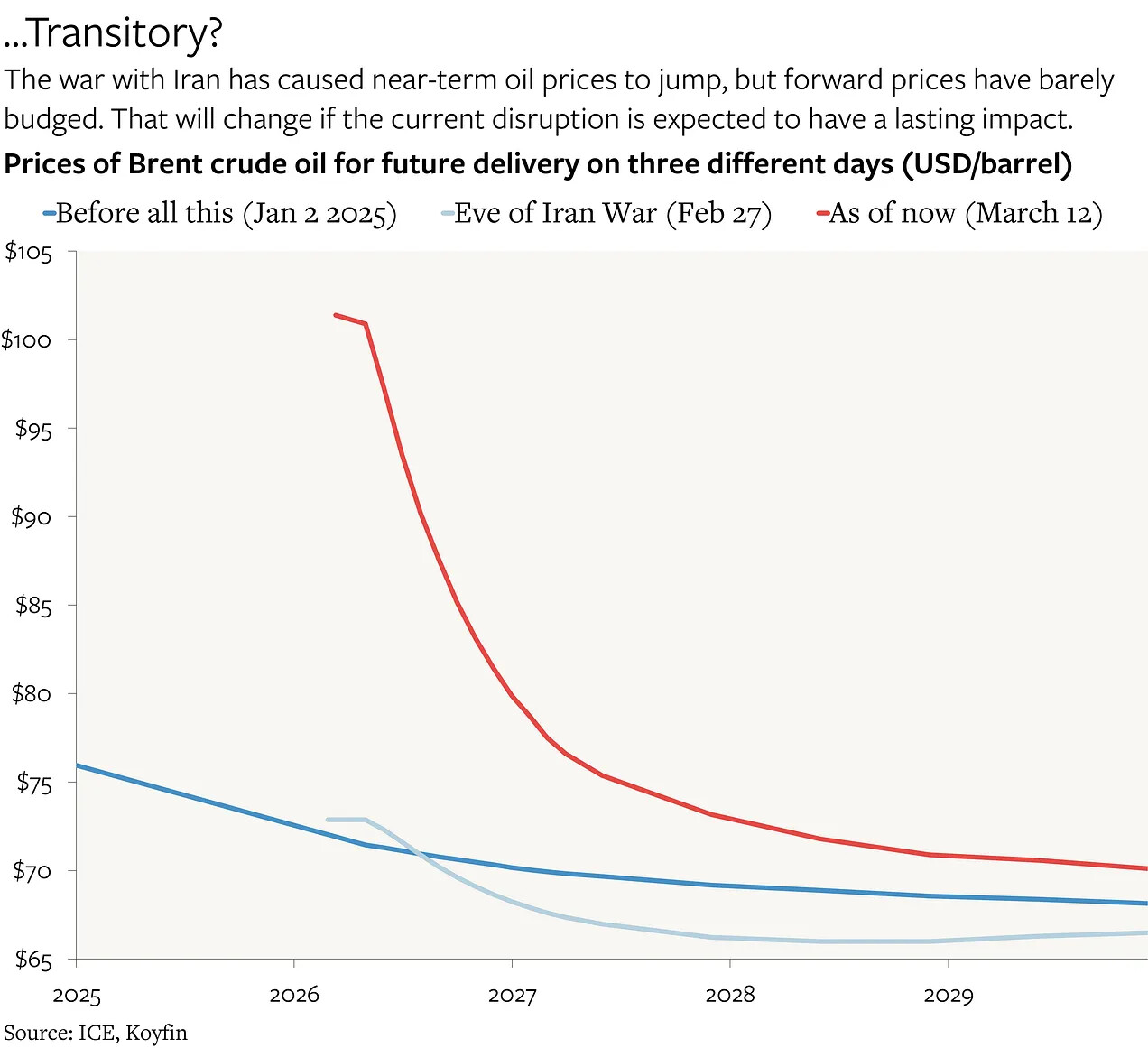
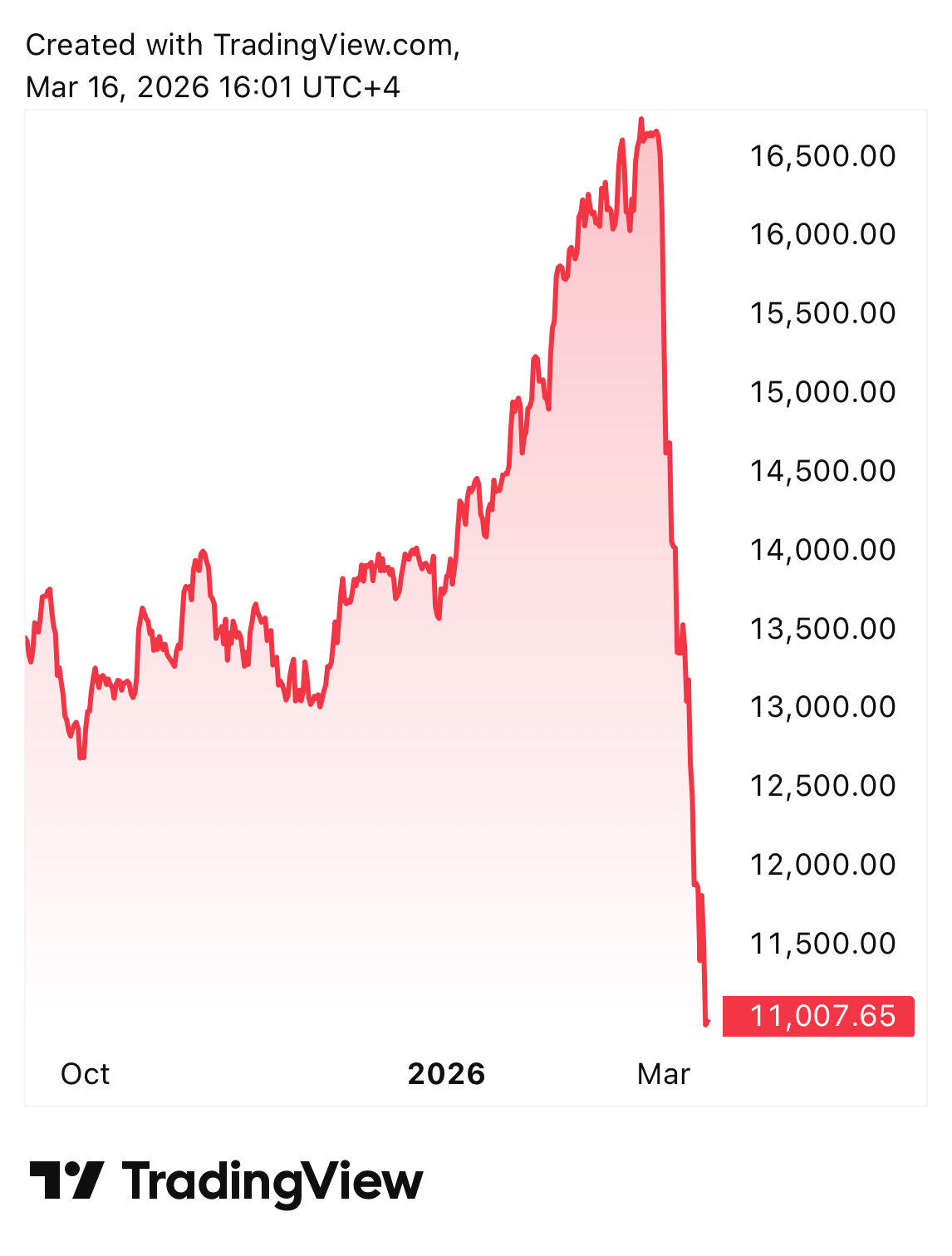
Pretty incredible that there’s bombs hitting the country and the possibility of WW3 starting on their doorstep and real estate index is just 15% down from October.
and it is still higher than it was at liberation day. So many assets had really been doing well before this war.
1 Like
3 out of 30 sell orders triggered at open. I modified one to a market order and that sold. So only 4/30 so far.
Portfolio is off the pre-Iran peak but doing pretty well considering the threat of Middle East conflagration: up 9% YTD (CHF terms).
Isn’t this based on real transactions? or this is index of real estate companies?
I would assume there is no transaction of real estate these days to establish a price
15/30 sell orders went though. Bought 5 positions.
Net reduction of 5% of portfolio. 12% still to go. Hoping for a Trump TACO Tuesday.