How do you actually define "enough"?

I’ve been reading through a lot of threads here recently and one thing keeps standing out to me. Whether people talk about burnout, FIRE targets, or job decisions, at some point it always comes down to the same question: what does “enough” actually mean?

And the answers are wildly different depending on where someone is in life.

A friend of mine, early 30s, just had his first kid. For him enough means knowing his family survives two years without income if things go sideways. That’s his number. Another friend, mid-40s, doesn’t care about runway. She wants the freedom to go part-time without wrecking her retirement. Completely different number, completely different definition.

What I find interesting is that most advice out there skips past this question entirely. It jumps straight to “save more, invest better, optimize your 3a.” All good. But it assumes you already know what you’re building towards.

I’ve been thinking about it in three stages for myself:

First is security. Enough that a job loss doesn’t become a crisis. For me that’s roughly five years of expenses.

Second is choice. Where work becomes something you do because you want to, not because you have to.

Third is full independence. Never needing a paycheck again.

Each one changes how you think about basically everything.

Do you have a concrete “enough” number? How did you get there?

2 Likes

What’s the difference between #2 and #3?

Fair question. The way I think about it: stage 2 means you still earn something, but you get to choose what, when, and how much. Maybe you go part-time, switch to something that pays less but fits your life better, or take a year off and come back. You have enough cushion that you’re not dependent on any specific job, but you’re not fully out of the game either.

Stage 3 is when work becomes entirely optional. Your investments or passive income cover your expenses indefinitely. You could never work again and be fine.

The practical difference is huge. Stage 2 might mean having 10-15 years of expenses saved plus a flexible skill set. Stage 3 means the full 25x or whatever your withdrawal rate requires. For most people, stage 2 is reachable decades before stage 3, and honestly, a lot of people find that stage 2 is already enough.

1 Like

@AlbisHiker What is you current status and your view with your numbers ?

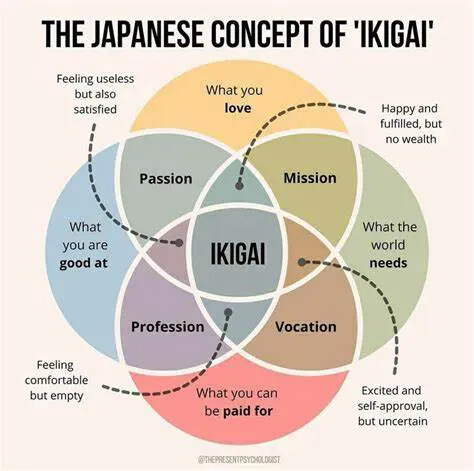
@PhilMongoose I think with #3, you select a job because of what you love, what the society need and less with what you can be paid the maximum for.

2 Likes

@FunnyDjoRegular Love the Ikigai reference, that’s basically what stage 2 enables. You stop optimizing for maximum pay and start optimizing for the overlap between what you’re good at and what feels meaningful.

I think our “enoughs” are very personal and depend a lot on the confidence we have in our skillset, our support network and who we have to care for. Depending on work for a residential permit if applicable would also enter the picture and make things more stressful.

As a single without dependents, I can have fairly low enoughs. Having a high trust in my skillset, that helps too.

One thing that helps me too is to differenciate my expenses when I’m working to those when I’m not. My expenses when not working are significantly lower than when I work (I do cook, use my car less and have less stress expenses).

I’ve started with a negative net worth and less money in my bank account than would take me through the month. To me, the first step of enough is “liquidity”: I have enough money in my bank account that I can afford to pay my bills until next salary comes in. To me, that is CHF 1000 that remain before the next salary comes in.

Then, there is "I can bridge the few months it takes to get outside help (for example unemployment). That came after 1 full year of work and 3 months of expenses in disposable liquid assets.

There has been the “I take liberties in my work and will do things my way, confident my results will shield me, no matter if my boss wants me to do them differently”. That level wasn’t monetary, I think it comes with work and life experience. I’ve reached it with the current job I’m leaving, so about 1.5 years ago.

I guess your step 1 would be my “I’m confident enough to start my own venture.”, for which I’m giving myself 1 year, so, to me, it comes at 1 year of expenses + all of the specific business expenses I would have (insurances, software, hardware,…) minus the income I expect I can reliably get during that time (for example unemployment, provided I am willing to take another job if I find one while doing my searches). The more I have stashed aside, the longer I can afford to pursue my own venture before having to capitulate if it doesn’t pan out and the more picky I can be about taking another job if I find one.

The “choice” step would probably be my “light FIRE”, which I take as enough assets to cover living at the poverty threshold which is currently slightly below 30k for a single person (which would mean CHF 750k in assets with a SWR of 4%). I’m confident I can live and expand my network and skillset at that level, so that I can make my starting situation good enough for me and my future situation better.

Coast FIRE, for me, comes with assets allowing for a SWR of 4%.

Full FI comes when my assets allow for a SWR of π%, just because I like the number and it’s between 3% and 3.5%.

Edit: to summarize:

  • Liquidity: CHF 1000.
  • Changing job as a “crisis” I can confidently handle: 3 months of expenses.
  • Changing job as no crisis at all or starting my own venture: 1 year of expenses.
  • Working as a choice: CHF 750k.
  • Coast FIRE: assets allowing for 4% SWR.
  • Full FI: assets allowing for π% SWR.
5 Likes

Good question, I’ve also been doing some soul searching lately. Whereas “enough” was a monetary value at first, let’s say 500k CHF liquid which would allow me to move to a coastFIRE type situation, slowly but steadily several softer aspects have crept in: speaking my own damn language after 25 damn years in the abroad, having a social circle with 20-30 years’ depth. Somehow after being abroad for so long something broke and I feel I had enough, just not the “enough” we’re talking about here!

I concluded that reaching FIRE needs 2 out of these 3:

  1. extreme frugality
  2. extreme salary
  3. sustained equity bull run

So the question for me becomes: if you don’t have 2 or the stamina to pursue it, can’t rely on 3, and don’t want/can’t do 1 (my grandpa always said “there’s no I can’t, there’s only I don’t want to”) then what’s the option? Stay in a country where you don’t particularly enjoy life - despite all the incredible benefits of CH - until you reach that FIRE number needs to be weighed by what you give up on the way there.

2 Likes

Or a bit of luck timing a crypto bull run

I refrained from putting a #4 “take extreme risks” on purpose, but yes in theory one can do it too if one gets very lucky :slight_smile:

Mostly agree, except that with #2 you can also reach it without any of the others. If you earn 500k/y for 10y, you don’t need 1 or 3.

1 Like

I’d say you only need 1 out of 3.

But having a bit of everything might be more balanced.

Just having reasonable spending, a decent salary and average stock market performance is enough.

3 Likes

@Wolverine This is a great breakdown. I really like the progression from liquidity to full FI. It mirrors what I was trying to describe, but yours is more granular and honest. The π% SWR made me smile, but it actually makes sense as a target, tha’t’s really great. The point about expenses being different when working vs. not working is something I hadn’t thought about clearly enough. You’re right that stress spending is real, and it probably distorts most people’s FIRE calculations upward. CHF 750k as “working as a choice”, does that assume a certain annual spend, or is it more of a gut feeling number for you?

1 Like

@Mirager This hit home. The part about “enough” shifting from a number to something softer, language, roots, depth of friendships, that’s exactly the kind of answer I was hoping this thread would surface.

Your 2-out-of-3 framework is sharp. I think what a lot of people underestimate is the cost of staying somewhere that doesn’t feel like home just to hit a number.

At some point the question isn’t “do I have enough money” but “am I spending my years well.” Curious, did you end up moving back, or are you still weighing it?

1 Like

It also serves the function of reminding me that that number is somewhat arbitrary and I shouldn’t get stuck on it too much.

It does somewhat match my out of work expenses with low travel and little social activities (which I’m not fond of so it matches my personality) but mostly, it comes from the constatation that if people can live with that while working and/or dealing with the life troubles they might have, I can certainly do it while having my time wholly available to myself and having access to the support mechanisms of middle class life from my previous life and network (reputation, knowledge of the social codes, knowledge of how to ride the administrative hurdles of society, putting up a good face to have the authorities on my side, etc.)

1 Like

No, not yet, it’s just something that’s been put on the table with my wife recently, but we know it needs careful planning on several levels - mostly around the kids’ education. The key issue is that once the glass cracks it’s not really repairable, and now it’s cracked.

Absolutely! Thinking of my age, and projections of my saving rate, salary expectations, potential for compounding I estimate that I’d need 10, possibly really 15 years to hit that number and support my kids finish with higher education, that’d bring me to 60, basically, and then the question becomes… what did I give up to get here, and was it really worth it?!

1 Like

Yeah. Sometimes, I wish life was like a video game and I could go back to my age 21 save point and do everything again with the benefit of hindsight! :stuck_out_tongue:

3 Likes

What happened to plenty of time (e.g. 30 years) to save, invest and compound at 5% average rate (in addition to pillar 1 and 2)? Should do the trick without your 3 points.

Normally for me “enough” is roughly double what I have now :smiley:

5 Likes

I’d say it mostly comes down to how early you want to retire.

At 30, you probably need all three.
At 50, you will likely need decent frugality, a decent salary and an average bull run.
At 60 instead of 65, one of the three is probably enough already.

2 Likes

Rephrase “enough” in terms of “years of spending accumulated” and this exercise gets much easier

25x → FIRE (33x if you’re conservative)

Starting from scratch you’ll need 7 years at a 75% savings rate, 10 years at 66% savings rate, 16.6 years at 50% savings rate, 24.5 years at 35% etc.

Combining “extreme frugality” with “extreme salary” will certainly make it easier to obtain faster timelines to enough, and you can probably create arbitrary gradations:

One year saved, five years accumulated → fifteen years (boring middle), twenty years accumulated (end in sight), twenty-five years stashed (FI!)

The question is how fast you want to get there. You could live like a student on median income; you could live like a median income person on twice/thrice median, etc. - the “boring middle” on a 75% savings rate takes like four years :wink: How you live your life at the end of the day is a personal decision.

6 Likes