Yes because of scarcity but also because these commodities were all things that people wanted for a practical use - besides being used as a currency and which does not apply to BTC. Other examples included salt, beaver pelts,….
I agree that gold’s value today is not tied to its practical use but historically it was considered beautiful and used as a decoration and as a status symbol in palaces, temples,… etc.
I agree 100%. However huge jump from that to trust BTC more than USD just because the supply of BTC is limited. We know and expect USD will depreciate at a more or less predictable rate and we know who is controlling this. On the other hand noone knows what’s going to happen to BTC value and no one is controlling it, the price is being set be a herd
In the article above people in Nigeria are turning to crypto because there are restrictions on accessing USD (20% difference between official FX rate and market rate). But they are able to access crypto exchanges. If I was in Nigeria and looking for a stable currency - as opposed to speculating on value increase which in reality seems to be what is going on - I would trust a US Central Banked backed crypto more than BTC , for the other reasons above
Of course that opens the bigger question whether crypto and exchanges will be banned driving them underground for criminals only. US put restrictions on gold in the past
They aren’t in the B2C business and they aren’t a consumer but as a company to all kinds of financing.
So there’s literally no reason for them to do so.
…except to drive their (Thiel’s) political and social agenda.
As for the “why”…we have already covered the store of value/edge to inflation use case, or they might have been inspired by the $100m profit from Tesla.
Yes, these are better examples. Cigarettes in prison are also one. My problem with treating metal as a good with inherent value is that the inherent value only adds up to something with huge weight. 1 kg of stainless steel costs 1.50 EUR. So if you wanted to pay for an iPhone with stainless steel, you would need 1000 kg . So I think scarcity is a more practical feature than usability in order to create a currency.
It would be great if we could peg a currency to a usable good that would not inflate in value as a result. One thing I can think about is energy. If we could make currency pegged to the cost of 1 kWh of energy, that would be interesting. But I don’t think this is doable, as you have varying costs of electricity production around the World, so you could not have 1 global price that you could convert to energy anywhere.
Interesting point. Maybe this is what will happen. People in 3rd World countries will opt for US-back crypto, just because of higher price stability. This stability, however, only exists because BTC is still relatively small part of the World economy and is even susceptible to irresponsible tweets
I’d say the value we give to fiat currencies has a lot to do with history. Precious metals had value because they were shiny, they were rare, they were easy enough to melt (so could be adopted early) and, for gold, didn’t tarnish (so gold could hold its value over time). That made them perfect to craft jewelry, and jewelry was something for the rich (because the poor put their efforts into getting things they could eat or take shelter in), so that probably helped to make them perceived as valuable.
The problem with gold as a means of exchange was that it was hard to assess its purity. Gold coins meant that there was a government attesting that this specific piece of gold had this specific mass and purity. It allowed to give it a specific value, by having a unit of exchanges (I could trade this specific piece of metal for 2 bushels of wheat there, that same piece of metal bought me 1 goat, 2 bushels of wheat are therefore worth roughly one goat").
Fiat currencies inherit from this system, and have benefited from us being accustomed to it to not really need to back it up with gold or another hard asset. They also keep value because they are usually legal tender in the land that mints them, meaning that people you’re trading with are forced to accept it as a means of exchange. The governement has a police force and an army to enforce that, so I guess the real value of fiat comes from the might of the states (economic power and diplomatic status also play a role in that. In a way, the strength of a fiat currency comes from the same power that makes an alpha wolf a pack leader : it’s not very tangible, but it is very real).
And now, BTC comes with mainly the same properties as the first gold coins: it can be attested that 1 BTC = 1 BTC, so it’s possible to use them as a measure of what you get when you exchange something you want to sell for something you want to buy (the perpetual problem of “are my two bags of potatoes worth your axe”).
So, yeah, currencies have value because we give it to them, but we give it to them because it makes our life way easier, so they have real inherent value, as a service: they make trading a lot less headachy than it would be if we had to exchange goods for goods without the use of a currency. How effective they are at that makes some currencies better than others. Bitcoins, being hard to counterfeit, easy to “move” around and having all the same properties are actually pretty efficient at being a currency. That is, if we can keep guaranteing that they are safe from tampering.
Damn you and damn this thread because that much is true! It’s facinating to see the thinking that went under the idea of Bitcoin, it was really designed as a decentralized currency and has pretty decent properties for that.
Edit: Although, to be fair, there’s also the big problem of hoarding and speculation, which is part of why you’d want your currency to be slightly inflationary, so as to encourage its use as a mean of exchange rather than an asset inflating in value outside of the economy.
Recent evidence against being good store of value in times of distress couldn’t be more overwhelming:
Bitcoin lost 84% of its value over the course of less than 12 months in 2018.
And that was without great inflation in the US.
The can invest in any other safe haven currency (could be JPY or CHF). Or even gold.
As I said: Pump & dump.
EDIT: no, actually I didn’t “say” it - though thought and meant to.
Yeah, to drive their agenda. Or for the novelty.
I doubt that there’s any relevant demand for Bitcoin payments from their government or business customers that couldn’t be served just as well with conventional currencies. Governments don’t do business in Bitcoin.
…unless it’s shady business (I wouldn’t be surprised if some secretive or secret “agencies” did). No, you don’t have to post anecdotal evidence (such as the Zug tax administration) that do. They’re also doing it as a political stunt.
I get it that with blockchain technology you can trust a Bitcoin is real, it is hard to counterfeit, easy to move around etc. My point about trust is a different one, how do we trust that the real, validated BTC is going to be able to buy anything in the future? Trust in BTC seems to be based on confidence alone, it is not backed by anything of real value.
Contrast that to commodity currency which was backed by the intrinsic value of the currency. Or fiat, since in stable countries fiat currency is backed by a degree of trust in the competence of the government and national bank (even though it is widely accepted fiat currency is not a good store of wealth in the long term )
Not being able to debase is usually considered a bug as it leads to large economic crisis in time of stress due to lack of elasticity. It’s clear that there’s a balance to be had between discipline and elasticity. Sometimes it’s hard to know what the balance should be and central banks might go too much one way or the other, but it’s also clear that not balancing between both leads to crisis (sometimes the issue is just a lack of liquidity, why blow up your economy because of it).
There’s lots of good books on money which explain those things (I liked “the end of alchemy” and “how finance made civilization possible”, also Mehrling’s class on money and banking).
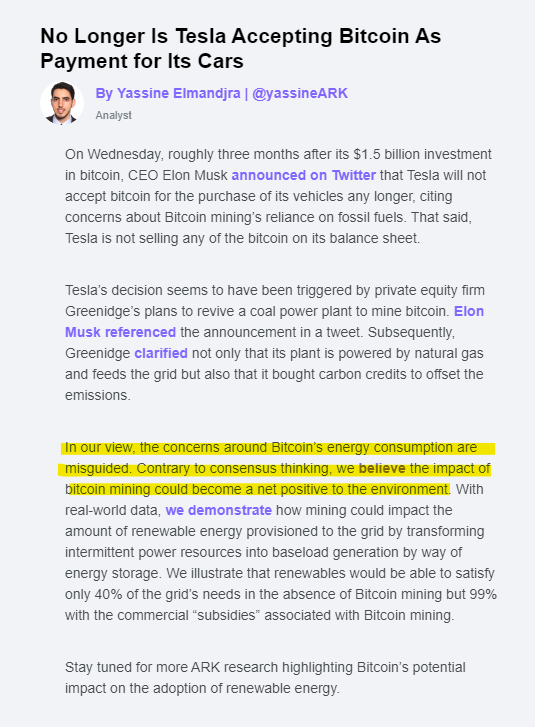
Their guy doesn’t know what he’s talking about, is unable to source or quote sane comparison figures for his research (published on their web site) and keeps plainly ignoring the reality of real-life Bitcoin mining, to indulge in his pipe dreams.
I see prices consistently going up in the last 10 years. Why would this fact be a good indicator for BTC continuing to be a good store of value in the future I am not sure.
Nothing that would support it being a good store of value?!
It’s on its own of no real-world utility. The price or worth of Bitcoin has outpaced real-life goods by orders of magnitude. The concept of store of value entails the asset having some sort of predictable purchasing power and limited (downward) volatility. Bitcoin is anything but that.
The same 1 Bitcoin that would have bought you a few chicken tendies in 2012 would now buy you a car.
This trajectory is obviously not sustainable.
Also, if Palantir are not mulling whether to put Bitcoin on their balance sheet, they’d not be buying at historically low prices.
Mit dem Lesen und der Teilnahme an diesem Forum bestätigst du, dass du die Forum-Richtlinien gelesen hast und damit einverstanden bist sowie den Haftungsausschluss auf http://www.mustachianpost.com/de/ akzeptierst.
 . So I think scarcity is a more practical feature than usability in order to create a currency.

 you have the whole panoply.