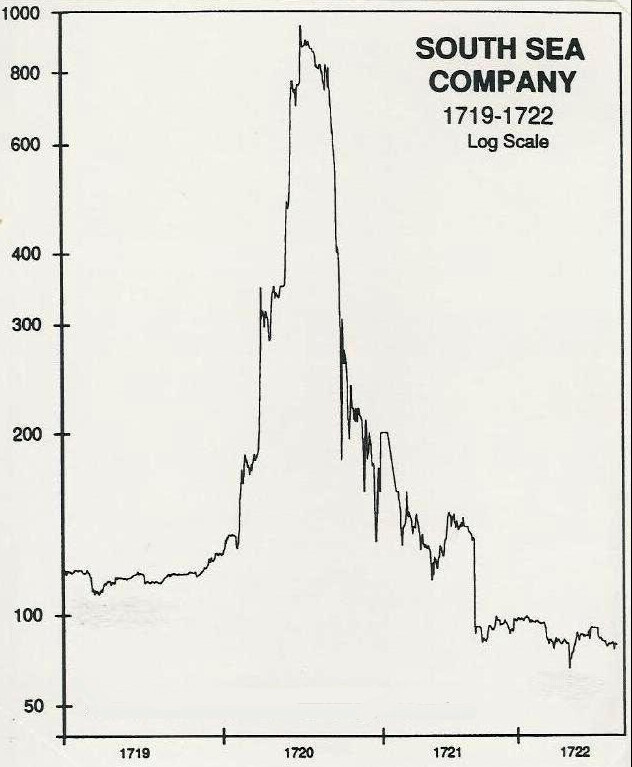
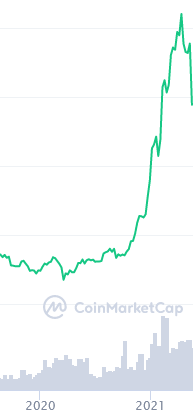
At this rate, adding another 0 to the price every four years, the world’s supply of Bitcoin (in USD) is going to surpass the world’s total stock market capitalisation within 10 years.
In other words, all Bitcoins combined would be worth more than all companies of the world combined on the stock market.
Unsustainable price trends are not a good argument for something offering sustainable store of value.
Assuming bitcoin would replace gold as a store of value, would there still be a 9x (~500k USD) to reach the 9T gold market cap or not? Maybe then once it reaches 500k there won’t be as much volatility.
It’s possible. But at some point people will try to diversify into other cryptocurrencies (like during the 2017 boom and seemingly during the current one), so perhaps it’s better to monitor the whole crypto market cap?
May I ask you why you’re calling Bitcoin a Ponzi Scheme?
Because outside from your take on “it needs exponentially increasing inflows that lead to massive gains” (which I totally get), it’s not clear to me why it could then not be applied to any other non cashflow generating asset.
Are Ponzis not supposed to be low risk/high reward investment propositions that have been secretly and fraudulently created?
Can we really apply this to Bitcoin when its whitepaper (which literally show how to put the thing in place) has been released in advance before its launch?
Speaking of Ponzi reminded me of this great Ponzi example with a local (Swiss) flavour, before the time of most forum members.
(The German version is a bit more detailed - European Kings Club – Wikipedia )
I like the part “Participation was particularly widespread in central Switzerland, where the scheme’s operators successfully exploited popular mistrust in the banking system.”
Crypto… for some it’s the heady profits, for many it’s also coming from a mistrust/loss of faith of the (central) banking system.
It’s definitely different this time, one day we’ll know if it rhymes…
Even though there’s not much additional factual information, the original footage from almost 30 years speaks for itself. I can’t help notice some similarities to some investment fads of today.
Salesman I came here as an enthusiastic bitcoiner willing to share about the “Future of Bitcoin,” but unfortunately, the thread is full of trolls and ill-informed people who are clearly not here to educate themselves. My bad, we should probably rename this thread “FUD of bitcoin.”
As for your Ponzi, Tulip, Pyramid scheme…you are right, the bitcoin sales department is paying me and here is my referral code… oh wait…
Now I know this won’t be sufficient for you and the others, but for me, these facts are sufficient to disprove your opinion:
There were not pre-mined coins
The whitepaper was published before the launch
The technology is public and open-source
Actually, all activities on-chain are public; you can see inflows, outflows, wallets/exchanges/miners/mempool activities, etc., etc., etc. it is not like you can easily “pull the rug” without warning → terrible pyramid scheme because your gains are not even guaranteed.
Bitcoin’s growth is organic
Without centralized leadership (we don’t even know the founders)
And last but not least, believe it or not, bitcoin has actual use cases beyond the get rich quick scheme. Bitcoin was not even created as a business project but rather as a foundational tech protocol.
It looks like a terrible pyramid scheme for Mr. Market (who the hell is this? and what is “automatic re-investing”???).
Of course not, a Picasso is rare as well, but is it durable, fungible, portable, divisible? Same story for gold, a watch, a bottle of wine, real estate…
I am not saying that there is no volatility and that bitcoin is the only scarce resources, but all the above properties combined together make it an unrivaled store of value.
TBH I wouldn’t bet these strings will last longer than a Picasso painting
How is BTC unrivaled? I understand nothing of cryptocurrencies, really, but isn’t it the case that any other “coin” could easily displace BTC as the preferred “store of value”? Isn’t there another coin with the same features and perhaps a couple orders of magnitude less power requirements? And of course the whole cryptocurrency business might not survive the test of time…
The argument would be that those other coins are not wasting as much energy to avoid double spend. So BTC would be more secure.
While this is true now, it doesn’t seem like something that’s set in stone (another blockchain could end up displacing it either with PoS like ETH or something else), though if/when it happens it will be gradual not a sudden shift (except if it crashes due to a new flaw being discovered)
We can agree it’s a decentralised scheme that doesn’t seem orchestrated by a nefarious organisation or “leader” on top.
That doesn’t mean you can’t sound like a Ponzi salesman - or that your posts couldn’t remind TeaCup of one, though.
While I don’t know about Satoshi Nakamoto exactly, it seems very plausible and believable that it wasn’t created as a get rich quick scheme. Also, I don’t think they anticipated that their (proof-of-work) scheme would, within a couple of years, consume more energy than entire mid-sized countries.
In fact, I think its creators didn’t (in earnest) anticipate today’s economics at all.
However, whatever you call it - pyramid, Ponzi, neither might be be entirely accurate - the de-facto economics of Bitcoin today are basically the same: The system and its price development do resemble a get-rich-quick scheme and rely on very similar economics.
It’s just that history (from 2017) seems to be able to repeat itself.
Bitcoin is fascinating. How many people who are strong BTC advocates nowadays have read the whitepaper, though? How many have really studied the fundamentals past the “it’s decentralized, and safe, and the price goes up and up and up”? Do they know how the decentralization, and the safety are guaranteed? And for how long it can go up and up before running out of fuel?
True believers should not care about the price, because Bitcoin should not be used to trade with fiat but to replace it. They should care about wide adoption (which you do). Yes, some people use Bitcoin as a protection against hyper-inflation, yes, some believe it is there to stay as a real currency, or a real store of value, but a lot of the money in it is there because its price has multiplied 10x in a matter of a year.
Even you, as an informed believer, have used the price going up as half of the argument when defending Bitcoin uses as a store of value. When you put it alongside that the price only goes up if more people buy in, that it comes from the volume traded and not from the entire Bitcoin supply, meaning that if too many people want to take too much fiat out of it, it will crumble, it is pretty concerning.
The price going up is not an argument, we can make the price go up on anything we want if we pour enough money in it. Heck, Hertz stock went up after the company filed for bankruptcy! Everybody and their mother is investing into skyrocketing “assets”, these days.
So, when people come on boards and talk about Bitcoin as an investment, because its price goes up, it sounds like salesmanship, because we know that more people buying in are needed for the prices to keep going up and that those who get in late are the most likely to be left holding the bags.
I’d say the problem isn’t really to find or create another more efficient coin with the same fundamentals but to get people to study the fundamentals, and those of the other coins, before throwing in the money they want to send on the moon. Some of Bitcoin’s success is fundamentals, most of its recent success also comes from it being known. The price goes up because it’s popular, it’s popular because the price goes up, very hard to dethrone during the craze.
Usually people come for the price, and hopefully stay for the tech, use cases, philosophy behind it and whatnot. And that’s fine!
Not really actually, if we take the second one in terms of market cap, Ethereum, you immediately have issues when it comes to the store of value use case:
it was premined, so the initial distribution was not fair giving more power to the founders (eg Vitalik)
it is much more centralized, it can be censored and developers could technically roll back transactions
Monetary policy can be changed by the developers
PoS implementation will accelerate the centralization problem
And little known fact, parts of Ethereum is running on AWS, which consume lots of energy and add a single point of failure/censorship
And that’s okay, Ethereum was not designed to be a store of value, it is better for other use cases. Above points applies to most other crypto as far as I know… Think about doge or Swissborg for instance.
Look, I really don’t know the details of how these things work. But isn’t it possible for someone to come up with a new and better (for all the features you care about like scarcity, decentralization, power usage, etc…) cryptocurrency/blockchain/protocol/whatever which would make BTC obsolete in the blink of an eye? What prevents that?
Hey guys, what’s your take on Monero (XMR)? I wrote about it here:
Would a truly private crypto not eventually win over one that is public? With Monero the transactions cannot be traced, so you also cannot check the balance of an account (like you can in Bitcoin).
Mit dem Lesen und der Teilnahme an diesem Forum bestätigst du, dass du die Forum-Richtlinien gelesen hast und damit einverstanden bist sowie den Haftungsausschluss auf http://www.mustachianpost.com/de/ akzeptierst.
 Unsustainable price trends are not a good argument for something offering sustainable store of value.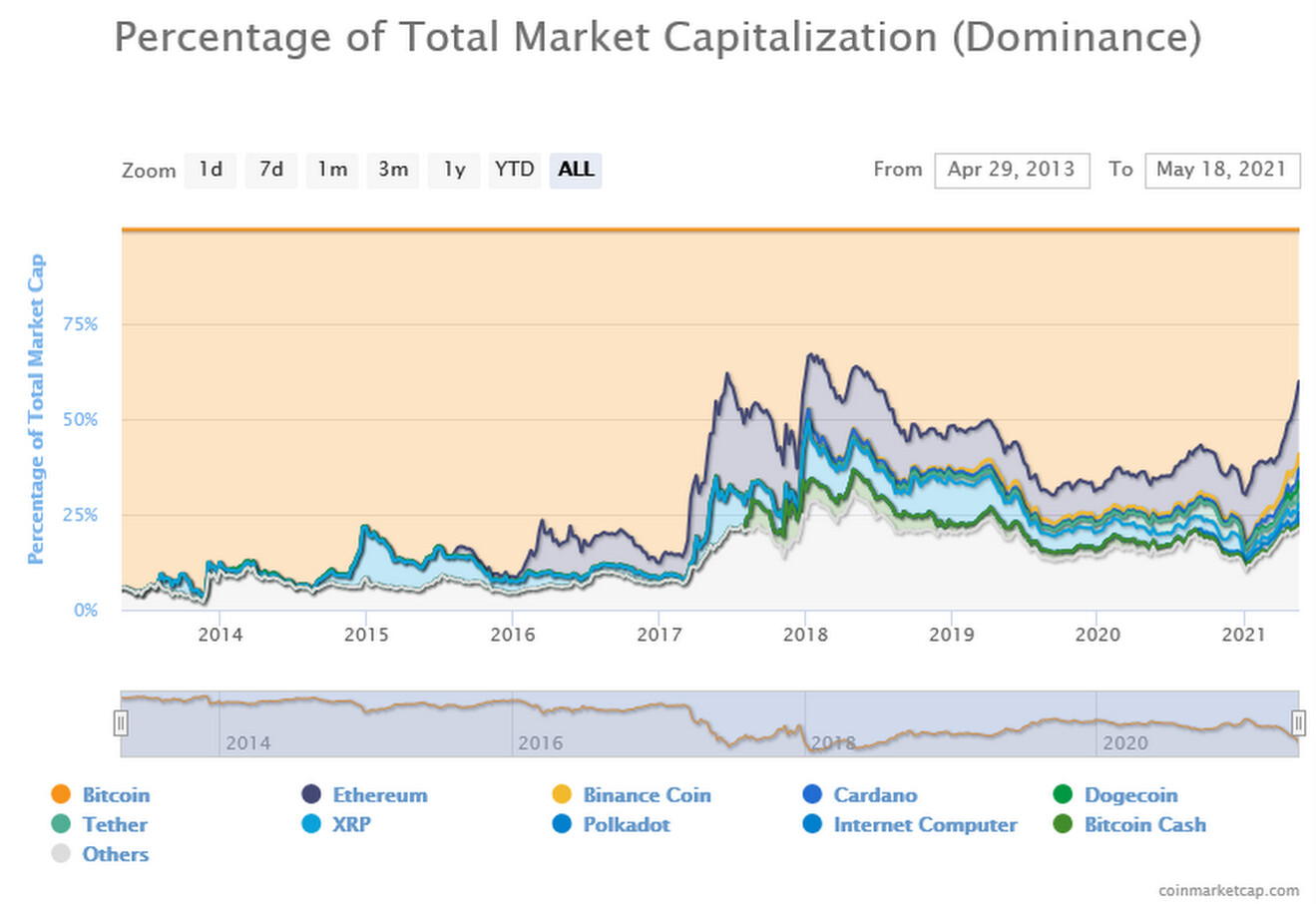
 .
. I came here as an enthusiastic bitcoiner willing to share about the “Future of Bitcoin,” but unfortunately, the thread is full of trolls and ill-informed people who are clearly not here to educate themselves. My bad, we should probably rename this thread “FUD of bitcoin.”
 and here is my referral code… oh wait…