Who is they? Do you have any proof that police is analyzing mobile carrier data and chasing quarantine breakers?
And i dont have to be careful because im not gonna try anything.
Who is they? Do you have any proof that police is analyzing mobile carrier data and chasing quarantine breakers?
And i dont have to be careful because im not gonna try anything.
Not quite proof, but I’ve heard about IMEI checks which ended up in large fines for braking the quarantine.
And this is something I don’t really get… Why they won’t go into force since 7.12? The situation on 14.12 may be quite different already…
Thay want to avoid that people travel back all the same day. This happened with british tourist wanting all the same day to fly back from Spain. It is better, in order to decrease the contamination, that people travel within a whole week in planes that are half full.
The tracking from people coming from abroad is only limited. Resources are already limited to trace the contact people of positive cases.
Here is a good document about the economics of covid-19 from the economist who recently wrote the open letter to the Swiss government.
Only my guess, worth exactly what you pay for it:
We have gone through some sudden dips (december 2018, the Coronadip, the dip of this end of October), people are on the edge and some want to get out, but there’s nowhere to run. Stocks are the only profitable asset where all this cash can be put and the central banks are backing it up.
So, volatility, as money fears that we may be loosing even that venue of returns as we may be getting toward a big correction/recession but a generally upward trend, as money doesn’t have anywhere to run but in stocks.
This will end either when the economy will catch up to the stock market, i.e.: people start to need the money they have in stocks to pay their bills and sell for it, which could compound into enough of a drop for fear to lead a good chunk of the other money out, or some big bankruptcy make people fear for loss of capital more than of missing out in the stock market or when interest rates go up, making investing in bonds a viable alternative again.
For now, when stocks go down, they go down quick. When they go up, they go up quick. Nobody knows what will happen next but my bet is that things will only become more stable if/when interest rates raise consistently, the Corona crisis is just the icing on the cake, the markets have been searching their own downfall for quite some time.
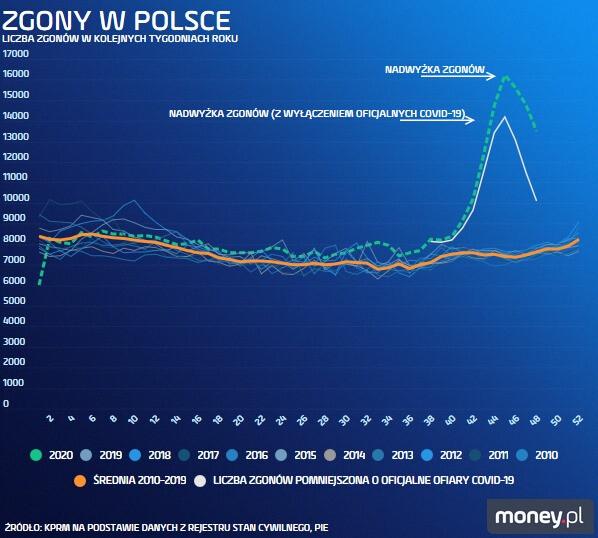
Here’s a chart that caught me a bit off guard. Weekly deaths in Poland. Green line is 2020, white line is 2020 minus official covid deaths. This year already 45’000 more people died than last year.
Swissmedic just approved the Pfizer/BioNtech vaccine:
Can’t wait to see all the experts now that got their doctor title on Youtube.
It’s official: I was an idiot that I was afraid of buying the corona dip. On one hand, I’ve heard a thousand times that even during Apocalypse, when Jesus Will Come to Judge the Living and the Dead, the markets will bounce back in a couple of months (in the worst case, a couple of years). On the other, it’s quite a different thing to experience the pain and fear, to see the melting portfolio, representing years of work and disciplined savings, literally in your eyes. I’ve learned the lesson the hard way.
I was right that the corona pandemic ended up much more severe than many people expected this spring, but I was wrong that this will lead to stock market catastrophy. Apparently, stocks are much more resilent (detached from the real eocnomy?) than I thought.
By the way my strategy is to wait for VIX to go back down. At least I avoid the high volatility days (I haven’t backtested what the impact is, but I guess it’s not huge, you might miss the dip in a mini crash but then it’s also hard to predict how things go in high vol times).
Yes, I think it was too high, first three (bull) years I was 90% in stocks and felt I could handle 100%, but during the crash I’ve realised it was too high. Since then I stopped investing monthly and started accumulating more cash (I also had to change my portfolio composition due to personal reasons, I might need more cash for buying an apartment in 2-3 years). In the end I hadn’t sold (although I was thinking about it), so at least there’re partial success (or less failure). But I wish I had the guts to buy more.
This!
Also, we may be past the dip, or we may experience another. There’s still quite some room for bad surprises and messages like yours (@1000000CHF) show that we’re mainly back to confidence in the markets, which may be a sign that most of the money that could get in is in and we’re at a turning point… or not.
That to say that it’s good we’ve learnt from this experience and that we should keep in mind that knowledge we’ve acquired about ourselves. Let’s act as we wished we would have, going forward.
The stock market isn’t the economy.
That’s a good point taken.
I srsly believe that the stock market would even recover from an extinction level event like a 10km asteroid hitting New York.
There won’t be a 10km asteroid hitting earth in the next 100 years. A 10km asteroid would really be an extinction level event, maybe some humans could survive that, but if it hits New York, the US will be no more. Even a 1km asteroid is enough to wipe out a country like France or Germany.
However you don’t need a 10km asteroid to wipe out a city like New York and we can’t really do much about it.

The new strain of Covid-19 sounds alarming.
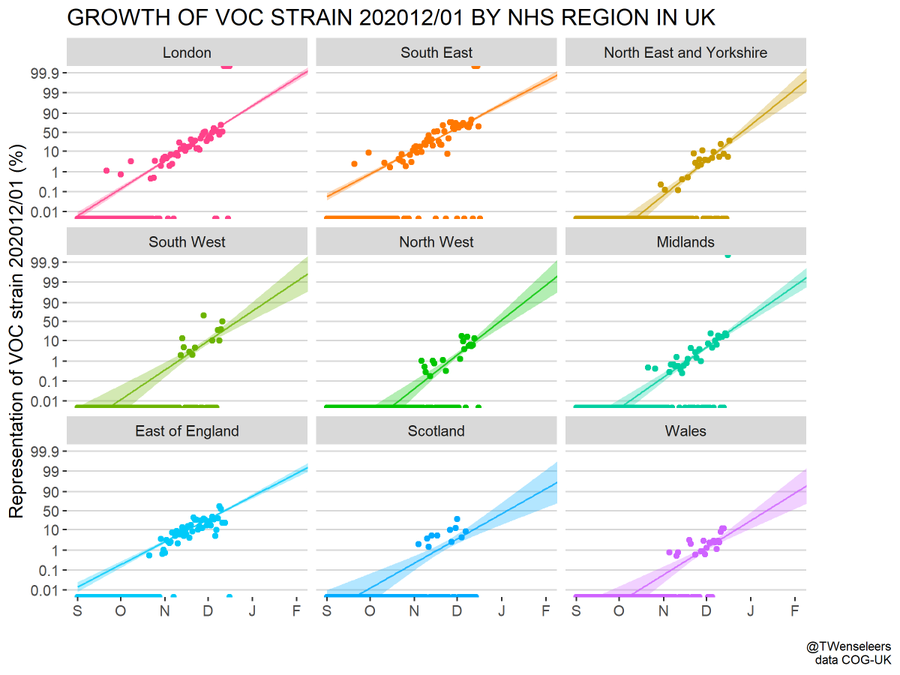
In general mutations of the virus are to be expected, but this is a new variant, that popped up independently (if I understand it correctly) in different places. This points to there being some advantage the new variant has over the old one. The new strain quickly dominates in places where it shows up. This could happen due to chance (founder effect) in some places, but if it happens in many places, it points to a higher transmissibility. Last I looked there was no sign that the new strain has a lower IFR than the old one, but everyone was warning that there was not enough data to really tell.
This paper suggests that based on epidemiological analysis the new strain is 50-74% more transmissible (95% CI) than the old one:
Estimated transmissibility and severity of novel SARS-CoV-2 Variant of Concern 202012/01 in England | CMMID Repository
Here’s quite a good recap about why this should be really worrying:
https://www.lesswrong.com/posts/CHtwDXy63BsLkQx4n/covid-12-24-we-re-f-ed-it-s-over
One poignant excerpt:
This is estimated as a 65% increase in infectiousness. If we want to stabilize infections in an area that was previously stable we’d need what would previously have been an R0 of about 0.6. If you have an R0 of 0.6 that means you would have previously been cutting infections in half each week or so.
Does that sound like something any Western country could possibly accomplish from here? What would even trying to do that even look like? Is there any chance people would stand for what was necessary to do that?
The flip side of all of this are the successful vaccines. Most experts seem to believe that the vaccines should work on the new variant aswell.
Nevertheless, it seems that the situation could get much worse (increased transmissibility of new strain) before it gets better (because of increased immunity through vaccination).
If you’re referring to South Africa vs. UK, those are different strains.
Yes exactly, but they share a common mutation! (I’m probably messing up some of the biological terms. Mutations happen all the time, I read somewhere that in around 90’000 sequenced Covid-19 genomes there were 12’000 mutations found. But most mutations only serve as a genetic tracker and don’t have any effect on the characteristics of the virus.)
There are a lot of strains popping up with that same mutation (in spike N501.Y), which could mean that this spike could play some role in the increased transmissibility. (But I’m far from an expert on any of this. I just found it peculiar that nobody was talking about this, when I believe it could have large consequences.)