Hey, I’ve been a member (in club noob) since I was born…

Hey, I’ve been a member (in club noob) since I was born…
Nah, you were not. Early adopter nerd.
Now we’re just old(er). I wonder when I would make fun of myself not being able to use a modern software. Time has come.
I went straight from IRC (Irssi) to this forum skipping a bit of the internet life in between. Had some ICQ chat experience I admit…
I have to find a way to use VIM here especially with this happening.
In still using IRC … though I use some bouncer that supports mobile clients these days instead of irssi. Much nicer if IRC is your conference chat …
discourse actually has some vim-like keyboard short cuts. try ? to see them.
use j/k to navigate posts etc. o to open. ‘g l’ to go to latest view.
/whois JEPG
ASL?
Damn this took me back many years, I think it was pre-2000 that I was starting my trolling journey in mIRC


Well I have to check if I can still boot a computer with a keyboard.
From two of the Twitter accounts I follow:
(Last AI post for the week, I promise)[$]
$ Thank god tomorrow’s Monday! 
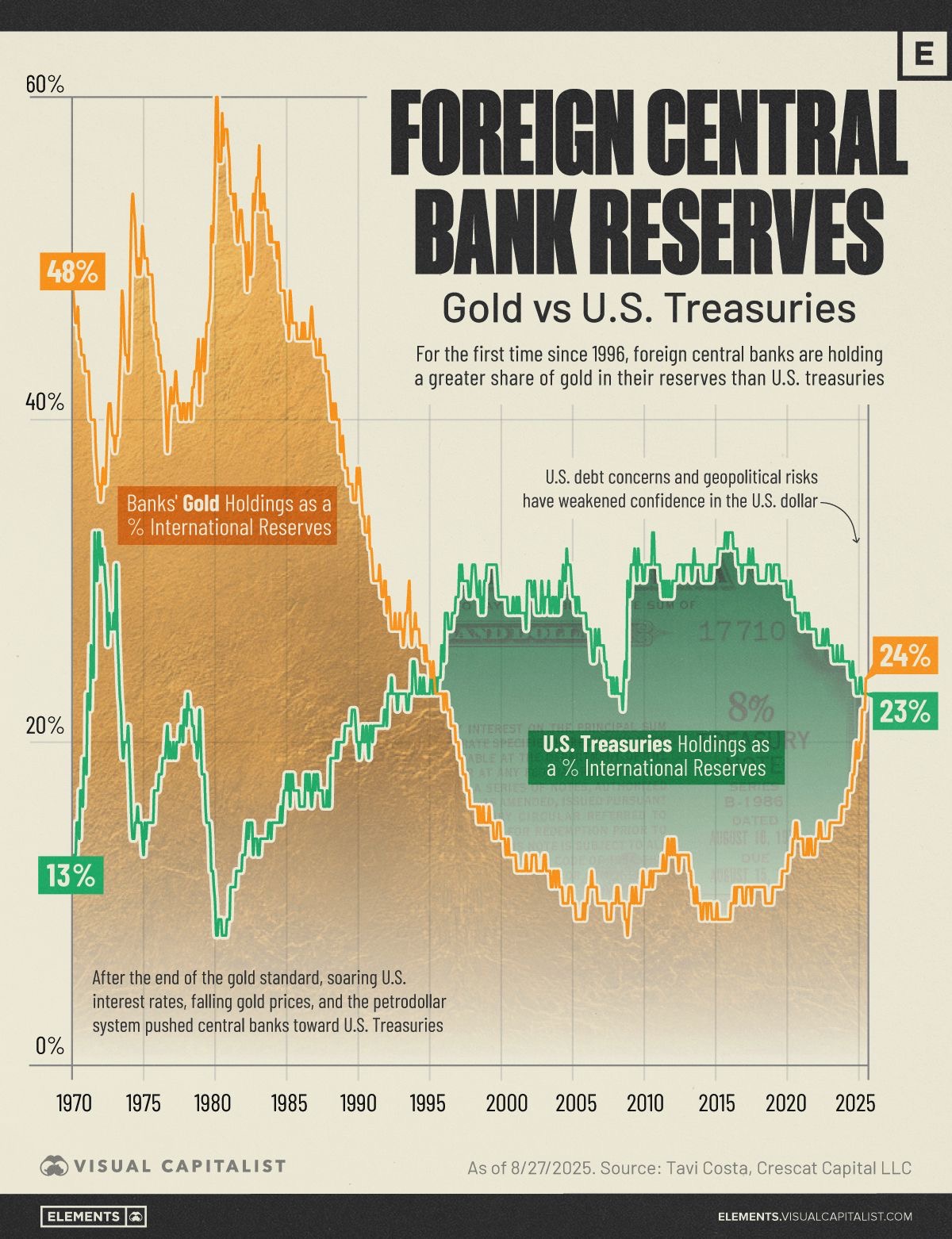
The USD is losing its reserve status — in real time.
Do you remember when people used to say, “One day the US dollar will lose its value”?
Well, that’s exactly what’s happening now — and at a rapid pace.
However, investors aren’t really fleeing into other currencies. Sure, the Swiss franc is holding up well, but it’s nothing compared to gold.
So, do investments in USD (like dividend stock ETFs) even make sense anymore?
Bonds are the investments in their respective currency.
Dividend stocks are still stocks, hence, they’re tied to the prospect of their companies. If the USD weakens, theoretically, having expenses in USD is a good thing, and it helps exports. As for the revenue side of things:
not all dividend companies have a huge chunk of their revenues tied to the USD → there are probably funds/companies out there that would be more resilient to USD depreciation.
One question we should be asking ourselves is “are the revenue prospects of this/these company/ies in jeopardy?” Even US companies with a domestic activity can be resilient to changes in value for the USD.
So as usual with stock picking it’s a matter of identifying the wheat from the chaff. The alternative being to just buy the haystack and keep buying more of it come hell or high waters.
How much is due to central banks selling treasury/buying gold (ie tons of gold being held/bought) and how much is due to gold price movement?
Well, I think:
• Central banks are actively shifting reserves
– Net buyers of gold for years, record purchases recently
– Some are reducing U.S. Treasuries → this is the main driver
• Gold price effect
– Gold has surged in price, so its share of reserves rises even without buying
Rough split: ~60–70% real buying / reserve shift, ~30–40% price movement
Looks like this data is “complicated” (Ft Alphaville)
(There’s no official source of data, there’s some industry body publishing numbers, where they might also lump sovereign wealth fund with central bank)
I read the other day that the SNB had sold off a large chunk of its gold reserves not long ago and there was some popular attempt to try to stop this.
Isn’t this the cue for the big, scary “currency doesn’t matter” crowd?
My simple and simplistic mind says “if I make X% more in USD than I lose in USD/[currency I need] then it’s net positive”.
You should add holding time and interest difference to your formula. Over longer periods of time sometimes the interest difference turns the forex gain into a loss and vice versa.
Anyhow, as I am one of the
When comparing to stocks the volatility of currencies are peanuts.
I am not that sophisticated, have internalised the 80:20 rule, and approaching most things with an Impact/Feasibility prioritisation matrix, so many years in consulting finally left a mark, all that corpo jargon has some practical wisdom!
I would say the 20% of efforts that do 80% of the job when it comes to evaluating the value of our assets for our own spending needs is to buy an accruing ETF in CHF.
That way, you only ever see the value of your portfolio displayed in CHF and whatever fluctuations happen to the same stocks when denominated in USD or another currency simply never happened to you (as, in theory, they don’t even if you hold funds with shares denominated in USD).
Edit: the slightly more complicated and less fee efficient way to do it for those who want to see dividends distributed is to use a distributing fund and then immediately convert the dividends in CHF.
I would recommend to differentiate between investments in stocks vs bonds/USD.
If demand for USD goes down , it would mainly impact the forex rate. But the investment in a stock (company) is independent of currency in which the stock is bought.
Of course if stock returns are not enough to compensate for currency devaluation, then it will be a loss for CHF based investors. But I think the chance of stocks underperforming CHF savings accounts in long run (>10 years) is very low.
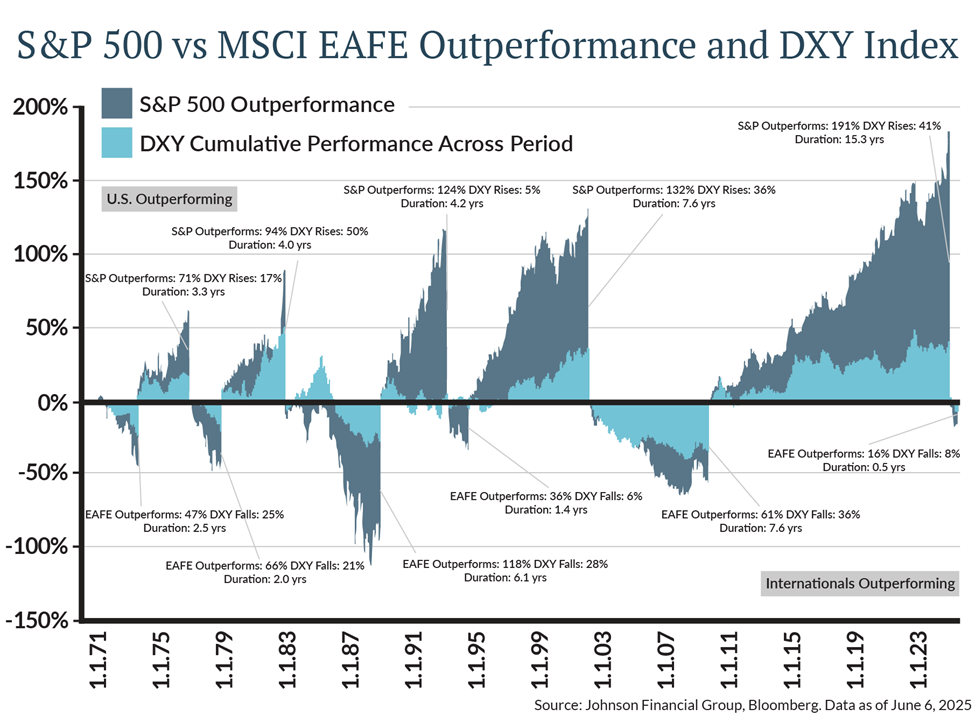
The stockmarket of a country in aggregate is still correlated to its home market currency (isn‘t necessarily the currency you buy the stock in of course, but for US stocks, USD has a correlation). Depends of course on a trillion factors (and breaks down on individual stocks), but there is a big effect still in aggregate.
Cederburg could be seen as indicating this.
This chart is also pretty telling imo: