So, until things change, things will stay the same.
Or, the markets will continue to go up, until the markets stop going up.
What insight.
So, until things change, things will stay the same.
Or, the markets will continue to go up, until the markets stop going up.
What insight.
Profound, right?
Well we can disagree with him , but he is not wrong. We all witness that people blindly pour money across all stocks every month without checking anything. And this is indeed a recent phenomenon. Maybe not more than 20 years old.
With inflows being large, stocks are bound to go up. He is just trying to raise an alarm because he cannot do anything about it. Pension money is also pouring into stocks via target date funds. So this means whenever market fall, Fed need to secure them. Story goes on. Hopefully regulators will do something about it before it’s too late.
personally I think the expected returns from stocks will be low because of this super high sense of safety attached to equity investments these days.
Bonds are boring, cash is trash and stocks are the safest thing to do. This narrative is a problem for returns from equity as there is no risk associated in price anymore. This can be witnessed in earnings yield of S&P 500 being lower than US 10 yr bond.
Is this really new? People have been paying into pensions and 401ks for a long time now. Perhaps it has increased but hasn’t this been happening for a long time.
Sure low cost ETF trackers may be a new things, but before that, there were equity funds.
As far as I know, index funds became popular in 401k in early 2000s. As of 2006, 16% of 401K assets were index funds as per this article
As per CNBC -: By 2027, target-date funds will capture roughly 66% of all 401(k) contributions, and about 46% of total 401(k) assets will be in TDFs, according to a 2023 estimate by Cerulli Associates, a market research firm.
UK had defined benefit pension back in the 17th century and I think 401ks already existed in the early 80s.
401K existence is not the same thing as they using index funds. I posted some info above.
I know we all want the equity growth story to continue forever but we should also try to plan for a scenario if it’s not the case.
but why are index funds important. if pensions invested in equity and bonds, you still have cash flowing in.
I believe because active managers don’t buy everything in index. This means they were not forced to buy unless they believe stock is interesting. They also can have higher cash bucket if they are waiting for an opportunity. You can see this with Buffet, he is not buying anything until he finds something interesting.
Today every USD going into VTI also buys stock of MSTR. Unknowing funding purchases of more bitcoins. I don’t think active managers are doing that.
Of course I am talking about history. Now active management is also forced to buy same stocks which index funds buy or else active will have bigger problems
I know all this, as do you, the main question is the “so what” as we say in the business. He’s sounding an alarm without offering an alternative, it’s been beaten into me to “bring solutions, not just problems”. My solution is taking high risk (TQQQ) profits and putting them into dividend growth (SCHD). There are other solutions for sure that are suitable for other people.
@PhilMongoose I think the point is not ETFs or mutual funds tracking indices, the first index-tracking mutual fund is from the 70s and first ETF is from 1992, the way I see the point is that inflows have swelled to hell the last 10-15 years because of bull run and TINA. I’ll see the RR podcast and Felix’s old video of passive vs active to get a reminder, I recall him saying (a few years back) that for passive to make inefficiencies there’s a long way to go, maybe now we’ve covered some of it.
That’s correct. He actually was on RR podcast and he did say that ironically until the collapse, index funds are the most optimal solution for most because nothing can counter these flows.
Well, they talk about a ‘passive-investment bubble’ making it sound like the passive part is the problem. If they say it is just an ‘investment bubble’ and that if people were pouring the same money but stock-picking instead, then that would be a bit different to what I understood they are saying.
I think you are right. We are in a TINA world. Now Buffett thinks there is an alternative and is sitting in T-Bills.
I am putting stuff into pension, gold and other commodities and some other more boring stocks. But pretty much all stocks have been pushed to quite high levels.
I guess that’s because there is systematic, regular and YUGE buying into specific funds buying the S&P500 at market cap weight, whereas retail stock picking would be none of the above, so less of an avalanche.
Why would it matter? If an active funds investing in equity gets inflow they’ll have to buy stocks. Maybe capital will be better allocated but they’re still being forced to buy.
Same for retail, if they have already decided to allocate capital to equity that will flow into the market regardless of passive or active.
Passive just made it easier since there’s no decision making.
Dunno, not sure to be honest when you put it that way. We could say “investment bubble” overall pushing stocks up by constant buying pressure vs selling pressure?
There was another RR episode debating this stuff (Randolph Cohen And/VS Michael Green)
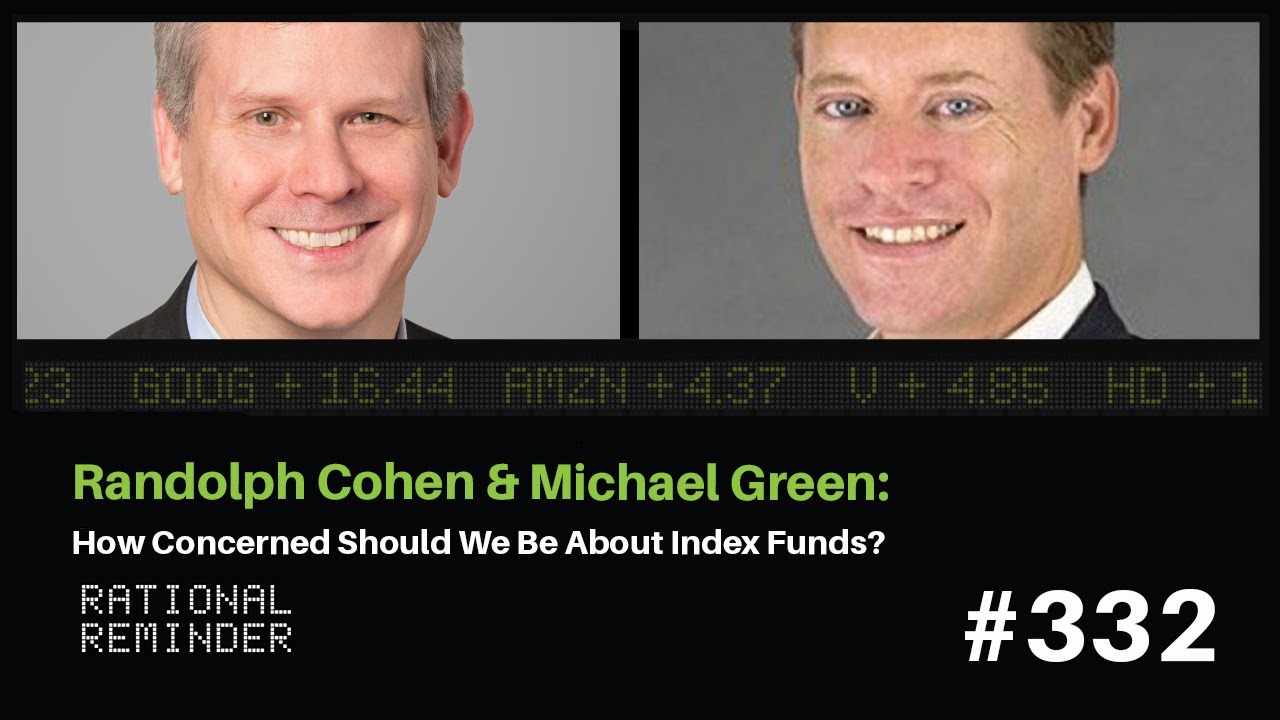
Summary of the Rational Reminder episode 332 – “How Concerned Should We Be About Index Funds?”
In this “grab‑your‑popcorn” episode, hosts Ben Felix and Cameron Passmore bring together two prominent voices in the passive‑investing debate:
| Speaker | Main Position | Key Points |
|---|---|---|
| Michael Green (Simplify Asset Management) | Highly concerned that the rapid growth of market‑cap‑weighted index funds and target‑date funds is distorting market prices and creating systemic risk. | • Passive inflows push up valuations, especially of large‑cap stocks, by reducing volatility and “making them seem less risky.”• The sheer scale of passive capital could lead to price‑elasticity effects, inflating stocks by as much as 50 % in his view.• Target‑date funds amplify the problem by automatically allocating more money into these indexes, potentially crowding out active strategies and reducing price discovery.• He likens the situation to the pre‑2008 CDO buildup—large pools of capital chasing the same assets. |
| Randy Cohen (Harvard Business School, senior lecturer) | Less alarmed; believes the concerns are overstated and that passive investing brings net benefits. | • Passive funds eliminate “trend‑chasing” behavior, which can actually improve market efficiency.• Many investors would have ended up in 60/40 or similar balanced portfolios anyway; the shift to index funds is more a change in vehicle than a fundamental allocation shift.• He stresses that the market’s forward‑looking returns and valuations are driven by fundamentals, not merely the flow of passive money.• While acknowledging that passive can affect price dynamics, he argues the effect is modest and not enough to cause a bubble. |
| Hosts’ framing | The conversation is framed as a “reality‑check” on whether the rise of passive investing warrants policy or portfolio‑construction changes. | • Both guests agree that investors should stay diversified and consider a tilt toward small‑cap/value exposure as a hedge against any potential over‑weighting of large‑cap stocks.• The episode ends with a practical takeaway: for most retail investors, staying in low‑cost broad‑market index funds remains a sound strategy, but being aware of the macro‑level debates can inform longer‑term asset‑allocation tweaks. |
Overall take‑away:
Sources: episode description and transcript excerpts from the Rational Reminder website and related podcast listings.
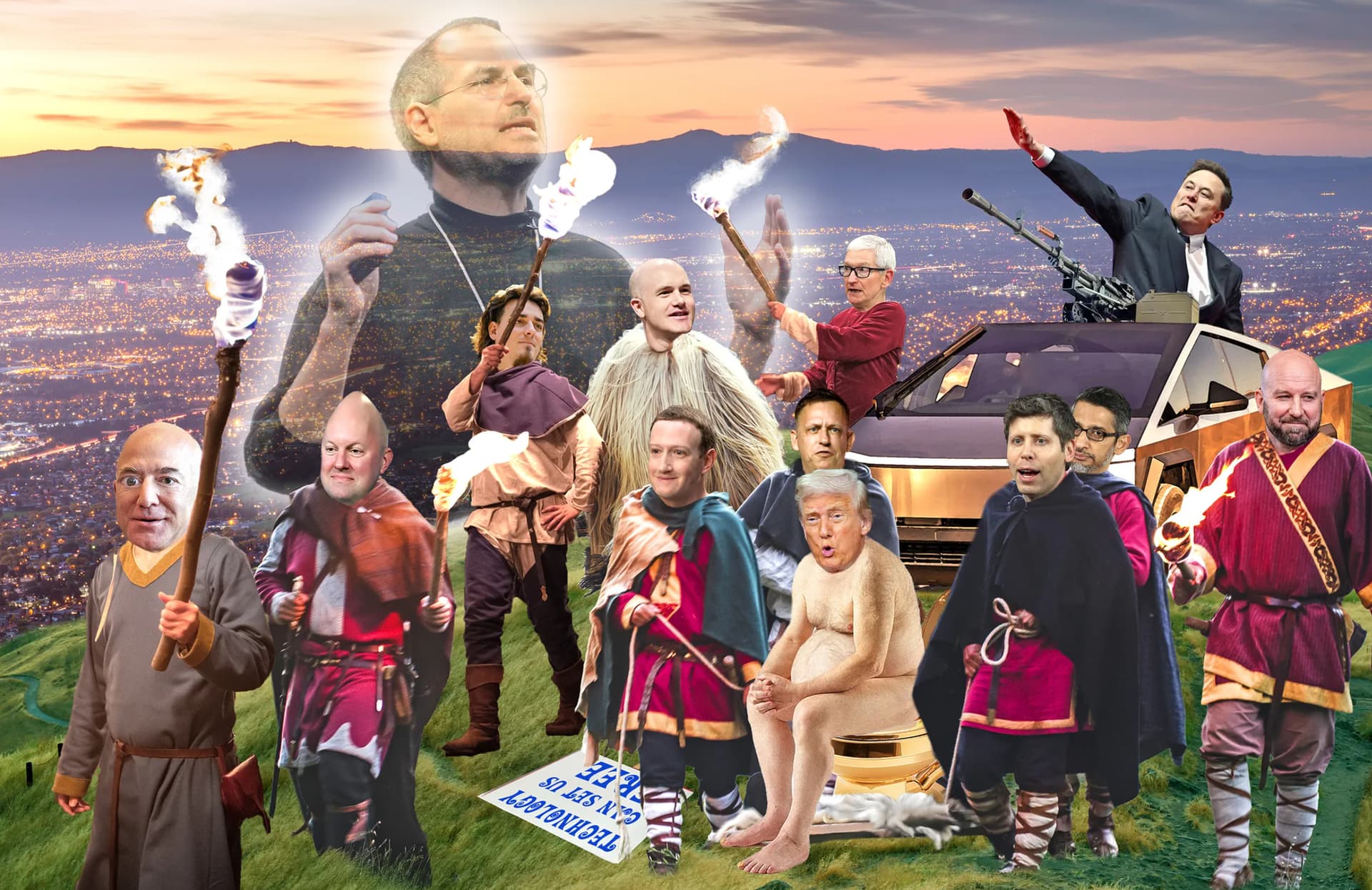
I Thought I Knew Silicon Valley. I Was Wrong by Steven Levy in WIRED.
Subtitle: Tech got what it wanted by electing Trump. A year later, it looks more like a suicide pact.
I mostly just marvel at the picture, but for those interested in the content of the article Gemini summarizes it as follows:
In the provided article from WIRED, author Steven Levy reflects on a dramatic and unsettling shift in Silicon Valley’s political landscape, lamenting that the tech world he knew and chronicled for decades has changed in a surprising and disturbing way. Levy’s tone is one of disappointment and surprise, as he grapples with the new reality of tech’s elite aligning with a political power whose values clash with the industry’s historical egalitarian and counterculture roots. He frames this alliance as a “suicide pact” for tech, and describes the leaders’ actions as a “dangerous dance with a capricious administration”.
Levy contrasts the current state of Silicon Valley with its origins, recalling a time when the burgeoning PC industry was a “nerdy successor to the political and cultural activism of the late 1960s”. He recounts how the original tech visionaries were rebels, from Steve Wozniak and Steve Jobs selling “blue boxes” to Mitch Kapor, a former meditation teacher, who valued people over profits. Levy had a “love affair with Silicon Valley,” believing its “wizards” were using technology to empower the common person and speak truth to power.
The author points to several examples to illustrate the change he perceives. He notes that powerful figures like Mark Zuckerberg have become “MAGA-friendly” and a cohort of billionaires have prioritized their companies’ fortunes over social well-being. Levy highlights the political pressures on tech leaders, citing Apple CEO Tim Cook’s decision to present a “dubious, most obsequious product” to the president, a move he believes the late Steve Jobs would never have made.
Levy explains that this political alignment is driven by fear, with venture capitalist David Hornik stating that the administration is “vindictive” and that business leaders fear “repercussions”. He observes that many tech executives are now reluctant to speak on politics, with some even considering “exit strategies” and citizenship in other countries should things get worse. This contrasts sharply with the past when employees could pressure executives to maintain corporate values by threatening to leave. However, following Elon Musk’s mass layoffs at X (formerly Twitter) without the app collapsing, internal activism has waned, and the environment at companies like Meta now feels like the '90s, where employees don’t bring their politics to the office.
The author ends with a sense of personal bewilderment and disappointment, asking how he “missed” the signs of this transformation. He notes that a small number of billionaires now control the information ecosystem and have formed an alliance with “the most consequential and fearsome political power in the world,” a combination he says is unprecedented in history. The Silicon Valley he once knew and loved has become “suddenly unfamiliar”.
Nice articles, but who cares nowadays? Isn’t WIRED a boomer thing?
No one has asked AI yet? C’mon.
The Orange Has Spoken.
Let’s see if f he can brake the mag7 with a bit of a neanderthal insights that he has