Chronicles of 2025

Kuppy speaks about this in more detail in the podcast. Apparently, the GPUs depreciate over 1-2 years. I personally subscribe to this view.
Other assets – buildings, data center cooling – might have a 10 year depreciation cycle, though even cooling is apparently on a shorter schedule.
I can’t speak to this.
But I would subscribe to the view that a 10 year decreciation view might be optimistic.

Possibly.

Currently, the “business” aka revenue for companies like GOOG and META is mostly ads (GOOG revenue: $350 billion in 2024, META : $165 billion). In the case of GOOG perhaps also some services and cloud (maybe). This is the revenue/bottom line profits financing their AI CapEx.
I personally don’t think the ad (or services or cloud) revenue for these companies is going to increase ten fold but I could be wrong given my personal YouTube watching ad experience.
In the case of GOOG, their AI business is disrupting their search ad business, too.

Well, except the companies that layed (financed) the fiber went bankrupt and other investors bought the capital invested on pennies for dollars invested.

Goofy Simplicissimus agrees there’s a first mover advantage.

Then again. Totally can they get it wrong, IMO. Megacorps got it wrong again and again. Fiber optics, railroads, you name it.
Just in my short time at the GOOG, the company probably spent billions if not tens of billions on bets that went south, from Google Wave – hundreds of people working on this for years – to Google Plus – thousands of people working this for years.
All of these projects ended up in the trash can.

Even potentially successful bets:
I believe I’ve mused on this before on this forum, but shortly after I started at the GOOG, someone suggested at a TGIF – maybe 2006 or so? – that Google turn its internal cloud technology into a product (you know, like AWS), to which Urs, employee number <single digit>, Swiss Google Fellow, SVP and heading infrastructure at the time, responded that this was not a business opportunity sought out by the market.
Fast forward a decade or so and Google is playing catch-up to Amazon and Azure.
Anyway, tl;dr: some of these megacorp SVP guys might be smart, but they might also just have been lucky, and they might be terrible at looking at business opportunities and how to make money despite having probably made billions by being in the right place at the right time.

Maybe sliced differently: why would the CEO getting paid hundreds of millions of dollars (Sundar) or being worth hundreds of billions of dollars (Zuck) give a :poop: about spending vs. expected ROI?
How would you handle handle this at the top of these companies? AI is the hot thing, clearly. Now
(a) Poor cold water on it (and your company’s stock price just tanks, your options are worthless)
(b) Race to be perceived as the leader, or at least contender (and keep cashing in on those stock options along the ride, as your stock goes up, for now)
Keep in mind also the shareholder structure of these companies where a select few will decide on the company’s fate.

Sir, I tried to explain in my previous post: you need a 20 fold revenue increase, not just milking 33% more out of existing customers. :wink:

Businesses do. Their accountants are used to paying taxes and not challenging them, CEOs just see this as marginal additional expenses.

Ok, I admit, I’m just talking out of my behind right now.

Anyway, I am not shorting any of this crap. But I am not long, either.

4 Likes

I understand, that wasn’t (only) a meme or troll post. I do still use that private use license from my spouse’s employer on the “family PC” since many years, which was below 20 CHF I think and it’s still up to date. The company will pay quite a bit more on licenses.
Privately, I don’t need the full office stack. While I do enjoy making lists in Excel, you can imagine my unwillingness to suddenly pay for it ever month. And how annoying these reminders for 365 or Onedrive are.

From the company’s perspective, it makes sense to push that monetization, but they’ll do fine even without my personal subscription.

Luckily, there are decent open-source alternatives for free, that do run on Windows as well as Linux.

Since you mentioned Apple, and back to memes, have you watched this gem (it’s that Spanish comedian with subtitles)? Might as well happen as MS or Google, I guess. Not my content, just stumbled upon it earlier. Wish those new iPhone were “only” 649 USD.

2 Likes

I don’t know if mega caps got it right or wrong. But I think we are yet to see real value in business environment. At this moment , I mainly see value at the margins. Perhaps most value is created in B2C environment or coding. But in B2B , I think there is still waiting game.

I think big tech corporations are trying to be winner in this race because half life of tech companies is rather short. A lot disappear if they miss significant technology shift. They cannot afford to lose this race (if it’s something big) and if this ends up being useless, these companies would continue their normal business.

btw Deepseek launched another model and it seems to be better than Open AI and is 68 times cheaper

since Deepseek is open source, can’t European companies deploy it on their private clouds?

What I’m asking myself is should I trust AI profitability calculations by people who think or agree that 99 is a 33% increase from 66… :wink:

7 Likes

I think AI is important here, not just for the standard improved recommendations, but also to help targeting (esp. for META after Apple blocked them).

In the end, I can imagine META just asking for $$$ for marketing and having their AI backend automagically create a campaign to serve a long tail of customers who don’t have a large marketing team (or maybe any team at all).

No sir, that’s a 50% increase :smiley:

Isn’t this one and the same?
I.e. if you “need more space on gmail”, it’s simply a GDrive sub?
Edit: Ah, the business kind, got it.

1 Like

No. I pay something like $7 a month for the ‘business’ version of GMail.

I’d never normally contemplate paying a subscription for email, but I was previously hosting my own email on my own physical server located in a London datacenter.

In recent years, due to energy crisis, the cost of running that server increased to over $80 per month, so shifting to Google Workspace was actually a saving!

Separately, I pay 30 CHF per year for 200GB GDrive storage (on a different email account).

1 Like

That remembered me about something I read a few years back. Google was already Alphabet and shareholders asked for more, so not that long ago. It was about lofty tech stocks evaluation (far lower than today) and yet Google was lagging behind.
The gist was, that the valuation at that time seemed to fairly reflect the ads business, and you would get the any of those side bets for free if they should take off.
Only know few (partly former) employees, but those were rather smart people. You’d know more of those. So yeah who knows. :sweat_smile:

2 Likes

Google has the potential to be much more. It is just badly managed.

Take Google Plus. Ignore the pros/cons of the product, but in the end it is a social network, so what is the one thing you want? Lots of people on it.

So how do they launch it? They roll out their GMail playbook and drip invites out slowly so that when people go on there, they find few/none of their friends on their. Just stupid.

Plus their propensity to drop products mean that I now never use Google products (Excepting GMail/Drive which I hope they can never drop) when there is a decnt alternative e.g. AWS instead of GCP.

3 Likes

Seriously, I must have had a brain fart or something, 66+33=99 (I think…)… Maybe I need to break out my old sun-powered Texas Instruments calculator, got it from my dad who’s had it since at least the 80s, still works, before attempting challenging mental arithmetic again. Found it, it’s this one, seems they really don’t make ‘em like they used to.

Not sure I get you, I don’t like the free online versions. That said, that price hike is very annoying, makes me reconsider if I really need it.

You can all laugh - please do, it’s good for health - but one other thing this faux boomer (me) doesn’t do is buy space. I buy USB sticks :stuck_out_tongue: Laugh away!

1 Like

Yeah. Google got me on the convenience hook. It’s mostly due to photo/video backups from my android phone that gets uploaded to Google.

One of my retirement projects will be to self-host this and cancel the subscription.

No.

They launched a new model. The comparison of a model to an entire company makes no sense, it is just a category error. But it is not better than OpenAI’s best models.

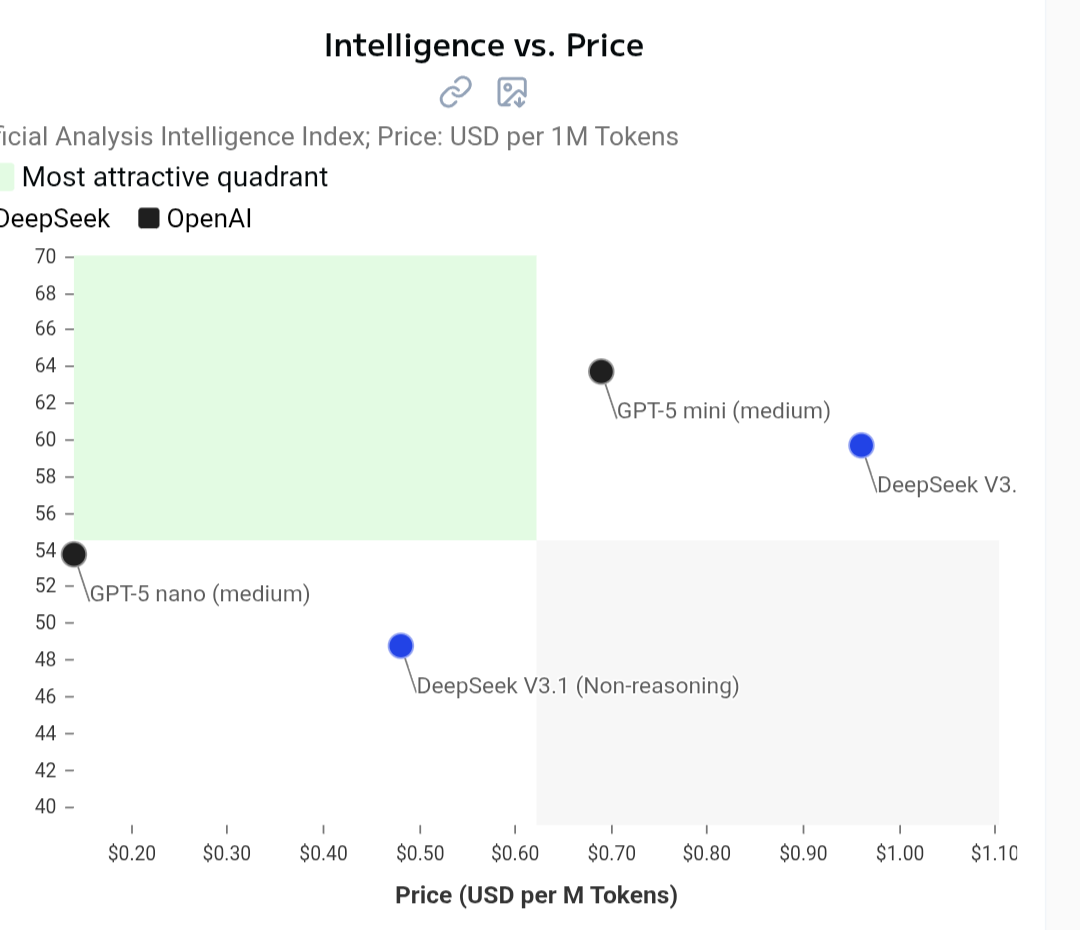
Deepseek v3.1 just about compares to the low end OpenAI models in performance, while also being more expensive. The exact numbers would depend on which benchmark you use, but e.g. the ArtificialAnalysis composite looks like:

Sure. But note that the same companies was already at $150B capex before the AI boom. Unless you’re saying that all non-AI datacenter spending has stopped completely, you don’t get to count all of that $400B as AI-capex. Some spending probably moved, but it can’t possibly be all of it.

I see four problems here.

  • The $40B depreciation cost is inflated as per previous paragraph.
  • The actual revenues are being underestimated. That $15B-$20B estimate would be basically just cover OpenAI and Anthropic. A huge proportion of the capex spend is for public clouds building compute being rented out. Everything said on e.g. earnings calls suggests that they’re basically fully sold out.
  • In addition to the actual revenues being underestimated, there’s the reality that consumer-facing AI apps are not being monetized very aggressively yet. And we’re not talking about some speculative effort to sign people up for expensive subscriptions, but just ads-based monetization of free users. OpenAI would easily make a minimum of $20B/year more just by showing ads on ChatGPT, probably $40B/year. Heck, the entire $250B/year Search ads market is up for grabs for maybe the only time in a generation. That opportunity alone is enough to justify all of this spending and more.
  • There’s a lag between the capex and the revenue. In a steady state that doesn’t matter, but this appears to be a market growing at 2x-3x in a year. Basically the AI revenues for this year are being generated with the capex from 2023+2024.

When the first step of the analysis is this detached from reality, it’s pretty hard for the conclusions to make sense.

4 Likes

Thanks. I read an article about it. I am not sure what benchmarks they used. Not sure what to make of it.

It said 90% of GPT5 performance, 1% of GPT5 price.

I think Deepseek is hell bent to commoditise LLM market.

1 Like

What I’m curious about is how an AI bubble pop would impact the real economy. Most of the investment seems to be NVidia GPUs, and given the margins NVidia has I’d expect most of that to be returned to shareholders, not jobs directly, and datacenters after being build also dont require a ton of people.

Of course the stock market will tank for a bit and spending in richer households will take a hit, but if it is just that it is probably overseeable?

1 Like

The stock market tanking in could lead to households spending less (as they don’t feel so rich anymore) sparking a recession. At one point, people were leveraged long into stocks. Not sure whether that is still the case.

1 Like

Hello, since there are no DMs in this website (or I’m blind and didn’t see them) I send you a message here. A while back you mentioned :

“““

I remember (no guarantee if correctly) few cases related to that law I read about when I searched for it. But none of them in the line of “but it’s the law”.

1 guy went against the tax office, because they wouldn’t accept his full buy-in while keeping his VB account. He eventually lost (not in the first round, though), i.e. he couldn’t deduct the full buy-in

The others were in connection with receiving welfare, and something with divorce and cashingout. Don’t remember the outcome

In my amateur understanding, the law is meant to prevent cases like the first, as they have negative tax consequences.

If you declare any vested benefits when doing buy-ins, I guess you are still acting in the spirit of this article.

Also, note the same law mentions the possibility to not transfer, respectively to transfer in and partly out again based on the regulation of the fund.

“““

I wonder if you had the source about the “guy who went against the tax office”. Haven’t found jurisprudence about it. In which language was it ?

Thank you a lot :slight_smile:

I’d love a link to the article if you can remember where you read it, because the claim about pricing is blatantly wrong.

You can check the Deepseek pricing here: Models & Pricing | DeepSeek API Docs

And the GPT-5 pricing here: https://openai.com/api/pricing/

That’s not a 100x difference in price. It’s not even 10x. That’s true whether you look at the current Deepseek price list, or the one that will go into effect in a couple of weeks.

The “90% performance” part claim is tricky to evaluate. You can mostly use benchmarks to put models in order, but statements like “10% better” are meaningless for almost all benchmarks, that’s just not how their scoring scales are set up. It’s like saying that 2 degrees celsius is twice as hot as 1 degree.

The cost of extra performance goes up fast, and there is definitely a sweet spot for price performance. If the only models in the world were GPT-5 and Deepseek v3.1, there are probably people for whom the extra performance was not worth the extra cost. But they are not the only models, OpenAI has multiple sizes of GPT-5 available at different costs. There is one that costs about the same as Deepseek v3.1 and performs better, and one that costs substantially less and performs worse.

You could just as easily spin this as GPT-5 nano providing 90% of the performance of Deepseek at 1/5th cost.

That might be their goal, but if so, they are not making any headway on it. They are farther behind than they were in January despite being the latest major lab to release a new model. The pricing change they announced with v3.1 is an equal amount of price increases and price cuts.

2 Likes

DeepSeek were previously way ahead on price performance. But they have steadily raised prices. OpenAI have also cut prices so on the pricing front, things are much closer than before.

These firms & their investors expect the following to be likely over the next 5-10 years:

  • AIs that are equivalent to remote workers that can automate 80%+ of current white collar jobs
  • AI Labs are able to retain a significant moat

They are not expecting most of the revenues to come through ChatGPT subscriptions.

To decide whether these investments make sense, you need to focus on the probability of AIs truly reshaping the economy, the ability of the current firms to profit from these changes.

I don’t think the answer to any of this is obvious at all, but focusing on comparisons with MS Office is deeply misguided.