I am wondering - why this deal was even made. Perhaps there is a plan to rapidly expand US LNG exports. But this would seem to be going completely against Circularity & Climate topic.
No. It was defined. At least in the framework.
Both these numbers are meant to be achieved during remainder of Trump‘s tenure. More or less 3 year period
I think 750B was clearly outlined by EU president in her press conference. She said their estimate is 250 B per year to completely eliminate Russia as supplier
The 600b (investments) is mainly being mentioned by US team and was not part of UvdL press conference
Might have been the smart thing: get 15% (incl car and pharmaceutical) and 0% on 70B. Promise something they won’t do anyway because it’s outside of their control (China did something similar in first term).
Then see what happens, if the purchase/investment won’t happen that will take a few years for Trump admin to react and at this point the focus might be elsewhere.
And FR/DE get to blame Brussels in the meantime which is good for internal politics (even so they were also the ones who didn’t want to go nuclear on retaliation).
2 Likes
Interesting. I really think Europe needs to stop relying on exports driven model for future. Both US (due to extortionist approach) & China (due to local competition) will become tough to deal with and compete.
Only thing i can think of is to use Digital services as growth engine for EU. consumption is already there, but production is not. So if regional industry can grow, that can help with job creation too.
Some market analysis: EU-US Trade Deal: A Damage Limitation Success
(and they’re right to point out they avoided all the worst stuff from April, VAT/food regulations/auto and pharma tariffs/etc)
3 Likes
ChatGPT says that the few countries who’re not particularly reliant on exports for their GDP are the US, Brazil, India and Nepal. The first three because of big internal markets, the last because it relies on remittance.
Under reliance on exporting (whatever it may be, including services and tourism) is something I can’t get my head around, as I feel that international trade is necessary, otherwise one is operating in a closed loop where they can endlessly recycle money between govt and population but nobody is getting any richer (growth, you mentioned), but I am aware I am not sufficiently knowledgeable.
You can have a closed loop ecosystem (I mean earth is one, right so a big economy could probably be as well as long as they have access to the right natural resources).
It’s more that we’re a lot more productive the more global and frictionless trade is, then every part of the world can leverage what they’re good at and specialization makes things more efficient. Do we need 20 countries knowing how to make airliners? Should every country manufacture every single drug? Every single chemical compound, etc? (so you probably want to balance things out, but e.g. US/EU was already balanced anyway, now we’re just adding friction)
1 Like
Yes, I get it and agree with you, I think I get a hold-up because in my simple mind when I remember that energy is conserved in a closed system given Newton’s laws of thermodynamics - I am not trolling - whereas in economics and finance (not sciences) money can be created out of thin air, so the ecosystem balance doesn’t have to be zero.
1 Like
Export driven economic growth is typically used by smaller countries. This was pioneered by Japan which was later emulated by South Korea and Germany too. Later China also took advantage of this model too.
The challenge with this type of growth is that it depends a lot on other economies. This is why countries with large population are better off with consumption driven economies in long run.
I can understand that Germany prefers to be exporters but this also concentrates the knowledge in few sectors. At an European level, I think given the large consumption base, EU can be self reliant and have a net trade balance = 0. Of course you always need to import what you do not have.
4 Likes
For the record, as I’ve been pretty vocal that ex-US, ex-China was the future of investing for me. The deal between the US and the EU signals to me that the US can stay a viable economic power and that other countries aren’t banding together to reorganize trade outside of them.
ex-US countries are probably searching for alternative trade partners but are still competing for access to the US market doing so, so are going at it from a competitors mindset rather than a truly collaborative one.
I no more consider the US as a direct investment risk by themselves (their economy is still probably going to suffer internally but global trade is less likely to end up upside down in my view) and would consider global market cap weighting not riskier than ex-US investing from a purely investing standpoint.
Not that my opinion matters at all in the grand scheme of things (and not that it has been especially right in the past, which it hasn’t) but I wanted to correct my apparent stance on this forum as it has shifted.
6 Likes
There’s nothing to correct  opinions change.
4 Likes
The two versions of US - EU trade deal
1 Like
Supply chains takes decades to change.
They will have to change anyways. EU & US will continue to lose market share in global trade as economic growth is higher in other areas. But in short term I wouldn’t expect much change.
Having said that trade deals are mainly for show, they don’t impact US economy that much because main economy is services.
What is yet to be seen is will US companies be preferred partners 10 years from now or they will seen with same suspicion as people look at Chinese companies today (state control, suspicious, etc)
1 Like
Apples and rocks, the US govt is not the Chinese govt, and Americans are not Chinese, there’s a cultural element to this which makes me not agree with this statement. Everything was fine with Biden, I wasn’t investing during Trump 1.0 but I believe it’d have made mainstream news. Everything was fine with all previous POTUS, it’s just Trump and his moronic ideas.
Who knows, maybe the tariffs - more likely the extortionist practices for other countries investing in the US in return of lower tariffs - will actually do some good to the US. If that’s the case then the next US admin will have to decide if it makes sense for them to keep whatever Trump set up given they won’t have its/his taint on them, or roll them back. My money is if there’s any sort of benefit to the US they will just carry on and call it Operation Paperclip 2.0.
My comments are based on what I see now.
In few years if things change, it would be better for everyone
But for now - I would not trust US to have access to my data (for now not much alternatives) and I am not buying American cars rest I anyways mainly buy locally
And who can confirm that VD Vance won’t win next elections
2 Likes
It was not an attack, just a counter opinion, hope it didn’t come off like that because it was not the purpose.
Vance, seeing him in that charade of a meeting with Zelenskyy, gives me school vibes of the guys flocking around the big bullies, who turn to sheep when on their own. Trump is taking a one man show plus bootlickers/sycophants approach, these setups historically scatter when the big boss is out of the picture because they derive their power from him, then there’s a frantic fight for power.
1 Like
I don’t see this as an attack
I think we both have different assumptions
- you are of opinion that current political regime and views in US are a passing phase and we shouldn’t extrapolate this to future.
- I am of opinion that past doesn’t matter, what matters is what’s happening today. For me to think different about future US policy, I need to see real change in real time. For now I am not seeing it. All I am seeing is that the great democracy is simply becoming an autocracy. Hopefully this gets corrected before it’s too late
As you know, 50% of my equity portfolio is linked to US stocks. So I really want US to be like the one from past instead of its present state. Let’s see what happens
1 Like
Yes, I do think (and hope) the current shift is a passing phase
On the second point, policy doesn’t change overnight. Not really, unless there’s a radical change in government, and for it to be so radical it most often needs to be undemocratic because people don’t change overnight.
Trump is behaving like an autocrat indeed, and this caters to some of his supporters, but I still firmly believe in the American separation of powers as set by the Founding Fathers, people who understood democracy and statehood better than most. Sure there’s erosion (eg with the SCOTUS) but the concept is that if one of the state powers breaks/weakens, the others won’t break at the same time.
For that to happen you’d need a strongman cancelling the existing laws and basically purging everyone and replacing them with puppets, as it’s happened in many countries/nation-states from antiquity. Not saying it’s impossible, just improbable for a country like the US in the current era, in my opinion.
I feel any country with reasonably developed state functions (ie, literally most of the countries on earth) can’t be changed so radically in a peaceful way. Thinking of Russia and China, for instance, pre- and post-WW2 respectively, where new state power structures were (re)created after civil wars, and the leadership DID abide to Soviet and Chinese laws - it’s just that they made laws to enable them to do what they wanted! Even Hitler did it democratically.
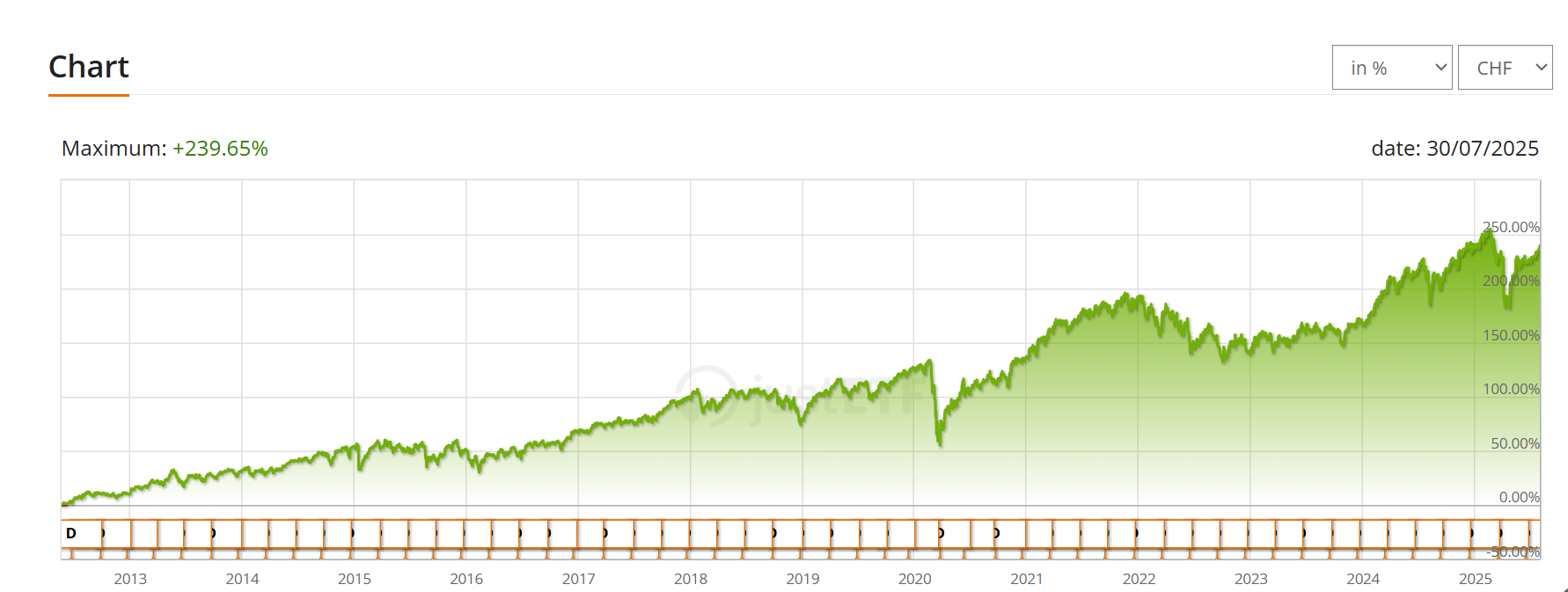
On topic, I had a look at VWRL’s chart in CHF on justETF this morning and had a thought precipitated by “when it doubt, zoom out” that the Liberation Day stuff is a non-insignificant blip even in the long scale. We’re getting reasonably close to breaking even in CHF! I also tried to remind myself what happened in July 2024 as I didn’t even remember that fall, and failed 
Trump has extended the tariff break with Mexico for 90 days. TACO indeed!
2 Likes
Is that why my TQQQ looks like a U today?!
Oh well I’ll take it
Edit: or not