You do realise that Rolex can easily sell watches for 20% more and nothing will happen to their sales . They don’t do it intentionally
I friend of mine is massively into watches, he’s saying that based on prices in the grey market Rolex could literally charge double, increase production by 10x and still run out of stock in minutes.
1 Like
Yeah maybe after COVID-19, where the big price spike was but not today. Watch Market Index | WatchCharts
Thanks for that info. I actually never did dig too deep, as I almost pay no taxes since I stopped working. I calculate the performance of my investments net of tax and debt interest. As long as private capital gains stay free of tax I won’t complain…
However, it is not exactly fair. As I own two pieces of real estate and have to pay fictional income tax for that it seems to me that I should be able to deduct the interest at least until it reaches the fictional taxable income. Maybe they did that, too lazy to check…
Rolex didn’t increase prices (too much) even then
Other watch makers like Omega did
Rolex & Hermes have a different pricing strategy. I think they never want their customers to feel that they could have got better deal somewhere else or if they waited a bit.
Hence no discounts , no price cuts, only reasonable price increases and second hand market is always higher than primary for these brands
Other folks like Omega, Gucci etc are slowing falling victims of short term management
@Mirager
I don’t think Rolex can boost production so much. That will not be good for their brand in long term. You might want to hear the Rolex podcast on acquired. I really liked the story of how Rolex survived Quartz by taking learnings from Blancpain
It’s my usual hyperbole for emphasis.
Thankfully even though I’m not mustachian I have fairly cheap tastes and no interest in watches.
July deadlines are not critical. Whoever thought tariff drama will be over before @Mirager comes back from Greek island vacation might need to change their thinking 
And looks like Bessent is killing Section 899 too.
3 Likes
Uhrenbranche in der Flaute: Rolex drosselt – Hoffnung im Streit um US-Zölle
Translation and emphasis courtesy of Gemini.
Swiss Watch Industry Under Pressure: Rolex Slows Deliveries
Demand for Swiss watches isn’t picking up. There’s also nervousness due to trade conflicts, but State Secretary Helene Budliger remains optimistic during an appearance.
Andrea Martel, Lausanne June 27, 2025, 5:30 AM 4 min
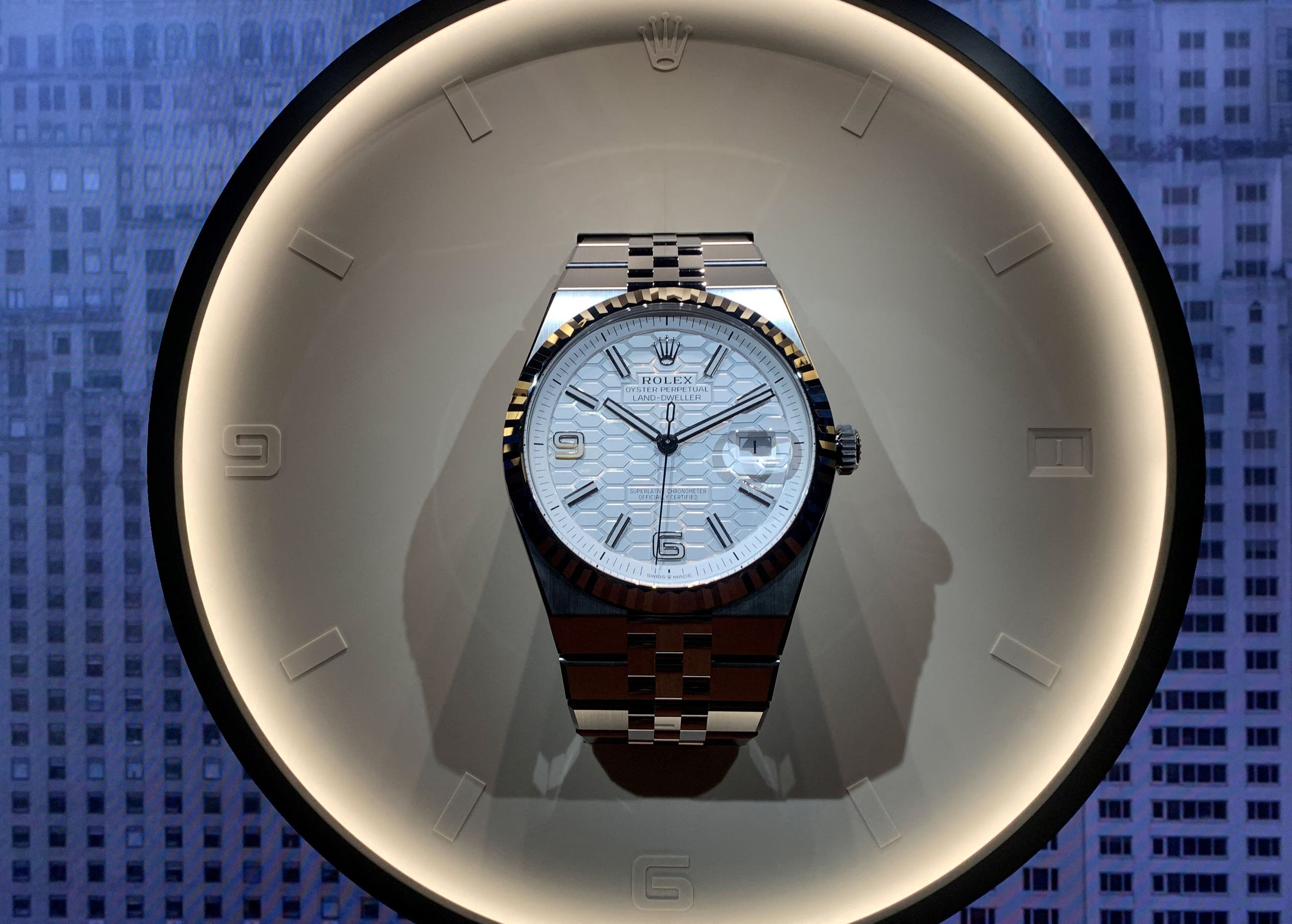
Even the new Rolex Land-Dweller model will arrive in stores in precisely measured quantities. Cecile Mantovani / Reuters
The information carries weight: Rolex is currently delivering fewer watches. This hasn’t been officially confirmed, but dealers across multiple markets consistently report noticeably lower delivery volumes. Not because shelves are full, but to prevent them from becoming so. There are still waiting lists for many models, but no longer for all of them.
The Geneva-based manufacturer, the epitome of controlled brand management, is reacting to a market environment that has been weakening for over a year and a half, and to an increasingly unpredictable international situation. Besides subdued demand, political factors like potential US punitive tariffs are also causing uncertainty. Before individual dealers can even think of offering a Rolex below the list price, the company pulls the emergency brake and restricts supply.
This step not only shows how carefully the leadership of Switzerland’s largest watch brand operates; it also potentially reveals more about the industry’s condition than official statistics do.
Export Figures Paint Too Rosy a Picture
Export figures have been stable since the beginning of the year. In the first five months, Swiss watch exports were up 1.1% in value compared to the previous year, following a 2.8% decline in the full year 2024.
However, this development only incompletely reflects the actual market situation. Yves Bugmann, President of the Federation of the Swiss Watch Industry (Fédération Horlogère, FH), points out that without the United States, a significantly more negative picture would emerge: exports would have shown a 4% decrease.
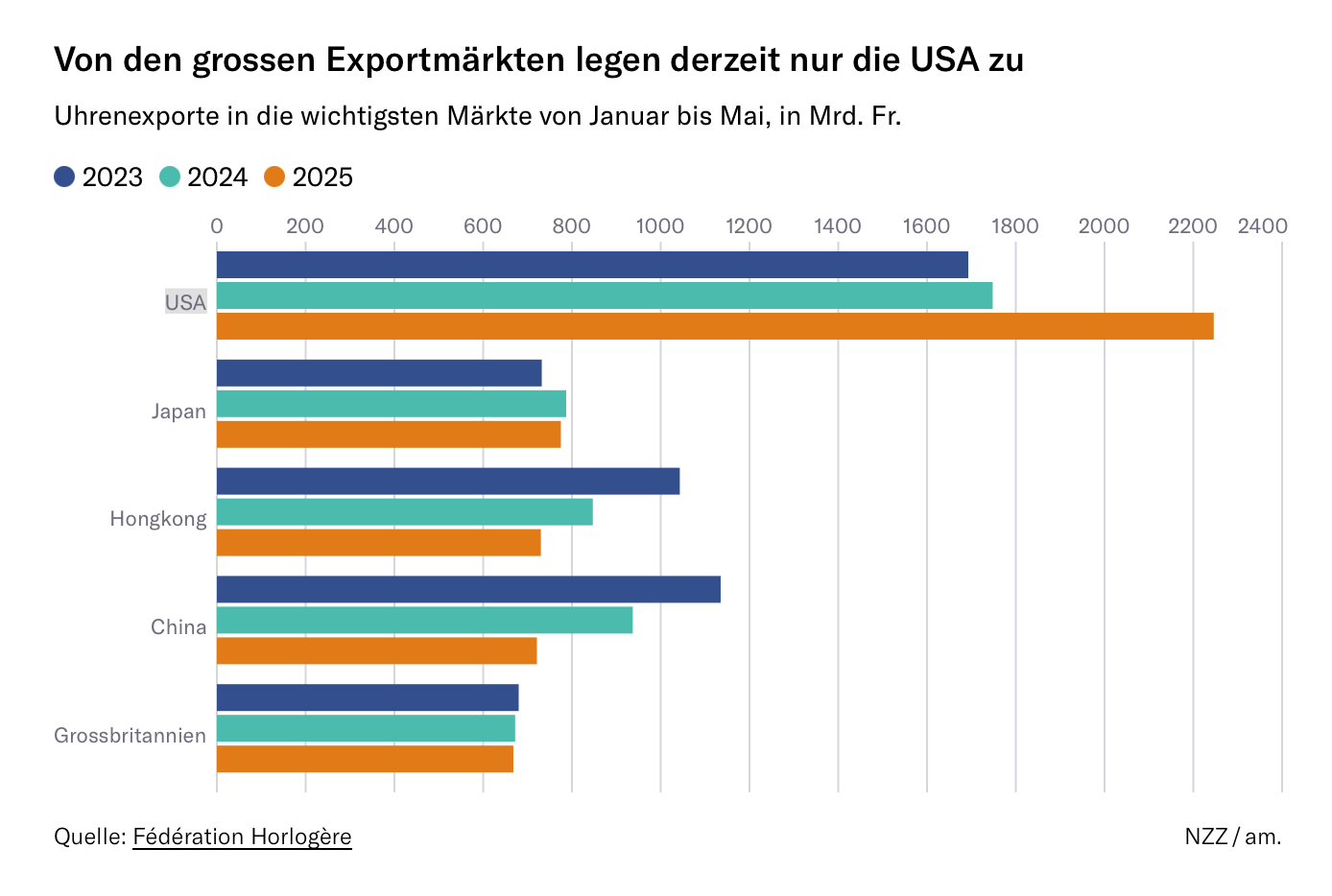
Figures from the USA, in particular, distort the overall picture. Exports there have risen by 28% since the beginning of the year. However, Bugmann warns against interpreting this increase as a sign of strong demand: “This figure does not reflect the actual sales situation. Warehouses in the USA were filled as a precaution against political turmoil.”
The trigger was US President Trump’s announcement on April 1st that punitive tariffs of 31% on Swiss exports would be introduced within a few days. The industry reacted immediately, delivering large quantities to the USA ahead of schedule to preempt the impending surcharge. In April, exports surged by 150%, followed by a 25% decline in May.
Among Major Export Markets, Only the USA is Growing
Watch exports to key markets from January to May, in CHF billions
Switzerland in Pole Position for Negotiations with USA
Indeed, there is nervousness. A deadline expires in Washington on July 9th: according to the Trump administration, anyone who hasn’t reached an agreement with the USA by then must expect “reciprocal tariffs”—in Switzerland’s case, this could be up to 31%.
However, Switzerland is well-positioned. This was stated by Seco Director Helene Budliger Artieda at the General Assembly of the watch industry in Lausanne. The State Secretary expects Switzerland to be among the first countries to conclude an agreement with the USA—“number two or three” after the United Kingdom, which has already signed.
One shouldn’t be too euphoric, though: “You don’t negotiate a free trade agreement in 90 days,” Budliger said. There will be a fundamental agreement, but not a legally binding one, and certainly not one with duty-free delivery.
Instead, Budliger expects an overarching tariff rate of around 10%—though with more targeted exceptions than today. “I can’t give a forecast,” she said, “but I dare say: We will not fall back to 20 or 30 percent.” Those who need to make calculations now should factor in around 10%—in addition to the 3.2% that already applied to the watch industry.
Such an agreement would be worth gold for the Swiss watch industry. The USA is by far the most important sales market, now accounting for one-fifth of exports. The industry could cope with an additional 10% tariff, as confirmed by various companies the NZZ spoke with, who wish to remain anonymous.
China and Hong Kong in Free Fall
America is currently the only driving force. While markets like Spain, India, or Sweden have also shown significant growth in recent months, it’s at a much lower level. Only the USA has the potential to compensate for the weakness in Asia.
In China and Hong Kong, traditionally important markets for Swiss watches, the trend continues to plummet. Between January and May, exports to Hong Kong fell by 14%, and to China by as much as 23%. The previous year looked barely better. Since the beginning of 2024, declines total minus 43% in China and 30% in Hong Kong.
FH President Bugmann sees no short-term recovery. Demand is subdued, and that won’t change quickly.
Apparently, Rolex shares this assessment. Not only the industry leader but also other brands in the high-price segment are acting cautiously, preferring to deliver too little rather than too much. But the fact that the market leader, of all companies, is deliberately applying the brakes makes it clear: the crisis is not yet over.
1 Like
I read this as that the whole tariff show is over, actually.
I’ll look but if you have a link it’s be great.
So, exactly like oil industry 
1 Like
3 Likes
I don’t think they are immune to general developments, but they are very good at managing their brand, supply and demand. Also not chasing short-term profits and instead thinking longer-term with no shareholder pressure (its owned by a charitable trust) helps.
This might be interesting
There is a proposal by Ted Cruz to abolish Fed interest accounts for banks. This would mean banks would need to move money from Fed interest accounts to US treasuries.
So this artificially increases the demand of US treasuries and reduces the cost of Fed expenses because interest is a cost element on their P&L. This saving would artificially reduce govt expenses too. Increased demand for US treasuries can push interest rates down.
In reality money would move from Savings account to US Govt Debt.
Aren’t central bank liquidity facilities a cornerstone of the financial system? A small grip in treasury market (banks would need to use very short term ones, not long dated treasuries, so not even sure how that helps with financing debt) could have very large consequences.
1 Like
I think they are not talking about removing liquidity provisions. It’s just about the interest paid on that money
It seems the plan here is to balance the budget on paper so that Flagship bill can be passed
How can politicians publicly make incorrect statements without facing widespread criticism? These accounting tricks don’t solve anything.
“Federal Reserve Chair Jerome Powell explicitly stated that ending interest payments would not save government money. The perceived savings are an “illusion” because the policy shift would not reduce net fiscal costs. Instead, transitioning from the current “ample reserves” framework to a scarce-reserves system would require years of volatile adjustments, disrupting monetary policy effectiveness.”
“Powell emphasized that ample reserves—a post-2008 crisis innovation—ensure banks can lend during economic stress. Forcing a return to scarce reserves would increase systemic fragility, as seen in pre-2008 liquidity crunches.”
“The American Bankers Association warns that ending interest payments would act as an “implicit tax” on reserves. Banks would face higher funding costs, reducing their capacity to lend to households and businesses. This could constrain credit access without improving the budget.”
Long-term Impacts of the One Big Beautiful Bill Act | The Budget Lab at Yale
Powell: Proposal to end Fed interest payments to banks would be ‘challenging’ | ABA Banking Journal
The Fed Should Stop Paying Interest on Reserves | RealClearMarkets
TL;DR The financial policy effectiveness would be greatly reduced combined with probably higher volatility.
2 Likes
Not everywhere people can challenge the government officials. They can have serious repercussions
I think in the US they could, but they face challenges with the computing capacity of the device between their ears.
1 Like
But interest management is also the whole point of a central bank  how would they influence the short term rate without it?