At the time I didn’t have any strategy other than feels, with big and documented (in my own hands) opportunity cost. I don’t consider opportunity cost money lost (possibly another massively naive stance), I only consider money lost when going into absolute negative values, which hasn’t happened to me yet.
To be honest I still don’t have any strategy for selling as, and however naive this may sound, selling is something I find very stressful regardless of whether the market or a position is going up or down, so my long-term plan is to transition to a model of never ever selling and relying on dividend growth and monetizing movements by trader-for-hire AKA covered call funds.
All these posts could be moved to another thread though as they are not about stock picking.
Well there’s nothing wrong with “selling after gains” itself,
it’s risk management (since you don’t know the future),
and more a matter of “how much” (close position or just part of it).
I personally trimmed my (what I see as a small personal betting, very lucky) PLTR position as I reached certain thresholds,
returned 2-3x my original investment,
but now letting it run without caring much where it goes.
(I know it’s also partially just psychology / mental accounting).
And of course I have thoughts of “oh but what if I didn’t trim it, I would have way more now” - but fully aware I’m more content with eliminating any loss vs. keeping the potential of twice-or-so the gain.
(In any direction not life-changing amounts)
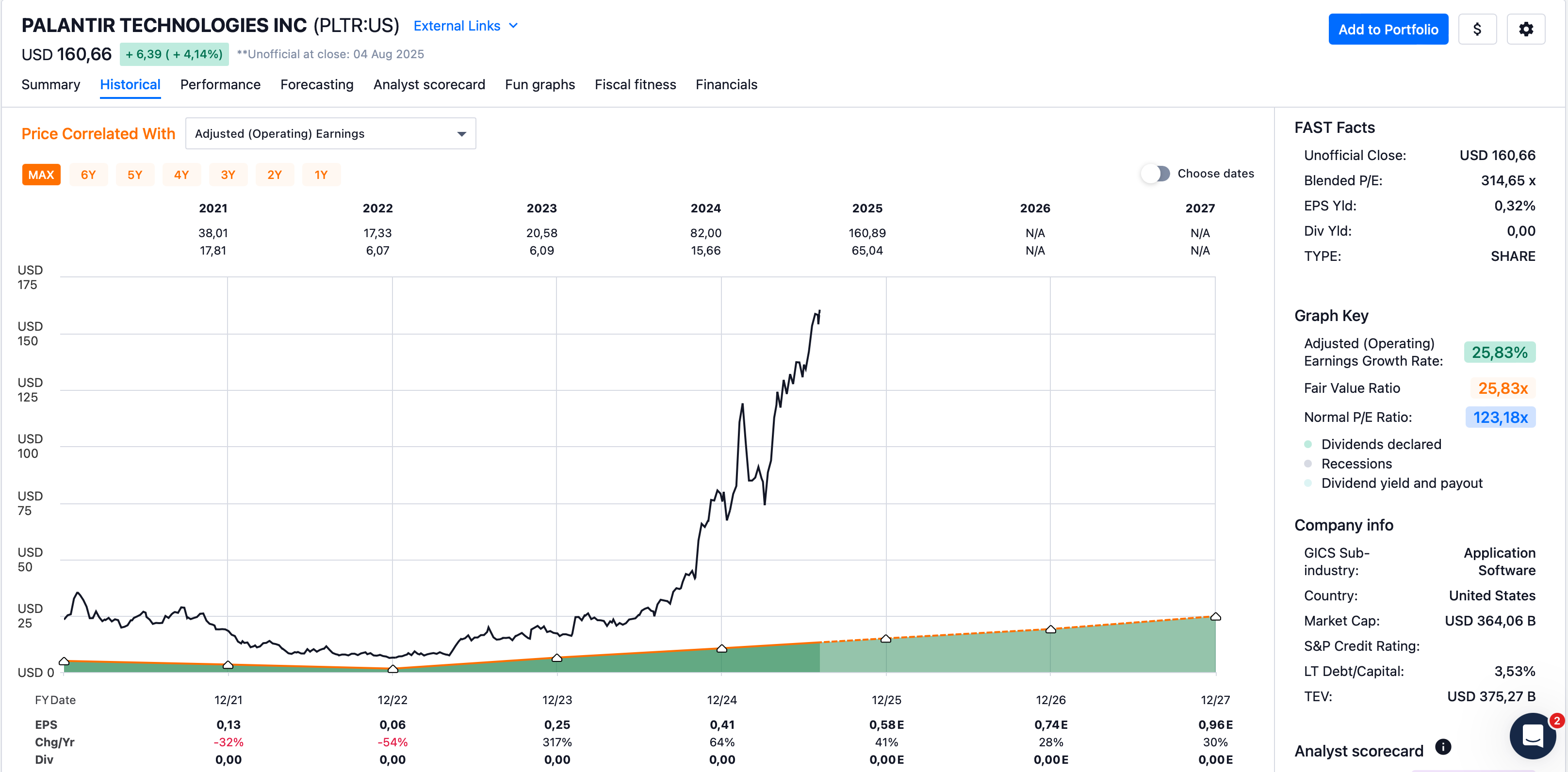
Currently at ~2000% gain (thanks to FIFO),
struggling to keep it below some of my smaller ETF positions.
Not sure I will be selling it any time soon,
as I am firsthand convinced they have the absolute best product on their market.
(Which of course doesn’t mean the stock will perform as good)
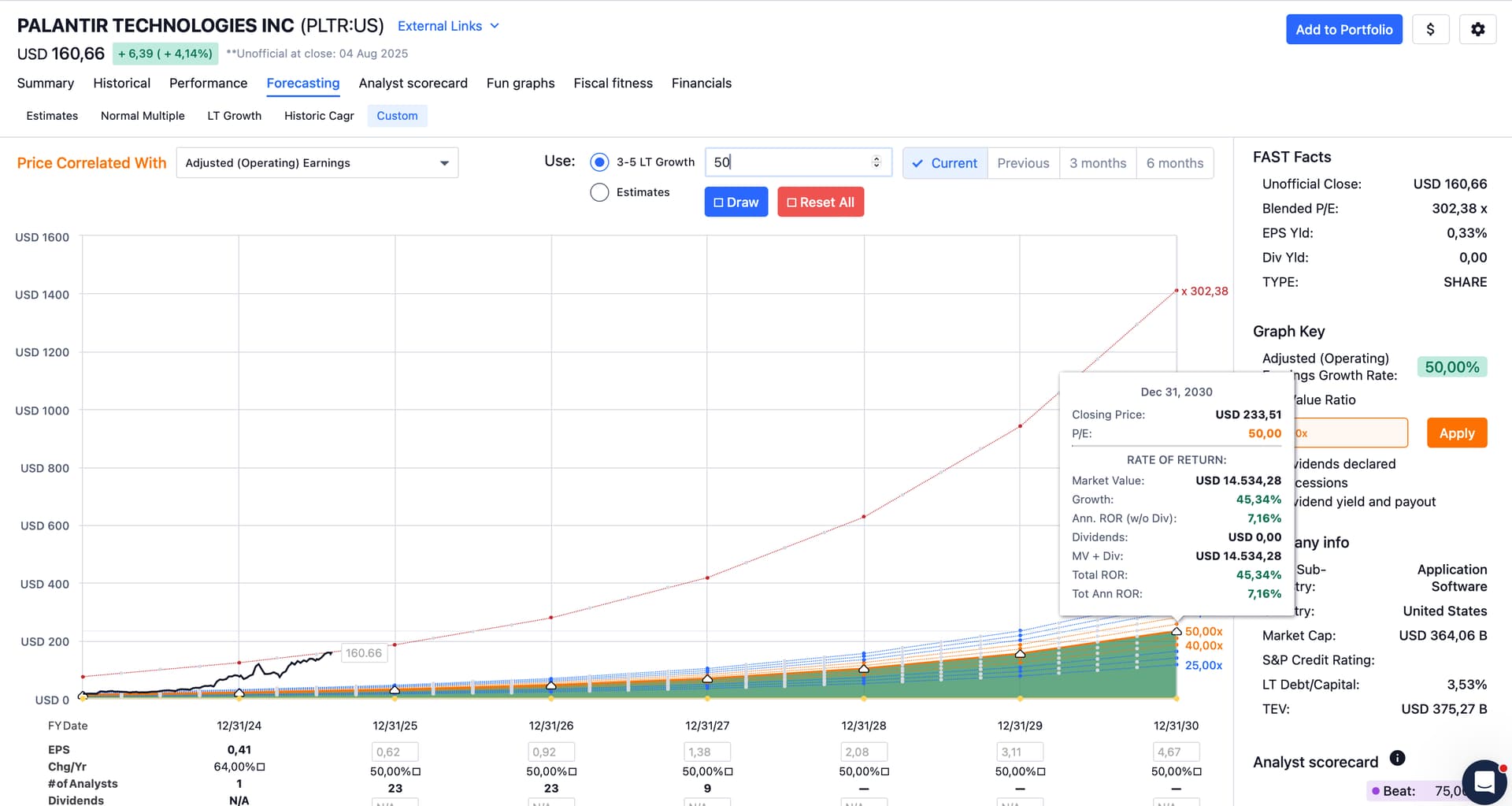
I went into the forecasting tool within FASTgraphs and modeled 50% annual earnings growth going forward (warranting a 50x P/E as the “fair” / orange line):
If the price returns to the “fair” 50x multiple, this results in a CAGR of over 7% at the end of 2030!
You basically can’t go wrong with this one …
Edit:
I’m similar with my AVGO investment, but I can’t bring myself to letting it run as the mental accounting in my head calculates “sell another tranche to exchange the 0.79% cash flow (dividend) it generates into 4 or 5 times that with a different company.”
There are some basic practices - not even strategies - which could work due to their simplicity, for example “take out your principal, let the rest run off into the sunset”, as you said.
@anon17469660 I can’t tell if you’re serious of joking
This resonates. For some stocks it is fairly clear to me what kind of trigger there might be (deadlines, expected upside, risk reduction), for others it is just buy and hold. The third group is most difficult for me: some losses already incurred but no plan to sell or to buy into.
Selling was the first thing I did automate. Not the same rules for every stock, at least at the beginning. Now I have a rule per strategy.
I found for myself that it is extremely difficult to stay objective once you own a stock. The risk of behavioral errors is just too big.
In my dividend strategy I sell when the defined rules for those stocks are not fulfilled in the last yearly and quarterly data and the stock is in the lower half of momentum.
In my momentum strategy I sell whenever I need the money for a new stock. For that purpose I rank all the stocks that are not on buy and are with me for more than 6 months, then I just sell the worst of this list.
Sometimes I hate what I have to do because of this rules. But in hindsight it was always a good compromise.
Buy-n-hold is nice and a good and simple strategy. But probably every company that ever existed for a long time did eventually go bankrupt. No need to stay and to lose, better sell when the risk rises.
There are probably endless possibilities to calculate momentum. As there is no perfect solution I take an easy one: I subtract the difference from the high to the actual price from the one year performance. Of course in a spreadsheet.
Remember: it is not the momentum strategy, it is the dividend strategy. Momentum is just used so that a trending stock is not sold just because it got a bit expensive.
I think selling is still on topic here; you need to pick what to buy and you need to pick what to sell. In my case a algorithm does both.
Mit dem Lesen und der Teilnahme an diesem Forum bestätigst du, dass du die Forum-Richtlinien gelesen hast und damit einverstanden bist sowie den Haftungsausschluss auf http://www.mustachianpost.com/de/ akzeptierst.