Bought HNST today as well, I either expect the competitors to buy them out or the share price to increase to USD 10-14.
Regarding EL; I bought ELF some time ago, instead. Might reevaluate EL this weekend.
Bought HNST today as well, I either expect the competitors to buy them out or the share price to increase to USD 10-14.
Regarding EL; I bought ELF some time ago, instead. Might reevaluate EL this weekend.
Anyone bought elevance health? Looks underpriced.

Just checked, bought in January 2024 at $3.12. As I said, quiet a roller coaster ride.
Was bought for my mechanical momentum strategy. I try to publish transactions near-time in the mechanical strategies thread. Hope I can hold a long time, but I just do what my capt’n (my mechanic) says…
Elevance does not look expensive now, that is true. But it seems to be on the way down. I usually wait until it starts rising. It is kind of a tightrope walk; I want it to have momentum, but I still want it to be kind of cheap.
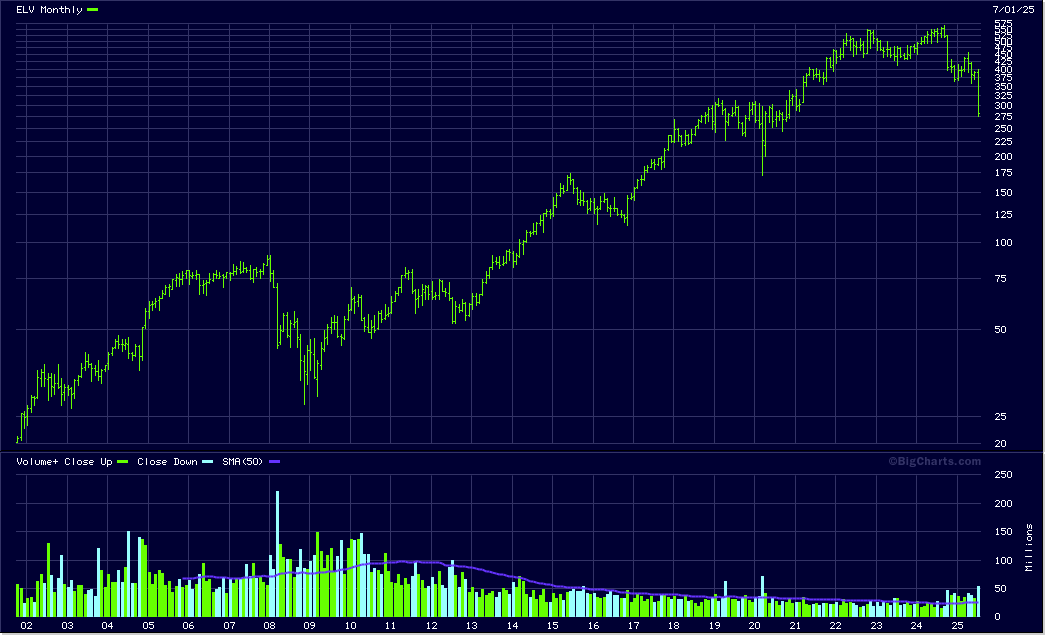
The long term chart shows that it is quiet common for the stock to take such dips:
I bought. Take that as a warning 
The hell with Novo?!
How Novo Nordisk lost its lead in the weight loss race
In short Lilly has better products and better strategy at the moment.
I know the space very well, actually work on it
Can recommend the book “The world for sale” by blas and farchy. This and many other interesting stories from the commodities world are featured.
Bought yesterday aftermarket and today after opening.
In my eyes, it is hefty undervalued. And if I’m wrong, it generates at least nice dividends, haha
Then you tell us! 
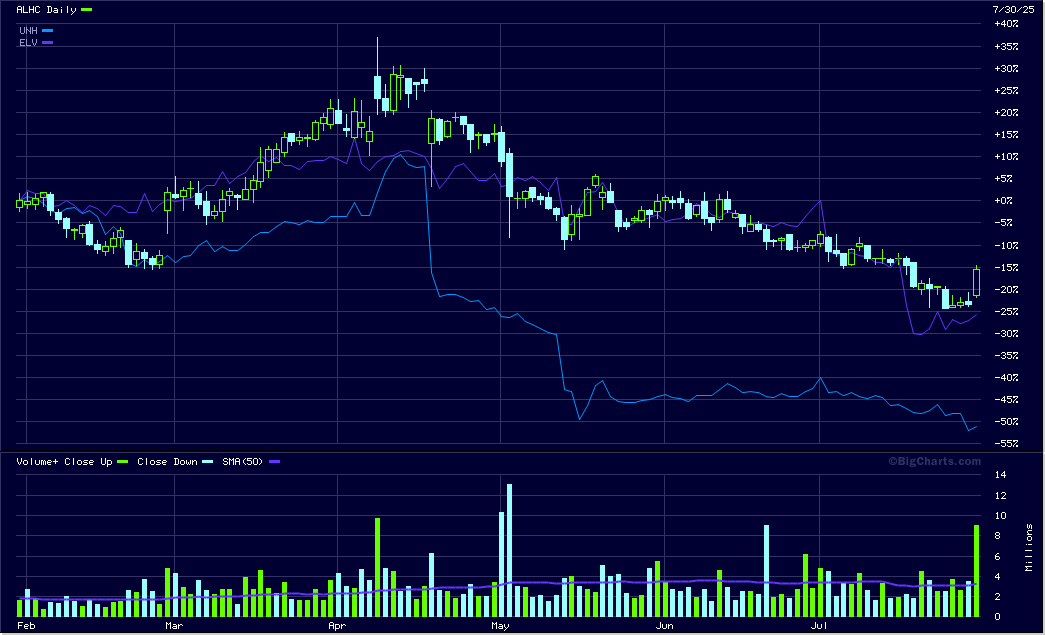
Alignment Health Care, one of my momentum stocks, made 30% yesterday on good numbers. Comparing with the other two health insurance stocks discussed here lately it seems that UNH has left the path while ELV moves quiet similar to ALHC, just the latest lift is still missing. They report their next numbers in October.
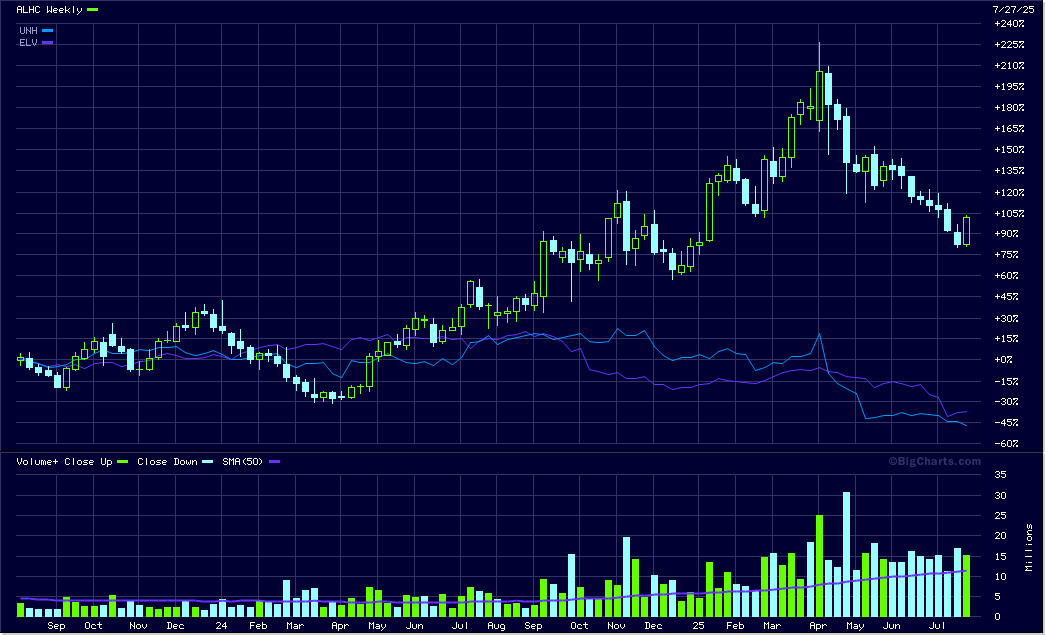
One way I like to look at charts is comparing. UNH is way off, more than sector problems it seems…
I think cutting medicaid and medicare will help those stocks in general. But the question is what they do with it. Alignment spent quiet some money on ads, especially for the ever growing Spanish speaking people.
short-time chart comparison:
Now, long-term one can see why I prefere Alignment:
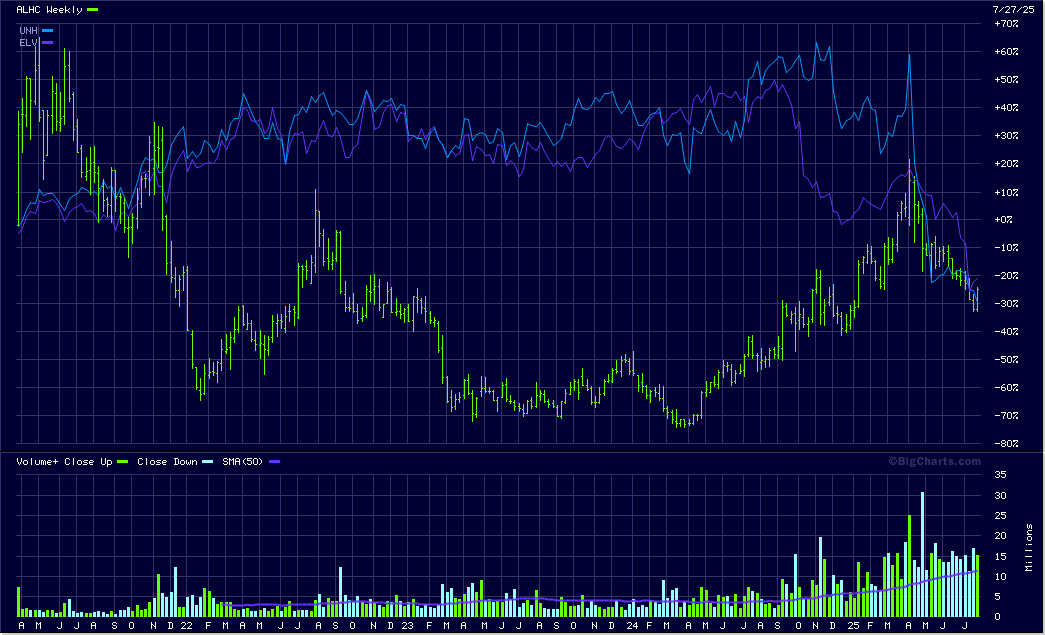
At the monthly chart one can see that the momentum probably was just a comeback:
According to the “undercover economist” this sector is doomed anyhow. But why not take a slice when there is some money to be made…
Addentum: the ad with Louis Miguel:

BTW: most of the rise occurred after market close, so it is still not visible on the charts.
Actually the arguments from the undercover economist are quiet good: there is an information deficit for health insurers, because every person knows his health situation himself better than any external place. So it is a losing game for insurers.
But then over a period of 30 years only a very little percentage of stocks make money at all. Most of the companies just go bankrupt, that is the way of the world, death and birth. The 2% best stocks made always up for that in the past.
But for me that means I don’t do buy-n-hold, I do “hold as long as possible, but not longer”. A small but important difference. Otherwise I could never invest in like healthcare insurers or even utilities (because of their cash flow situation).
BTW: I always say “I do”, but actually it is my captain, the mechanical investment strategy, that does.
One of my favourite books, literally changed the way I see the world!
How is Novo Nordisk Fast Graphs looking like? Forward P/E looks interesting
Finance stocks are difficult in that field. Their trading good is money, so investments are not always clearly investments in my sense. I usually try to filter out all business activity that is not like an investment into the business infrastructure.
MET looks still OK to me, even the free cashflow (the investmets) are difficult to identify. I think I did use only “other - net” of 173 millions as of last year.
I hold Metlife for many years, over a decade I think, loaded up a big chunk in 2020 at $27.20. Hope to be able to hold much longer…
How do you guys calculate the investment cash flow of finance stocks?
Anytime, buddy.

So, IIUC, with your idiosyncratic background (and the flying broom just now), you’re basically issuing a “strong buy” (“broom level” buy) on this one?
Did I get this right?
Quite honestly … I was going to say “above my pay grade”, but that would really be a euphemism for saying “I don’t know at all”. So, I really don’t know.
Long term, I believe even financials (and their stock price) bend to earnings’ multiples and (operating and free) cash flow, so while short term things might look like voodoo for some financials, longer term, I feel you can evaluate them like other companies.
Do you have (very) differing thoughts on this?
Yes, I do. Normally free cash flow equals operating cash flow minus investment cash flow. Now if money is the trading good in my humble opinion one cannot call it investment; it is normal business. Therefor I do not count the financial “investments” in the investing cash flow. Probably a too simple view, but I could not find anything better.
They buy a new office complex: investment. They buy computers: investment. They buy bonds: no investment, it is their business.
My view is very simplistic but served me OK until now.
Of course, who doesn’t want a flying broom?!
What about idiosyncratic background  ?
?