Eh you know how it is, going (back) to Bogle will get you performance, going away will give you over- or underperformance 
Sorry, I might be interrupting some conversation. Reading about stock picking, I’m kind of falling for value investing. I read about Warren Buffet’s buying great companies at a cheap price. I realized I needed a stock screener.
I like Quant Investing a lot, as it extended this value approach to the European market and picks stock from the global universe. And it seems to be deeply committed to scientific research and methods. There are several battle-tested filters to support the value approach. Some forum member mention Fast Graph, Finviz and home-made tools.
I have some questions:
- Where do you get the data for the home-made tools?
- What governs your decision to purchase a subscription? Do you reliably make X CHF more by using these tools?
- Other tools you recommend?
Here is an overview of Stock Screeners I created:
| Platform | Stock Universe / Regions | Price / Month | Key Features & Differentiators | Source |
|---|---|---|---|---|
| Bloomberg Terminal | Global, all asset classes | $1,666–$2,083 | Deepest data, EQS equity screening, real-time analytics, news, pro tools, all markets | link |
| Webull | US focus (equities, options, futures) | $3.99 (Premium); Free | Customizable real-time screener, technical filters, low-cost trades, active traders | link |
| TradingView | Global, 50+ countries | $14–$239 | Advanced charting, global exchange coverage, social features, technical/fundamental | link |
| FINVIZ | Primarily US, some global | Free, $39.50 (Elite) | Visual heatmaps, rapid screening, technical and fundamental filters | link |
| FAST Graphs | 18,000+ (US, Canada, some global) | $16-40 | Deep valuation tools, fair value visuals, historic data, portfolio integration | link |
| Quant Investing | 22,000+ global stocks, all regions | €36 | 110+ quant ratios, multi-factor, global scope, backtesting, quant strategies | link |
| Magic Formula Investing | US | free | Applies magic formula “good company” at “cheap price” to US listed equities | link |
| Koyfin | Global, 100,000+ equities | Free, $39–$79 | 5,900+ filter criteria, template screens, global data, export/download | link |
| Stock Rover | US & Canada only | Free, $7.99-$27.99 | Deep fundamentals, portfolio integration, ratings, powerful filters | link |
| Yahoo Finance | Global (US tilt) | Free, $20.83 (Plus) | Intuitive UI, broad coverage, ESG, news integration | link |
| Stockopedia | US, UK, EU, Aus, Global | €60 (EU)–125 (global) | Quant scores, portfolios, analytics, value screen | link |
| Screener.in | India | Free, ₹416 (~$5) | Full Indian market coverage, alerts | link |
| StockEdge | India | ₹250-₹1,999 (~$24) | Technical and fundamental, trading signals, analytics | link |
| TC2000 | US & Canada | $21-$83 | Real-time, interactive charts and screening, built-in trading | link |
| Seeking Alpha | Global | Free, $25 (Premium) | Quant/fundamental ratings, yield analyses, research overlays | link |
| Business Quant | 8000+ US | Free, $19-$70 (by region) | Deep company KPIs, sector/industry analytics, macro/fundamental | link |
| Stock Region | US | $10.99/week; $449.99/yr | Real-time data, education for US retail investors | link |
| GuruFocus | Global | $449 -$1348/yr | Guru portfolios, value stocks, broad fundamentals | link |
| Morningstar | Global (US/EU tilt) | $34.95 | Renowned fund/ETF/equity screener, ratings, research tools | link |
| ChartMill | Global | Free, $25 | Custom quant/technical filters, flexible analysis, portfolio tracking | link |
| StockFetcher | Global (US-centric) | $8.95-$16.95 | Scriptable filters, powerful technical screens | link |
| Trade Ideas | Primarily US, some global | Free, $89-$178 | AI scans, real-time alerts, charting for day/swing traders | link |
| TrendSpider | Global | $51-124 | Charting, pattern recognition, backtesting, automation (trading bots) | link |
| Simply Wall St | Global 120k | Free, $10–$20 | Fundamental visualization, user-friendly, value analytics | link |
| Magnifi | US/Global ETFs & funds | $14 | Investment search engine, AI-powered insights, fund filtering | link |
| Stock Market Guides | US | $29-$69 | Trading signals, technical analysis, education, backtesting, strategy tools | link |
3 Likes
Nice list, thanks for that. I sometimes use koyfin and finviz screeners.
I did explain the whole process of my dividend investing (which has value parts) in my mechanical investment strategies thread.
To find a new dividend investment I do the following:
- I open the portfolio of the SCHD ETF, the U.S. dividend 100 index and copy the 100 stock symbols.
- I paste those symbols into an empty finviz screen.
- I sort this finviz list by dividend yield
- I open a spreadsheet with prepared columns for the data I’m interested in
- I open the EDGAR database with the first symbol of the sorted list, if this company is of a sector I can still buy. I look for the last yearly and quarterly financial report.
- I enter the needed data into my spreadsheet.
- The spreadsheet has some formulas that tell me if the company fulfills all of my requirement. If it does I buy it.
- If it does not I continue with the next company in the list.
Remark: The U.S. dividend 100 index is just a shortcut. One could define any criteria and use any screener, then check for the requirements.
This is straight forward, no need to complicate things. There is too much randomness involved anyhow.
5 Likes
Anyone own ELV and UNH who can comiserate with me? 
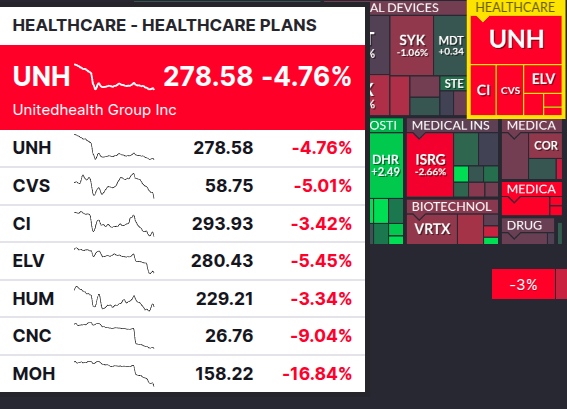
These companies are getting completely slaughtered!

Bought a small chip of UNH after the big drop.
Not worried atm, I’ll check again the fundamentals to understand if it’s worth it to increase the position
Maybe in a few days/weeks, as I purchased yesterday at 280$ 
1 Like
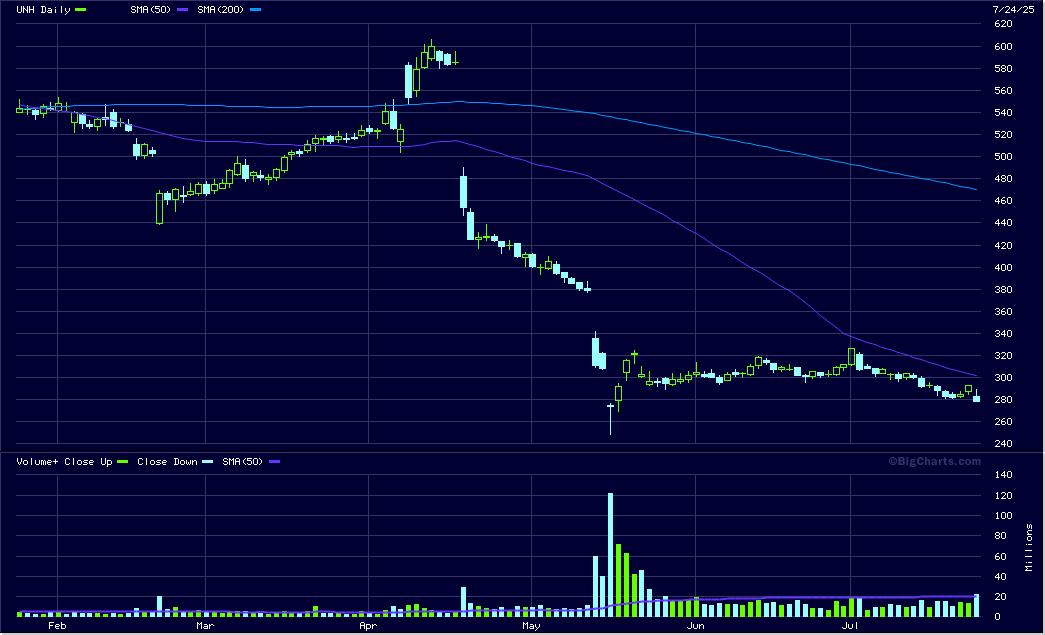
I analyzed UNH some time back. Just in case, I would never buy unless they start to rise. There is no gain in suffering the fall before the rise starts and there will be still enough to gain… if they ever rise again.
Now there are some things I don’t like. Checking the balance sheet there is more goodwill than equity. That is an alarm sign. In the best case scenario many years ahead gains will be lowered by that fact. But then, current liabilities are way higher than current assets. It may go to zero, null, adios!
I would not touch such a company with gloves, at least not until it starts to rise seriously. As I said, over a hundred trades you will make more money that way than buying falling knifes.
5 Likes
BTW: the point of me analyzing a company is finding reasons not to buy. Usually I stop there, as I don’t need to spend more time with that issue (and I am the “managing siesta director”). At UNH I stopped quiet early…
I have one outstanding short put on UNH $265 1Aug2025.
Let’s see whether I’ll be assigned.
So you’re using SMAs + due diligence, right?
No SMAs. Due diligence completely mechanical in form of a checklist where the items depend on the strategy. Usually I stop when the first requirement is not fulfilled.
Just did the checklist for my dividend portfolio… surprise. At the actual price I could buy UNH for this strategy. Last time I checked it was too expensive.
But I choose the stocks for the dividend strategy from the U.S. Dividend 100 index, and UNH is not contained there.
Well, you have common momentum measure SMAs in your chart 
Looking at this chart, if I was interested in a single stock, I wouldn’t touch it for a while either.
Yes I do. And I like to look at it. But it is not part of my selection process, it’s more for fun. I keep a chartbook of all my investments and look at the day, week and monthly charts from time to time.
(Unfortunately this forum does not allow real-time linked images, otherwise I probably would move the chartbook here).
Funny. I was thinking to myself “hey, at least I sold CI before this ‘crash’, only to discover that I actually hadn’t!”
1 Like
It looks like I had a buy order on CHTR…
Why do you still hold this trade? You made 85% of the maximum profit in two months (out of 7). And you stand to gain less than 1% of your blocked capital in 4 months… I usually aim for 1% in two weeks. Much better to close this trade and enter a new, much more profitable one…
1 Like
What do you make of EL then? This has bounced now.
Not sure if this is the right thread to discuss option strategies… but I’m happy to answer your question.
Closing out short options is not an exact science for me, but it depends primarily on the return target. In my options thread, I once said that I aim for a return of around 1% of the capital invested per two weeks (=> 25-30% per year).
If an option is performing well and I achieve this target ahead of schedule, I weigh up the return already received per day against the expected return per day for the remaining term. If the residual return is well below my goal, I buy back the option and sell a new put option that again meets my return target.
In your example (85% return after 30% of the option’s term), the case would be crystal clear to me. Your friend’s 1 dollar per day target is completely arbitrary and ignores your risk appetite, strike price and portfolio size.
In addition, closing a short option also allows you to reset the risk (underlying, term, return). Imagine how annoyed you would be if UNH shares really tanked in the autumn and you ended up owning the shares after all.
Because I’m interested: what return target have you set yourself? And what terms do you typically choose (apparently much longer than me)?
1 Like
Another way to evaluate an open short put:
Would you sell a short put on UNH today with a strike price of $160 19Dec25 for a premium of $135?
I certainly wouldn’t. The option has a delta of only 0.033…
1 Like
As I said before, UNH passes my tests for the dividend strategy now, which came quite as a surprise. The cash flow and the reduced price do that.
Now Estée Lauder is another story. Quiet nice price movement since April, but not really cheap. Goodwill is higher than equity. It basically means you buy a company that consists entirely of other companies and debt.
Cash flow is OK, but it would not make it into my dividend strategy because of the low dividend yield.
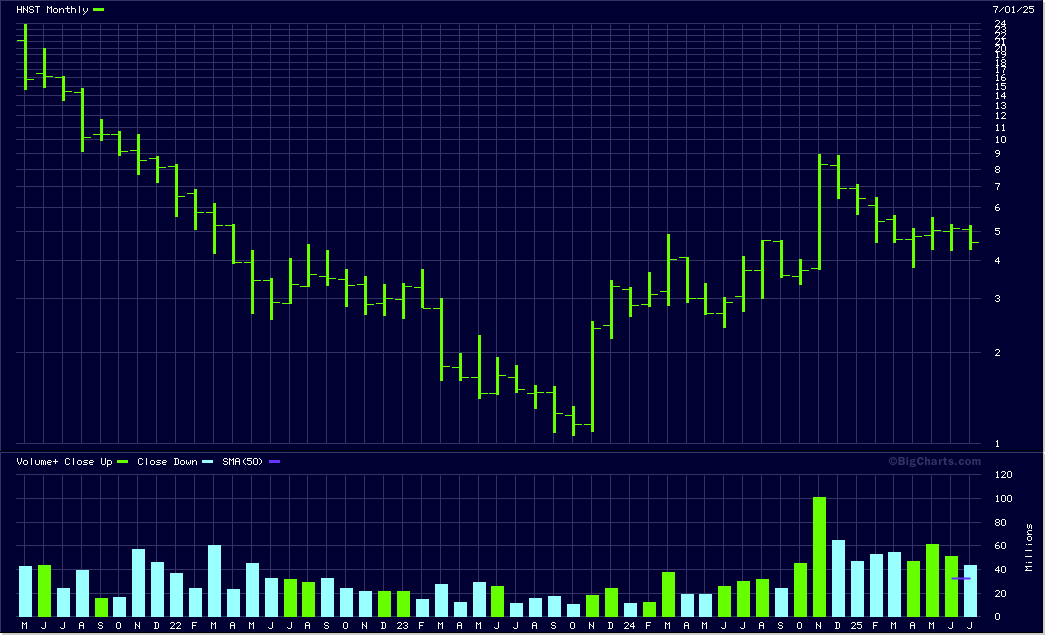
Anyhow, from that industry I own stocks of “the honest company” (HNST) and who could beat that name. Bought them when they were still cheap and started to rise, but quiet a roller coaster ride. Who knows, maybe EL wants to upper it’s goodwill a bit and buy it from me.