Unfortunately only PLTR 
@anon17469660 any view / graph on GSK?
1 Like
Thanks for the ticker, looks fairly interesting!
(but with some homework to do before buying)

Looks nicely undervalued given the growth of the company, stock price certainly has a margin of safety. If it returned to its historic “normal” valuation of 13.5 x P/E you’d really have a nice upside potential.
Plus it looks like the company is expected to grow at a nice cliff starting next year.

I also like the “A” S&P credit rating. Long term debt / capital of ~43% seems acceptable, and the analysts track record of predicting earnings seems mostly fine.
Dividend yield of 4% is nice.
Earnings forecasting trend doesn’t look concerning, either, with analysts forecasting updates – 6 months ago versus 3 months ago versus most recent foercasting – adjusting upwards for this year, flat’ish for next year, and growing again for 2026.
Always nice to see when analyst earnings predictions don’t trend downwards …

Almost looks like a buy so far.
Things I would check out further:
- there was a spin-off in July 2022 and a stock split right afterwards – does this explain the dividend cut in 2022 sufficiently (and were shareholders participating from the spin off)?
- is there a fundamental issue reflected in the stock price? Had you bought the company 20 years ago, your annualized rate of return would have been under 4% (including dividends) until today. A bit meagre.
Is there some issue the market sees that depresses the stock price despite seemingly growing earnings? Or is this just e.g. a tail effect of them cutting their dividend.

Things I (personally, for my portfolio) don’t like:
- their dividend was basically kept flat from 2014 to 2021 (though, admittedly, their earnings were flat for that period, too, so possibly wise from the company’s perspective to not raise dividends)
- their earnings growth was mostly flat from 2004 to 2021 and only in recent years they started growing earnings again – possibly this is related to the spin-off (would need to research further)
To end on a more positive note: things look more attractive if you look just at the more recent years where they’ve been able to grow earnings again. Nice earnings growth rate, dividends are growing again, stock price still seems to have a margin of safety.

Be well and invest well!
2 Likes
That’s a nice analysis. The difficulty that I am amazed you seem to skip is not trying to find out a lot more about the companies than what the graphs tell you. Especially in a field I know like pharma!
I’d go study their pipeline, the patent cliffs, the competition, the market shares per drug/disease, what else is in the pipeline from competitors, then go deeper into each drug’s data, try to figure out potential opportunities and risks, key dates in the future, policy developments…oh wait I do this for a living already and can’t invest in pharma 
But seriously, don’t know if/why Altria and Philip Morris would require less due diligence, I guess the need for constant innovation for tobacco (or Coca Cola, or Banking, Insurance, household goods) is about 1/100th of what’s needed for pharma, but regardless, I get that when a company appears undervalued and has a good history of earnings and dividend growth it may make a good long-term income-focused investment, but really struggling with remaining agnostic across industries.
2 Likes
Many thanks for the detailed reply. I am getting closer and closer to enter a buy order…
Yeah, your handicap aside, I find this really an interesting question and I keep coming across it.
Some (mostly) value investors prefer to first look at the company and its prospects, their pipeline, you name it: just like you would do it the way you look at pharma companies IIUC.
Only then, after these things check out, they would look at fundamentals and valuation (the way I look at companies through FASTgraphs) and figure out if the company still makes sense buying at its current valuation.
And only then make a decision whether to buy.
I tend to prefer to first filter via valuation. I have two ways to explain why either approach might work better.
First, why your approach might work better: you’re an expert in the field, you can judge whether the company’s pipeline makes sense, their patent cliff, the competetion, all the things you mention plus some additional somewhat unique X ray vision capabilites that you have that allow you to look at companies (I assume restricted to that sector?) and basically be able to determine in a relatively short amount of time that company X has great prospects while company Y seems doomed and company Z might be iffy.
Second, why my approach works better for me: I’m mostly an imbecile for judging any given company* on their prospects by judging their business plans and genuine prospects based on the quality of their plans. My best aka most efficient filters are:
(a) how did the company fare in their past? Do their earnings grow steadily like Altria’s, clockwork for the past 20 years, recession proof, you name it?
(b) how are analysts estimating earnings (growth)? Up and to the right? Track record of the earnings estimates by analysts? Etc.
If both look good, let me look at the business: is the narrative satifsfying to me? In the best case I’ll do some amateur digging the way the investor in approach one does.
Maybe put the on my watchlist or even step forward to buying.
I wouldn’t put one approach above the other.
At best, you can combine the two. I really only feel comfortable with approach two.
I believe approach one requires expert knowledge for quick/efficient sorting out shite companies. I don’t have that knowledge.
I believe approach two requires just some basic knowledge of business metrics and market history and it allows me to separate the general wheat from the chaff.
Yeah, I think you just stated the explanation yourself: there are companies with a moat – some seemingly insurmountable, others climbable – and when Mr. Market decides that The Coca Cola Company is on sale, based on about 100 years of history, my opinion is that you can just buy it, regardless of their lacking track record of innovation and growth partially (mostly?) only thanks to acquisitions. That’s where the blue line in FASTgraphs – the so-called “normal P/E ratio” aka the historical P/E ratio as judged by Mr. Market – comes in handy: some companies are just (seemingly) always given a premium valuation by the market despite their apparent lack of innovation, but just because investors love the company and are willing to pay up, whether it makes sense or not.

Other companies – and pharma is a prime example – need constant innovation and capital re-invested. Most of them don’t benefit from a prime valuation, but some behemoths – like AMGN or MRK in my depot – seem to work like clockwork, too. Earnings grow, dividends grow, stock price follows action. I like them, but I could not tell you why they work so much better than BMY …
Anyway, fun discussion.
Edit: for the company that triggered this discussion – GSK – I would indeed spend a lot more time educating myself about it if I were more seriously interested. At the moment I find it “interesting”, but not “buy level interesting”.
To bring myself to “buy level interesting” I would look at their most recent earnings calls, investor presentations, 10Q and 10Ks, if it were a US listed company, and just do a bit more homework.
That said, I feel my homework would still just be surface level due diligence to get myself more comfortable (or pick up any obvious distress) versus your level of scrutiny where you’d ask hard questions about the next couple and the next 5-10 years of revenue and profit.
* Except for a personal, not really justifiable aversion against Tech for having seen from the inside the endless ways how to waste shareholder money on stupid shit. But I digress …
2 Likes
Lovely response, really!
FYI, somewhat shocking for behemoths, most pharmas make their money off one or two drugs, in reality, and a good 60-80% in the US. J&J for instance sells a lot of small, cheap things in huge volumes (like commodities almost!), while their real cutting-edge pharma division (Janssen) has a couple of big hitters at most. Same goes for most of them.

Not my data. Edit hah, I’ve worked on 11 of the top 20 
1 Like
I don’t think it is possible to analyse big pharma companies. Heck talking to the top finance people in the company itself and they don’t have a good handle on it either. Things are just too complex and too unknown.
Things can turn on a dime with a good/bad clinical trial, or a new entrant in the market.
2 Likes
Totally true. New entrants can be massive game changers, there’ve been several the last 20 years - for the benefit of patients - but they are never secret. Everyone knows the same science, and given how long development, regulation and launch take there’s a decent handle on what’s coming with years’ notice. And indeed, the science may not work for reasons that sometimes are never known. It’s less “analyzing” a pharma and more gaining a reasonable expectation of how things could go.
Just checked my stocks and holy crap. I’d bought JD on a whim a month ago and pretty much forgot about it. Today I see it up 75%! 
4 Likes
Bought one share of BABA on a whim for my son’s portfolio in April 2021 and pretty much forgot about it. Today I see the position is down only a sliver over 50%!

I even bought it before they initiated a dividend – I must be a stockpicking genius …

1 Like
I’m so pissed about BABA. I had so much profit on that, I was waiting for the ANT spin-off to cash in and then that idiot Jack Ma had to open his big mouth and ended up trashing the stock. I sold recently (hence the recent recovery for BABA and China stock as a whole).
4 Likes
I think it’s a lovely strategy to create a lasting bond with the little ones.
“Sooo, whichi one do you like?”

“ok, bought”
4 Likes
Glad some vocal combinations are hard for babies to utter …

The bonding would have never happened.
P.S.: To be fair, the kiddo was 16 at the time and would have not recommended to buy BABA as I found out shortly after the buy. 
I guess I still shine as a model father, showing to his son in an exemplary way what mistakes not to make in life … am I holding this right?
5 Likes
Just get him 10k of BRK.B, forget about it for 30 years, it’ll be worth multiple millions
Not even joking, that’s what I am doing for my kids.
2 Likes
But when do the babies make the “BRK.B” sound, though?
Maybe when they spit out something their taste buds don’t like yet…? So stick a cornichon into their mouth while asking in @Brndete’s voice "“Sooo, whichi one do you like?”
“Pfbftb…” [some crying ensues]
“Ok, that sounded like BRK.B. Bought!”
Ok, how does that go?
Goofy: “I’m sorry, Son, there’s just not enough cash in your account for [expensive graduation gift]”
Son: “Don’t tell me you lost it on obscure stocks you bought based on one of your graphs??”
Goofy: [Silence] … [more silence] … “Ahm, well, the important lesson here is, ahm …”
Son: “Moooom, he did again”
Ok, enough from my side, I leave you to your charts here 
6 Likes
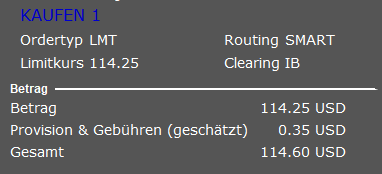
Why 1 share and what’s the overhead/trading cost for such small purchases?
Oh, great question.
The initial investment strategy (for his portfolio) was to invest in tranches of about 200 bucks and continue diversifying (with the pretty much sole purpose of teaching that diversification saves you from collossal losses [and of course spares you from making collossal wins …].
At the time the USD 240 for a share seemed close enough to USD 200 so I splurged on buying an entire share instead of just a fraction equivalent to USD 200.
Today’s strategy is a little more lenient: it’s no longer a hard limit of USD 200 per position, but a (small) fixed percentage of the overall portfolio. Diversification is still king for investors with limited knowledge, and IMO even for those with excess knowledge. YMMV.
The overhead trading cost feels of course prohibitive – except if your are with Swissquote (or, God forbid: a so called real Swiss bank, which calculates fees in the tens of basis points … – anyway, I digress … where were we? Yes, the trading cost for a USD 200 position is perhaps not optimal, even on IBKR, but it’s still illustrative once I seriously discuss the portfolio with my son.
I expect a decade or two or even more until we have that discussion in ernest.
1 Like
 .