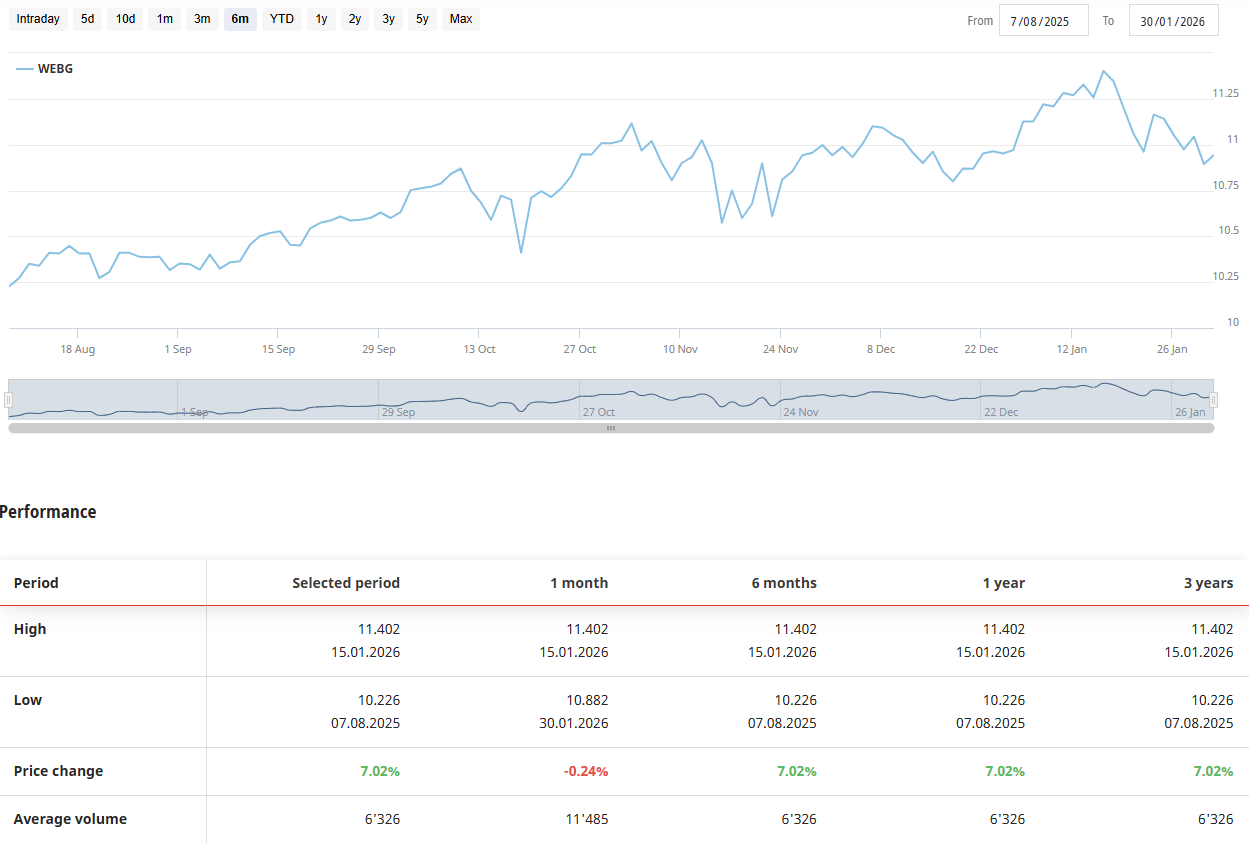
Can anyone explain to me how to interpret this table? Is the average volume referring to daily traded volume or its something else? I tried to buy this ETF on SIX and got a warning of limited liquidity and potential inability to close position. Is this only meant for large traders?
The way I read it - table says there are >6000 ETF units traded per day. So for smaller trades, it should not be an issue
Either that or they (IBKR?) are just overcautious as with various other warnings. Maybe they use the same metrics for ETFs as for individual stocks even though low volume for ETFs is not nearly as much of a risk (at official listings with market makers).
Even very large trades are very likely to go through, however, you may want to watch the spread and use limit orders to prevent bad surprises.
I’ve bought thousands of shares in a single trade of an ETF at SIX with an average volume much lower than that and there was no problem (but I also got that warning at IBKR). I think I even got an immediate fill better than what was in the order book.
WEBG tracks the Solactive GBS Global Markets Large & Mid Cap index and is the only ETF based on this index. As Solactive is a service provider to Amundi, Amundi may have significant influence over the index’s construction and governance.
WRDUSW (don’t include Emerging market) could be a good alternative to WEBG
Though I don’t like the TER being waived temporarily. But if the final TER is close to eg 0.10% it would be pretty interesting. No US tax leakage, EU domiciled and it includes emerging markets.
I ran the numbers assuming that DA-1 reclaim is not fully paid out. The result is surprising. All numbers below are post tax and assume a 20% marginal tax rate.
100% DA‑1 payout: US‑domiciled funds outperform by 0.108%.
75% payout: advantage shrinks to 0.036%.
50% payout: IE‑domiciled funds outperform by 0.036%.
The break‑even point is at a 62.5% DA‑1 payout rate.
This means that, assuming identical TERs, IE‑domiciled funds become more attractive once DA‑1 recovery falls below that threshold.
This will move however in future dependend on changing dividend yields and US/INT share of the world market.
Ucits TERs are also higher.
Optimal would be to split the portfolio. Use US fund domicile for US stocks and i.e. the new Vanguard ex-US ucits fund, for an easy two fund portfolio with optimal tax, if you don‘t get full DA-1.
That’s true; a two fund portfolio is optimal in this case, assuming the additional complexity is acceptable.
If the TER of UCITS funds converges toward that of US‑domiciled funds, there will be little benefit left to holding US funds. UCITS funds also have the significant advantage of avoiding exposure to US estate tax and potential dealings with the IRS.
I thought so, for a world portfolio, its the most tax efficient to hold a US ETF (e.g. VTI), plus a UCITS ETF for dev/emerging? @Fizzy are you saying this is actually not worth it?
While US‑domiciled funds are superior for most investors, there are situations where their advantage is reduced or disappears entirely. The outcome depends on individual factors such as marginal tax rate, the effective DA‑1 recovery rate, and the TER.
In addition, your portfolio should match your personal requirements and allow you to sleep well at night.
Mit dem Lesen und der Teilnahme an diesem Forum bestätigst du, dass du die Forum-Richtlinien gelesen hast und damit einverstanden bist sowie den Haftungsausschluss auf http://www.mustachianpost.com/de/ akzeptierst.