I just stumbled over this ”light ESG” label from the Amundi prospectus regarding WEBG/WEBN:
“The Investment Manager integrates consideration of certain sustainability risks referred to in the section of this Prospectus entitled “Risk Factors - Sustainable Investment Risk” by excluding the securities of companies involved in the production or sale of controversial weapons as defined in “Replication Methods for Passively Managed Sub-Funds”. The Sub-Fund takes into account principal adverse impacts of investments on sustainability factors in its investment process as outlined in more detail in section “Sustainable Investing” of this prospectus."
E.g. Lockhead is not part of the ETF’s holdings but of the index.
Would be a no-go criteria for me. A market cap weighted index product should do exactly what it’s said out to do and not do some arbitrary ESG filtering.
It is a good reason to avoid Amundi’s products. If they indeed have a deeply hidden ESG screen and still call the fund an index fund, that is not something that increases trust, to put it mildly.
There are plenty of alternatives a few bps more expensive, but with a much better tracking difference. The implementation quality of a fund is worth a few bps.
My experience with same ETF, same isin, different ticker symbols because of different trading currencies and/or trading places, is never a problem of liquidity, because they are the same fund, same shares, and there are market makers. The reported spread should be ok and bid/ask reported real time even with no transaction on this specific one, but in relation with the global trades.
The thing is, if there is little to no volume on the ticker you want to buy (but a lot at other places), the last price is not updated accordingly. You need a broker that is displaying real time bid/ask prices and my experience with IBKR and the very same European ETF traded on SIX (USD and CHF) among other (EUR, GBP, USD at other places), it is not, and it may even warn you about the difference you set in your order (based on “real” bid/ask price) and what it thinks is good based on last traded price on this specific ticker).
When someone is buying AVSV @SIX, aren’t they trading with someone @SIX also?
Same with buying AVWS @Xetra?
So if there is more trading going on at Xetra, shouldn‘t the bid-ask difference generally be smaller?
Yes. Where is more supply/demand, the spread should be lower. The question is whether that really matters, because there should never be a completely catastrophic spread, as market makers and those who do arbitrage should be present. At least, that’s my understanding.
It sounds like they will calculate and publish the tax values only if someone submits the annual report of the fund to them, which will probably be available in April or May 2026 for the year 2025. Not sure whether local tax authorities would do that based on tax declarations if nobody else submits the annual report.
Question is, should I keep buying it from Xetra in EUR (0.25% FX conversion fee in Degiro) or should I embrace it in CHF from SIX (much lower volumes and higher spread)?
Or should I completely ditch them because of the “ESG screening” mentioned above?
The issue is that WEBG is the only all world ETF that is:
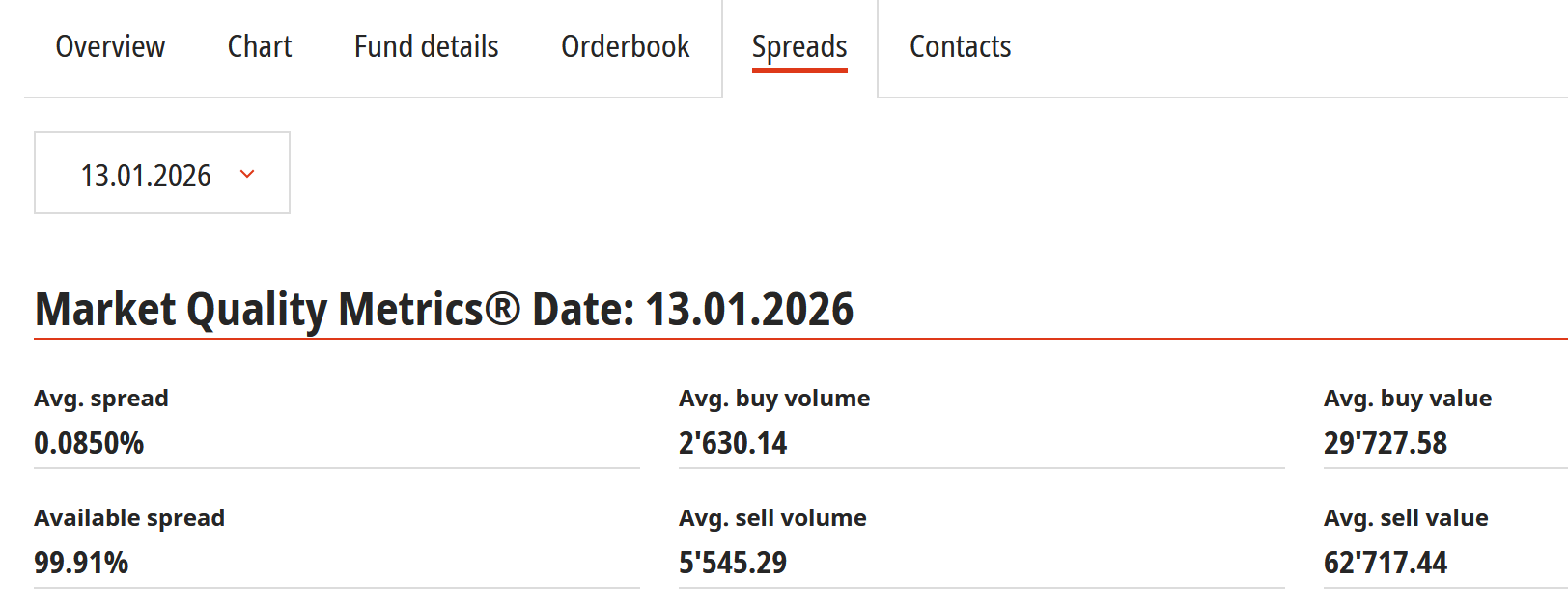
According to SIX, the average spread is below 0.1%. Right now it’s 0.07% (and spread cost is roughly half per transaction). It seems unlikely that you would lose more than 0.25% in additional spread costs on average, so buying in CHF sounds like the better choice to me with Degiro (assuming no significant difference in exchange-specific fees).
I prefer an MSCI ETF without any screening to a Solactive ETF with screening even if I may sympathize with a more local index provider and asset manager. That said, the performance difference is likely very small over the long term and WEBG should still be an excellent choice. It’s up to your personal preference.
Technically, the Swisscanto ESGen SDG Index Equity World ETF also fits your criteria. However, Swisscanto seems to have designed their own index, which deviates much more from global MCW than WEBG and it also comes with a much higher TER of 0.35%, so I’m not recommending it.
I checked the current spread in the order book. That was just a random snapshot to kind of confirm the average claimed by SIX, not an important number.
Market makers are obliged to always provide a certain level of liquidity for official ETF listings. The theoretically allowed spread is fairly large, if I remember correctly, however, if the spread of market makers is small enough in practice, the actual trading volume doesn’t matter much. It’s a lot less critical than for (small) individual stocks.
I typically check the spread before each order at SIX (and set a limit) to avoid bad surprises. But the average spread seems to be fine for WEBG. You could check the spread in the order book at different times tomorrow to check whether you see outliers at certain times. It’s possible that the spread is higher while the US (pre)market is closed but that is a potential issue at all European exchanges.
I think normally WEBG is traded in USD in SIX. So when someone enters a buy order in CHF, most likely market makers can swap USD with CHF and fill the order using bank FX rates
Mit dem Lesen und der Teilnahme an diesem Forum bestätigst du, dass du die Forum-Richtlinien gelesen hast und damit einverstanden bist sowie den Haftungsausschluss auf http://www.mustachianpost.com/de/ akzeptierst.