Unpopular opinion: Many of us are probably aiming for the wrong FI number

Lately I’ve been rethinking the way I calculate my FI target.

The standard approach is pretty straightforward:
Annual expenses / SWR = FI number

But there’s one assumption in this calculation, that I find more and more questionable:
→ This assumes an income of 0

I know, Barista FIRE is nothing new. But I wonder why I should treat traditional FI as the default goal, rather than questioning whether I actually want to stop earning money altogether.

Personally, my goal isn’t necessarily to never work again. It’s to never HAVE to work again in a job I don’t enjoy.
And I found out, that this distinction makes an enormous difference financially.

I ran some numbers:
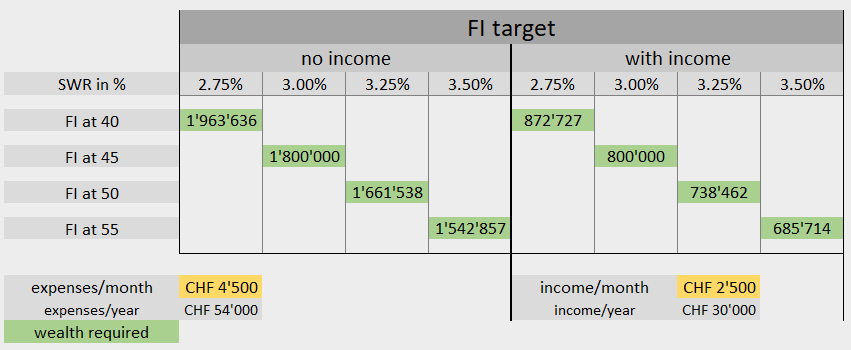
Assuming monthly expenses of CHF 4.5K and a 3% SWR:

  • “Traditional FI”: 1.8M required
  • With 1K / month income: 1.4M required
  • With 2K / month income: 1.0M required
  • With 3K / month income: 600K required

What I find interesting:
We spend years optimizing our saving rate, investment returns and withdrawal strategies.
But maybe one of the biggest variables in the entire FI discussion is something we possibly don’t challenge enough:

How much income would we actually enjoy earning after becoming FI?

Maybe you’d love to work two days a week in your current job. Maybe you’d teach, consult or turn a hobby into a small business.
Not because you need to maximize your income, but because you enjoy the work.
And if that income covers a certain part of your expenses, your FI timeline changes dramatically.

Of course, there is a trade-off: You’re trading some financial independence for dependence on future income. That’s why I’d still want a plan for what happens, if that income vanishes.
But here’s the question I’ve been asking myself:

Is it really worth working, say 10 years, in a job you don’t enjoy that much, just to reach a FI number, that assumes you’ll never earn another CHF? Or could it make more sense, to aim for a smaller nest egg and design a life where earning some money is actually part of the plan?

I’m curious how others think about this.
For those pursuing FI: Do you calculate your target assuming zero future income, even if you expect to keep working in some position? And if so, why?

10 Likes

Yeah. I think maybe we are a partly self-selecting group of people who are always looking at irrational worst case scenarios.

I do plan on zero income but probably this is not realistic as money has always flowed in some way or another even when I wasn’t looking for it.

A lot of us may be risk-averse and so planning on over-shooting, but it is better to actually under-shoot as we over-estimate the risk of running out of money and under-estimate the risk of wasting our good years.

6 Likes

Without attacking any of your work - it’s fantastic, I think the main takeaway with this is: “You can’t have it all” in a way.

So imho the best success in this approach - given it’s uncertain nature - is always to “just wing it” - endless calculations and spreadsheets probably don’t make a more successful retirement than making it due with the 4% rule 100% stocks and some “gut feel”.

And this especially works, if one is a bit generous on all sides, so:

  • Planning for a bit more than you need
  • Planning on earning nothing (or less) than one probably does
  • Not 100% accounting all positive factors (many don’t know that the AHV payments from wealth will slightly reduce your income taxes)
  • etc.

The really risky thing is to calculate this stuff out and pretend you know what you’re doing, because you shuffled around some numbers. More complex retirement planning and strategies don’t pay off - imho and from what I saw only are a mental exercise that can be substituted for simpler “rules of thumb”.

But yes - earning income is a huge FIRE booster - but I think most people want the real deal - and they’d rather not be in need of work. Even the sweet part time job can start to suck - only now you’re stuck and maybe left a huge golden bucket and stand there with 3K for 3 days of work… instead of idk. 10K+ for 5 days.

I however don’t get being overly cautious either - and can only explain this with irrationality. If you’re 100% in stocks, you don’t need a 2% withdrawal rate, that’s ridiculous - even at 4%, the chance of running out of money (without you noticing and being able to react) is nearly 0 - again, given you calculated generously.

My FI goal is at about 2.5M and 100K withdrawal. I can easily feed 8 people on 100K if I need to and we can support our future kids, without having so much wealth that they can lay back and hope for daddies wallet. I prefer it that way… and if shit hits the fan, I’ll be able to feed my family with 60K - so more than enough cushion :slight_smile:

Not because you need to maximize your income, but because you enjoy the work.

One point on this: Imho this is just “copium” or a lie to be blunt - you can’t tell me there are people that do consulting “for fun”… I mean come on… We can look at jobs that people do for fun (artists, musicians, etc.) and they pay like garbage for 98% of the participants… in order for work to truly count as “having fun” - my definition would be that you would do that even for free - and then the question arises: So why take money then and make it transactional? There is no free lunch - and there is no “fun” in a monetary transactional relationship imho.

3 Likes

I had one case where it was a free lunch. I did something for fun/free. Then one day thought of putting out the equivalent of a ‘tip jar’.

It ended up making $2,000 a month until a change of job stopped me from doing maintenance work on it.

The problem is finding low income jobs, that are paid well per hour.

I likely cannot find a job earning 2k that would be enjoyable enoigh for me to go for a half-assed retirement.

I will not work a Barista job suddenly earning a fraction per hour compared to what I earn now, just so I make 1-2K extra. I’d rather full steam ahead a few years more and not work at all.
My job will likely not accept 40% and for consulting you need to work hard to build a client network for some years. It’s like starting a business. Very far from retirement. You may even fail completely there.

It would just help me to mentally feel more save, that I could do that at an earlier then planned proper fire date.

2 Likes

I think one aspect I’m experiencing is that as we progress on the path to FIRE, we gain confidence and options and more ability to say no to jobs we don’t like or to pursue jobs we actually like.

I wouldn’t be surprised if, at the “end” of the journey, some of us end up actually appreciating their position, having struck a life balance they like and not needing the RE part of FIRE anymore.

Others may go on to pursue their own ventures and make some money out of it.

Others will pursue fully unpaid activities, as their freedom allows to.

I think the important part is to stay on the journey and adjust on the way to be as much in tune with ourselves as we can.

Having some kind of power, being listened to and being recognized by a network can give people a sense of enjoyment or fulfillment. For me, I think it may join some of my personal objectives, which can be most efficiently pursued by paid positions (because of the power and responsibilities that go with them), or failing that by providing services I could be paid for. The original path of bettering myself through unpaid activities and helping other people on their way would still be an option.

4 Likes

There’s plenty of us, it’s great

Pic unrelated

1 Like

Absolutely, every person has their own definition of what independence means, I guess.

I understand your point, assuming the following is a given for you:

I for my part can say that I absolutely love helping people, and I find it very rewarding to see how I can make their lives a little easier.

However, at this point in my life, I’m not (yet) willing to give my time away for free, which is why I don’t offer my services free of charge.

1 Like

Income during FI certainly helps a lot, but it’s far from guaranteed, as @Tony1337 says, finding something well paid per hour at low hours is not easy.

IMO flexible withdrawals are the bigger lever. Being able to live with less or adapt the lifestyle for a few years when markets are bad, and live bigger in the good ones. As long as the lower boundary still allows an ok life, of course.

How much flexibility do you all plan in? Fixed SWR or some kind of guardrails?

2 Likes

I’m joining @Akia in that I think we are planning too much.

I would say income in retirement happens, or doesn’t happen. Planning to get well paid hours at part time still puts making money at the front of the reflexion, while the whole purpose of FIRE is for money not to be a factor (so not something we need nor actively try to avoid).

I would still plan for full FIRE, stay open minded and adjust along the way if applicable provided my new life experiences, skillsets, network and increasing financial independence.

3 Likes

Y’all will probably enjoy playing around with LevelSpend, a calculator developed by bogleheads frustrated with 4% rule etc. – development thread here: https://www.bogleheads.org/forum/viewtopic.php?t=473403

2 Likes

Looks like it doesn’t account for sequence of returns but instead uses a single “portfolio growth rate” percentage applied year after year?

The default withdrawn amount displayed seems to be inflation adjusted (the chart is in real dollars by default). The advanced options don’t seem to allow to set an amount for expected inflation, I’m guessing they use 2%?

It gives me a 5% inflation adjusted withdrawal rate at age 41, with no income, a small pension kicking in at age 65 and a life expectation of 120 years (so the portfolio would have to carry me through 80 years with no/very low income). Either I really don’t understand how it works and what it displays or I’m not convinced.

2 Likes

So is the portfolio return: it’s after inflation.

Which is why inflation doesn’t matter. Except if you have income not adjusted. I.e. pensions - for which you can set an assumption for inflation in advanced settings.

These seem somewhat reasonable assumptions.

…or do they? I’m not too sure, given the political pressure on central banks to set interest rates below inflation rates (or more accurately, below what they historically have set them according to inflation figures, accounting for a certain target :bullseye: inflation), danger of financial repression and lost investor confidence.

Trump has been a vocal proponent of lowering interest rates (though so far been kept in check by Fed governance), and Europe may well have one or two debt crises looming - though this time, it’s not just comparatively tiny Greece.

With regard to that calculator: As for that calculator, I share your skepticism regarding the sequence of return risk. Glaring oversight, when real portfolio growth and returns can be so volatile (at 4% above inflation, they’re bound to be).

I’m asking myself similar questions. Maybe I’m one of those being overly conservative and careful in their planning. From my point of view, your 4.5k appear too low for FI. I don’t know you lifestyle, but to live from 4.5k in Switzerland looks tough to me, since you need to deduct quite a few things from that:

4.5k - social contribution - health insurance - rent or (Eigenmietwert + maintenance costs) - tax

And I think, once people are FI, they have plenty of time to do things that might cost more money like travel, hobbies etc.

Your SWR of 3% I consider as save, but if you never want to work again, you have to protect yourself from sequence of return risk and you would need to have some of your assets in lower yielding buckets of cash, bonds etc. so that you can bridge bad market times without drawing from your equity portfolio. So, you need to remove those short term liquidity buckets from your total assets that will return you 3%.

But once you have both, a large equity portfolio plus short and medium term liquidity you should be safe to never going back to work again.
A German mathematician called Andreas Beck has written a very good paper on this topic: Geld anlegen und davon leben.pdf
(I copied this from someone else who posted it in this forum, but I like the concept)

On top of that I think we all don’t know how the future will look like. Maybe Switzerland will introduce a new tax in 10 years that would punish people like us. Or health care cost quadruple or there will be changes to 2nd pillar or AHV etc. For the sake of these these potential risks I would plan even more conservatively

I think that’s one of the major difference between FIRE mindsets.

Some consider free time as an opportunity for expensive activities and need more to FIRE.

Some consider it as an opportunity for cost saving activities (gardening, home/car repairs, sewing, others) and probably need less to FIRE.

None is right nor wrong but knowing where our mind is helps to target the right number.

3 Likes

For me personally, the FIRE mindset doesn’t necessarily mean frugalism. But I agree with you that many peoples FIRE plan includes a frugal lifestyle.