getting back withheld dividends: If there are witheld dividiends based on Swiss law, you will get them back in full if you declare them in your tax statement. Same for any DA-1 dividends. You will always get back the full amount, even if this will result in a negative tax bill. It is not tied to your income before or after taxes.
reducing your taxable income by indicating wealth management costs. Honestly, I never thought about correlating this with my actual wealth. I just put a fantasy number of (I think) around CHF 500. So far, there has never been an issue with this. Since this is tied to your taxable income, you can never get negative taxable income. So if you have a low income, your reduction benefit is lower. You might have enough deduction otherwise (i.e. through health insurance or work or transport expenses) so that the deduction for wealth management costs would result in a negative income. In this case, it will not be considered by the tax authorities.
Thanks for your reply. This is exactly where I am confused. I thought these two were unrelated just like you said.
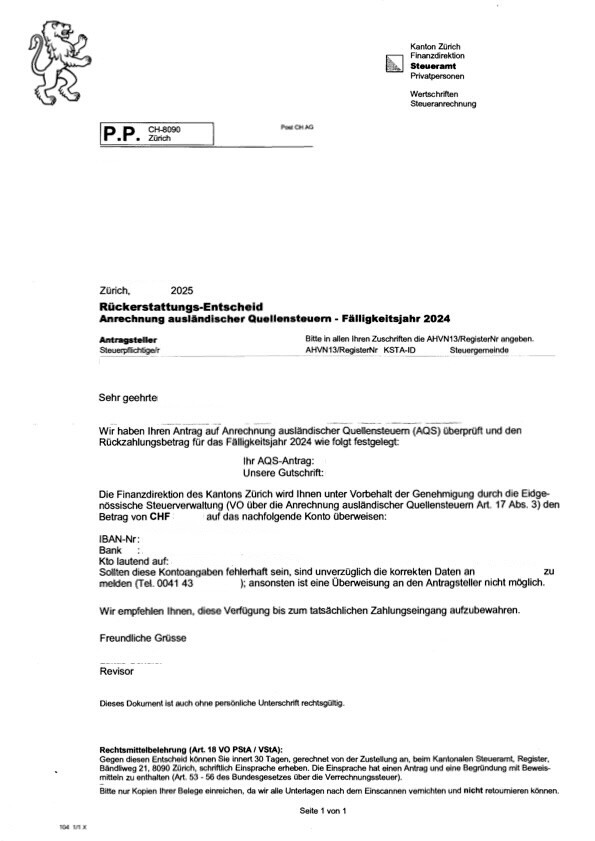
But in the letter I got now that shows my DA1 dividends 15% WT refund it explains me I will not get my full dividends WT back that I paid. I will get „the lowest of three values“, and while one of them is my expected WT refund, the other one is a value calculated based on the original dividend value and subtracting the wealth management deductions. And this value is substantially lower and hence I don’t get the full initial amount back.
So the two points you mentioned are not independent - as far as I understand, due to deducting the wealth management in my regular tax I now get less Dividend WT Refund. So there must be a tradeoff here?
Interesting. I guess I should have read your original post more carefully
No idea, I have never received such a letter. Maybe ask at your local tax office.
I don’t think this is correct, the whole point of this large thread is to discuss the limitations to the amount of DA-1 dividends that will be reimbursed
I think there is no trade-off, in the sense that the optimal course of action is clear: deduct the wealth management fees:
some of them will be for non-US-dividend generating assets, so this will result in net tax saving anyway
some of them will be for US-dividend generating assets, this might have no effect on final tax liability (by cancelling out the DA-1 reimbursement) or might be positive for you in case your average tax rate is high enough as @assemblyrequired explained
Basically, you generated some income in form of dividends from some US assets, and US took 15% of that income. You now go to the Swiss tax authorities and say “could you reimburse me that 15%?” - their reply is “ok, but only to the extent of the taxes that you are paying to me on that income, I don’t plan to go into negative for this”. So depending on how much Swiss taxes you are paying on that income (those specific US dividends): if it’s more than 15%, you get 15% back, if it is less than 15% - you get only the Swiss taxes you owe (basically they say “we are not gonna levy any taxes on this income since you already paid to US, but the fact that you paid to US more than I would’ve taken is your problem)
The refund is done by CH, but only to the tune that I pay income tax on it.
So the difference I didn’t get back is staying with the Americans.
It’s just interesting that this is never mentioned also by MP in the blog posts about ETF domicile. It always seems like you get the full 15% back, but in reality you can often only get a lot less.
For my initial question, I can probably just use the tool to calculate the tax difference the wealth management deduction makes for me, but I agree, it will always be higher than it’s effect here (?)
Worst case I think the deduction will have no impact on the taxes as you explained, and just adding the deduction will be less work than simulating what happens by adding deduction - so I’d just deduct it and move on
And if you get less money than requested - it’s just how the rules are and there is nothing actionable you can do about it (except for the teeny tiny technicality of knowing that the increase in your taxable income in future years will be effectively taxed at a slightly smaller rate than your actual marginal tax rate, because you will get more DA-1 reimbursement out of it), so..
Don’t think of it as a refund. It’s not money that is locked away somewhere that you can get back.
You normally would have to pay Swiss taxes on those dividends, but if you already paid taxes on it in form of WHT levied by a country Switzerland has a double tax treaty with, the Swiss authorities abstain from levying taxes on those dividends.
You don’t “get back” any withholding tax; you simply don’t have to pay Swiss income tax on those dividends.
This is not quite correct. You do pay taxes, because you pay them at the marginal tax rate (say, 29%). They just made the rule such that they only credit what you paid to the Americans up to your average tax rate (say, 14%). It’s less what the Americans took, but still quite nice of the Swiss taxpeople to accept most of it as a credit.
No, you pay taxes at the average/effective tax rate. The marginal tax rate is only relevant if you want to compare two tax scenarios with different levels of taxable income, e.g., when considering optional deductible contributions such as pillar 3a.
US WHT doesn’t affect your taxable income, though (if you declare it in DA-1). Your taxable income is the same as if the US didn’t have any withholding taxes at all. Your tax rate is (tax amount / taxable income)¹, which is the average/effective tax rate. And DA-1 eliminates double taxation on that.
¹ Ignoring wealth taxes and special cases like foreign real estate income, not relevant here.
Claiming that you are paying your marginal tax rate on those dividends is quite arbitrary, why these dividends are necessarily the “last francs” that are being added to your income?
One can then just flip your statement around and say “you pay 0 or the lowest bracket income tax rate on those dividends, you then pay marginal tax rate on your other income”.
Okay, I think our discussion is mostly philosophical.
My point was that you can somewhat choose how you allocate your dividend-bleeding investments between ETFs and Pillars, and it’s important to look at marginal tax rate. Tax office uses average tax rate, and it may be somewhat important to look at it also, especially past retirement.
Mit dem Lesen und der Teilnahme an diesem Forum bestätigst du, dass du die Forum-Richtlinien gelesen hast und damit einverstanden bist sowie den Haftungsausschluss auf http://www.mustachianpost.com/de/ akzeptierst.