Wait for it, once you become Swiss you might realize that even as Swiss and while speaking the local language, you might still have trouble getting a local 'Orts’citizenship. 
2 Likes
In fact the argument turned the other way around makes sense:
While speaking the lokal language does not guarantee being integrated (what you say), not speaking the lokal language is an attestation to a lack of will to truly integrate (what you have implied in other posts) and therefore, language knowledge is a prerequisite.
6 Likes
I keep finding this requirement (in a multilingual country) inadequate. We will probably not find an agreement here, but it is/was in any case a nice discussion to have 
2 Likes
Sir, respectfully, you brought on the argument of not being able to order a beer within a 30 minute train ride of your residence (because of the local language being different?).
Perhaps make up your mind which one it is?
That’s great to hear! Keep it up. Your next sentence, though …
That again though sounds – counter intuitivally – … well, a little arrogant, perhaps? Maybe I miss the nuance again, but if you show up in a C or Java programming camp, you can all day claim that you know the computer languages Python, JavaScript and Haskell. Nobody cares. You just don’t speak the language in the camp. Saying that you find it polite to learn more about C/Java does not cut it in that camp, IMO. It’s not just polite to learn German (C/Java), it’s simply mandatory.
“Inadequate”. That’s quite a word. I would advise you to get your Swiss citizenship (any which way) and then launch an intiative along your thoughts for what language requirements are necessary to get Swiss citizenship.
This would probably be a fast track course on what the majority of the Swiss – and even the aspiring to be Swiss, if the comments on this topic are any measure – think about this kind of idea.
I – again – do not want to dismiss how you think about this (the way I perceived it), but it’s not what people here think (I think).
You’re always entitled to your own opinions, of course.
2 Likes
This was a generic example, something a person can experience. It was not related to me personally
Why am I so dismissed?
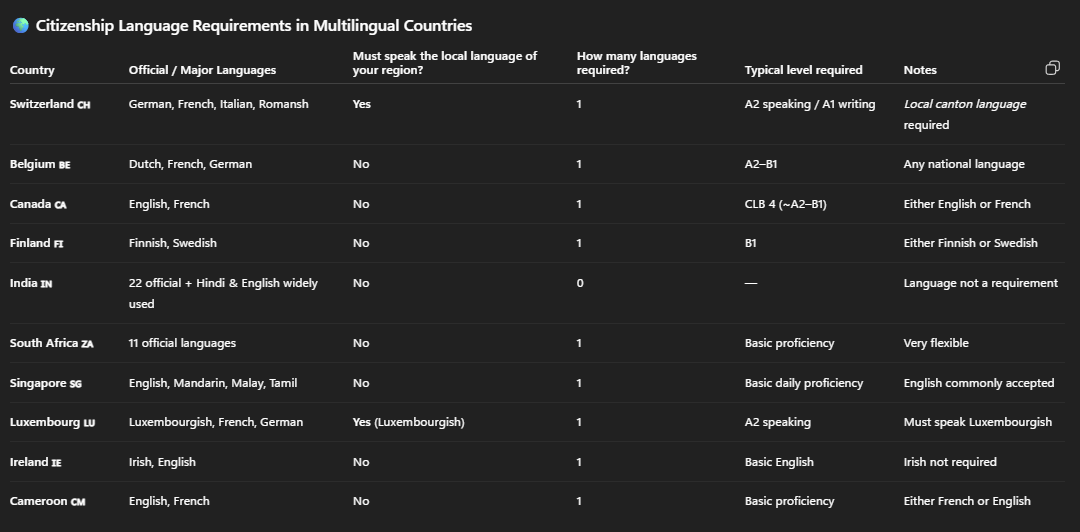
An answer from ChatGPT (which should be taken with a grain of salt) to the question:
in a multilingual country, what are the general rules for getting citizenship? how many languages shall I know?
Looks like I am in one of the few countries not aligned with my way of thinking 
But in Luxembourg, they have it worse.
Goofy just too dumb to have groked it. Sorry.
Sure. Goofy just reminded himself of what he told himself before replying with his previous answer: “Don’t wrestle with a pig”.
Of course the pig reference applies only to Goofy’s own remarks. By now, @lcln.
So … that’s the Cuban part of Switzerland?
Everyday I learn something new and surprising on the Internet …
1 Like
You mean economic migrants from the UK, right? I just call all foreigners immigrants, “expat” is just some word the English made up while sipping Peeno Greejo, after it dawned on them they are “bloody foreigners” in Spain. Bet their knowledge of Spanish ends at “Fabregas”.
2 Likes
There’s already one that will get a vote I think next year.
(No chances of passing)
1 Like
Migrants would include (in my limided experience, and sorted by caviar amuse bouches sponsored by the GOOG (I kid I kid, don’t all hate Tech, please; I never had any caviar at the GOOG; but do hate them somewhat (I e.g. had oysters)). From my very personal experience these were the initial migrants (to ZRH):
- Former block countries (Poland, etc)
- Maybe the collective of Spain and Portugal
- France and Germany. Maybe the other way around.
- Oh, and some UK, too.
- But also some Skandinavians.
Sample of maybe 30 in late 2005.
TBH, these early expats excelled at integrating (including learning the language) as there wasn’t yet a large enough expat community to compensate.
In the interest of fairness, that one is on me. Being able to order a beer is an example I’ve used myself as a milestone of communication. It is, of course, just a silly generalisation and more than just ordering a beer is required for socialization, though people around here tend to be pretty friendly and will make you feel welcome and probably not let you sit alone at your table if you enter a bar.
I think federalism plays a big part in that. We have a history of fighting and lording over each other. Foreign powers meddling in our business is a big part of why Switzerland is currently what it is and allowing local areas to decide as many things as they can on the local level is part of the reasons why the 26 (half-)cantons are still together.
I can’t vouch for the legal part of it but on a felt level, for someone from Valais/Wallis where the community of the people from local descent (or who have bought such status) is a distinct entity from the municipal power and holds a distinctive power of its own, it feels like citizenship comes from your local status, and cantonal/intercantonal “treatises” (laws) make it expand to the rest of Switzerland. In short, you need to have your roots somewhere in Switzerland and that gives you access to the rest of it, not the other way around.
Of course, the actual legalities of it are probably somewhat different from that and the facilitated process has been made to overcome some of the (potentially unfair) hurdles local communities could put on foreigners but I wouldn’t be surprised if that heritage is part of why the system is how it is right now and why many people are attached to it.
4 Likes

Thank you @Wolverine, very informative.
1 Like
I can’t even socialize in my native language, so no chance at all in German.
8 Likes
Huh? Your argument appears to be that only 10% of the Swiss population speak Italian therefore it’s silly to consider Italian language skills as a key indicator (not the only one) of effective integration when living in Ticino and applying for citizenship there?
It seems like you fundamentally have a different perspective on things than the Swiss federal / cantonal system. If you do want to go for residency, you may have much bigger challenges for your interview than just the language requirement - just as a friendly headsup
5 Likes
Correct. You would not get Ticino citizenship, but rather Swiss citizenship. And if the country allows multiple languages to be spoken, it could also embrace linguistic diversity among its (new) citizens (assuming the knowledge of at least one national language).
But I second what @Wolverine said. Most likely has to do more with historic reasons rather than integration
1 Like
Just to be clear, what I’m saying is that it probably has to do with both.
From the evaluation point of view, being integrated probably means being integrated where you are. “But I could be integrated in Zürich” while you live in Lugano probably doesn’t cut it.
Language skills aren’t the sole measure of integration but the image projected if you request an interview in a different language than the local one while dealing with a local interviewer on the local level isn’t a positive one.
Also, one thing that being proficient in the local language displays is that you are taking steps toward mixing in the local culture, which is important too.
1 Like
Becoming Swiss is a consequence of becoming a citizen of your Kanton with approval from your Gemeinde.
Your Kanton is part of the Swiss confederation, so you become Swiss.
I think, that’s why.
3 Likes