Fortsetzung der Diskussion von What is your second pillar performance?:
Continuation of a discussion from the thread What is your second pillar performance?
In general, I’m quite happy with the second pillar system in Switzerland. Still, I would very much welcome a free choice of pension provider by the employee.
Having a single pension fund that you can remain with in spite of changing jobs would be very practical from a consumer standpoint.
But unless contracts were very binding, you would end up with a situation similar to that of mandatory health insurance. Some pension funds would end up with mostly contributors, while others would end up with mostly withdrawers. Most likely, a balancing system would have to be put in place to distribute the financial burden between pension funds, as happened with health insurance. So you would effectively end up with a single pension fund, just with multiple faces but near-identical terms and conditions, which would kind of defeat the purpose.
A simple and practicable solution, in my opinion, would be to apply the same rules which currently apply to 1e plans to the entire extra-obligatory portion of pension fund benefits. That would enable participants to choose how to invest that portion, at their own risk. That would seem logical because it is the obligatory portion that is meant to secure your existence, not the extra-obligatory.
I see the pension system much stronger than probably most others here. If I were policy-maker, I would:
Stop the Full Insurance Scheme (Vollversicherung) and instead force the Common BVG Overlay Pension (Stiftung Auffangeinrichtung) a catch-all in a sense that it had to offer every employer a coverage
Stop any sales provisions (which is mainly a Problem of the Full Insurance Scheme anyways)
Create a Risk Pooling System where all Pension Funds together (as well as Vested Benefits Foundations) share the longetivity risk. This to ensure no anti-social escaping the insurance by either employers (like e.g. Google) or individuals (that go to vested benefits accouts)
mandate the Common BvG Overlay insurance to offer annuities, even if funds were previously held in vested benefits accounts. Plus optionally the roght that other pension funds may as well offer annuity conversions from employees that had their funds either at other pension funds or vested benefits accounts. But this with a clear ban on sales/advisory provisions and the like
prevent withdrawal of more than 75% of cash, plus withdrawal if the resulting pension fell short of 50% of the AHV Pension that the employee receives
stop 1e plans, same logic: prevent people escaping the risk pool
put the top quintile of pension funds based on their TER under an annual finma audit re. whether mandated governance was executed as per policy (this will drive TER down across the board)
Grant employees the right (subject to 75% yes votes) to force a change in pension provider
ban pension contributions plus buy-ins exceeding 30% of the insured salary and 10x the maximal AHV pension (about 300k p.a.)
Force Pension Funds that leaving employees may keep their funds with them, that they didn’t get any insurance but still participated interest granted to ordinary employees
Re @Mirager The „Problem“ with this community is that many here tend towards an anglosaxian-libertarian mindset: meaning that the concept of risk pooling (which proofed crucial for the development of today‘s society) … that this concept was considered socialist/communist and not incentivizing for performance.
I personally have a very strong liberal mindset (but not libertarian) and background in Insurance. In my view, Insurance was very important for the development and stability of society. This PROVIDED the risk of moral hazard was addressed in a way that insurance covered damages - but only to the extent it was still better for the insured to do all they could to prevent damage. Meaning: are are generally better off with not even incurring the damage but if shit hits the fan, you are still adequately covered.
But as said, this community leans towards a libertarian mindset. Which is probably a matter of age, social situatio and „prior luck“ in the big lottery of life (and monetary situation / status / prospect).
There are many shades of grey between libertarian and communist, as well as how to organize things.
I’m curious about these points:
That’s not only a gimmick for high-earners, though. From an employer’s / pension’s perspective, it’s “we voluntarily insure your salary above 135k, but you have to carry the investment risk yourself”, meaning it’s also designed to protect “the pool”. And the limit is high enough to not endanger a decent pensions with the regular conditions.
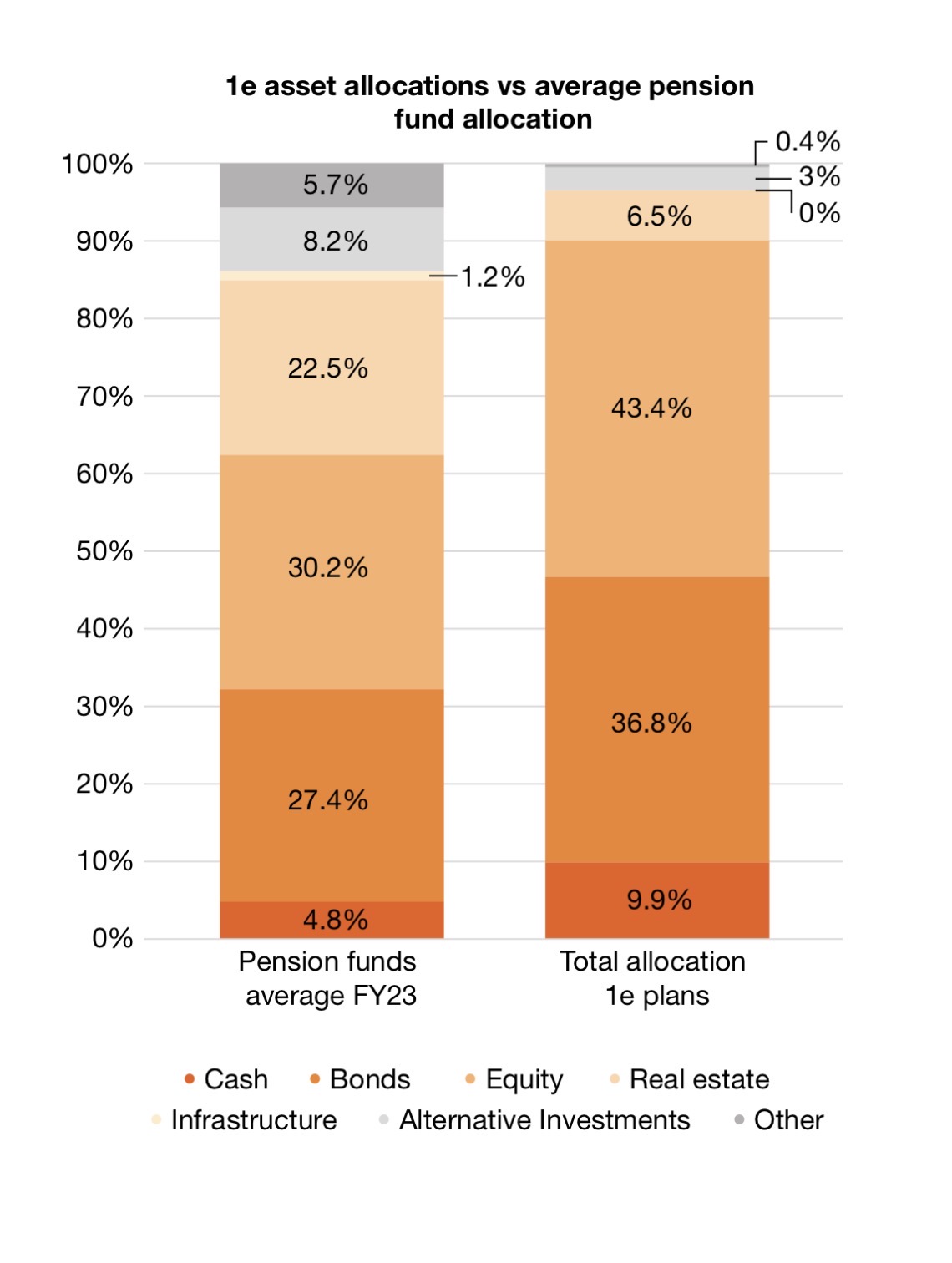
Either way, 1e has a surprisingly low adaption rate.
I guess you aim at tax deductions, but wouldn’t that go into the opposite direction of other targets? It would severely limit employee’s possibility to “join the pool” and close contribution gaps.
Why / what is anti-social in this context? Employees in different industries and companies have different risk profiles. That can currently be addressed by setting contributions and risk premiums, as well as interest and pensions.
Similar as above, while high contributions help to cover pension payments in tough times, they become liabilities, eventually.
Risk pooling has, historically, proven advantageous. That is why there is an obligatory 2nd pillar that applies to all employees in Switzerland equally. This compulsory portion has a genuine social risk-sharing character. I view it positively, though in my opinion the mandatory contributions should be higher to make the current conversion rate sustainable.
Extra-obligatory pension fund benefits, on the other hand, are a pure employee benefit without any true social character. There is no equality among employees as a whole where extra-obligatory benefits are concerned. Many companies use different pension plans for different levels of employees, in which case benefits are not even equal for all employees within the same company.
Since extra-obligatory benefits are effectively a salary bonus, rather than compulsory old-age provision, it would seem fair to allow employees to choose how they are invested. That is already the case with 1e plans, but that only benefits high earners. In my opinion, freedom to invest should be expanded to all extra-obligatory benefits so that lower-income employees can also benefit from it.
In my opinion, obligatory and extra-obligatory benefits should be completely segregated, as with obligatory and extra-obligatory health insurance. Contribution rates, interest, and conversion rates should be calculated separately for each. But that’s just my personal view.
I see it as same
Making 1e more standard and widely accessible allows the mandatory portion to be in common pool and regulated while the extra mandatory portion can be invested by people in whatever way they seem appropriate.
The key issue is that most people don’t know how to invest and how to manage risk. And thus they might not know what’s the best way to manage their 1e plans. Current system of downside protection works very well for people who don’t know what they are doing.
For example where can you get a 1.25% guaranteed Fixed depot at this moment? If you ask 100 people how to create a portfolio with guaranteed 1.25% return in CHF terms, I wonder how many people will be able to create one.
Having said that, I also think this guarantee of 1.25% and the 6.8% (conversion rate) for BVG annuities is also a reason why pension funds don’t go very aggressively in equities. This could be dampening long term returns too
—//
In my view the pension system in CH works fine for now. But we don’t know if it would work fine with continuing aging population. The key risk for new generations is cross subsidies between pensioners and contributors. If this risk can be minimised then interest can follow fund performance and then it’s only a matter of asset allocation.
I remember a slide deck when my previous employer was considering introducing 1e plans.
Iirc it was something like a majority of people picking a more conservative allocation than what was in the regular plan… (Which might make sense people tend to be risk adverse)
Should probably be zero. Without risk pooling, getting above the risk free rate risk free returns (as in guaranteed) should not be feasible. Pension funds can manage it because they have a pool of participants with varying risk profiles and investing horizons. It still requires deep knowledge and branch specific risk management skills.
That’s basically what pillar 3 achieves: Voluntary insurance with individual portfolio allocation and bearing the investment risk oneself. The difference? 1e plans are just exclusive to the high earners (and tax-deductible for employers). A gimmick for high earners.
I’ll throw in something to be provocative: mandate that pension funds focus on driving maximum sustainable risk adjusted returns for pensioners. In other words, no ‘forcing’ of dilutive ESG agendas at the expense of pensioners while pension execs still rake in the $$$ despite trailing the benchmark index which could have been achieved with a lot less overhead.
If a person had accumulated 10,000 euros in the second pillar by September 2021, their average gross salary over the last five years had been 2,000 euros, they have consistently contributed 6 per cent to the second pillar (a personal contribution of 2 per cent and a state top-up of 4 per cent*), and their second-pillar fund achieved an average market return (8 per cent**) over the period from 1 September 2021 to 31 August 2026, the 10,000-euro portfolio has grown to more than 23,000 euros as of today. The person who decided to withdraw their saved 10,000 euros, however, received 8,000 euros in their bank account after paying income tax. “Money withdrawn from the second pillar before retirement age has mainly been spent on consumption, meaning that the financial security of a great many Estonian people has taken a significant hit,” said Vahur Vallistu, Chairman of the Management Board at LHV Varahaldus.
snip
For example, over a period of twenty years, a person earning the Estonian average gross salary of 2,200 euros can, by making a 10 per cent contribution (6 per cent personal contribution and 4 per cent state top-up), based on the average annual nominal return of second-pillar funds (4.6 per cent since 2002****) and an average annual wage growth of 3 per cent (the Ministry of Finance’s long-term forecast), will have accumulated over 100,000 euros by retirement age.
Now take this with a grain of salt, because there’s not a lot of advocacy for allowing complete withdrawals of the 2nd pillar in Switzerland.
It does serve well to show what can be ruined by messing with complex and poorly understood incentives
Mit dem Lesen und der Teilnahme an diesem Forum bestätigst du, dass du die Forum-Richtlinien gelesen hast und damit einverstanden bist sowie den Haftungsausschluss auf http://www.mustachianpost.com/de/ akzeptierst.