Pulling the plug (at least for now)

Inspired by @finalcountdown’s recent post and other stories from fellow mustachians (hi @elmago), especially in this “Share your story” section, I thought I’d share where I stand with this whole FI(RE) thing.

I got interested in FIRE around 2015–2016, at a time when I had a significant change at work that took away much of the “enjoyment”. That was the trigger! :flexed_biceps: I started looking seriously at our family finances and realised that, continuing as we were (lifestyle inflation :money_with_wings:, saving a bit here and there, but nothing structured), I would never be in a position to take strong career decisions. I decided that I needed a certain amount of FU money !

I started following MMM, learned the basics, and began saving more deliberately, without depriving the family. One thing we always valued – and still do – is travelling, especially to less developed regions. We wanted the kids to experience different cultures and ways of living. We never cut back on that. My wife was never fully onboard with the FIRE mindset, but ‘tolerated it with patience’…:upside_down_face:

In the meantime, I changed jobs and found some stability, at least initially. But the FIRE “obsession” (maybe that’s the right word - for me at least) had already taken hold. Even when things were fine, in the back of my mind I was counting the days until I would reach a number that felt “safe enough” to pull the plug.

I never really thought in terms of SWR. Quite quickly I realised that, given our income, family situation, and the thousands of “what if” scenarios I could simulate, I was unlikely to ever reach a net worth where any “safe” withdrawal rate – neither 3.14% nor 0.0001% (let alone the infamous 4% rule !) – would make me feel fully comfortable. So my thinking drifted more toward a “die with zero” type of approach, even though I only read Bill Perkins’ book a month ago.

Over time this turned into endless retirement calculator simulations. Changing assumptions. Adjusting parameters. Seeing if I could shave off a few months…

Fast forward to 2026. Our net worth today – also due to some extraordinary (although planned and enjoyable) expenses in the last couple of years, which meant we saved almost nothing in 2024 and 2025 – is still way below what I once thought would give me confidence. But the target was never stable anyway, because the assumptions kept moving…what did grow steadily was the mental pressure.

The focus slowly shifted from FI (which was originally - for me - about optionality) to RE as an escape. Combined with decreasing job satisfaction and the feeling that I couldn’t easily change direction because of family “constraints” (kids still in school, mortgage, responsibilities), the stress increased. In the last couple of years I started feeling anxious at the beginning of each workday. And worse, I was bringing that negativity home. My wife (a saint !) had to patiently listen to my continuous “rants” and “psychoalanlyse” me every second day ! :sweat_smile:

Recently, a few serious illnesses among people in my neighbourhood – same age group – acted as a catalyst. To protect my own sanity and avoid poisoning family life with constant frustration, I felt I had no real alternative but to pull the :electric_plug:. I gave notice at the end of January. By the end of April, I will be jobless.

My wife works about 50%, with an income much lower than mine. It won’t cover all our expenses. So yes, we will have to start consuming part of our nest egg :nest_with_eggs:

My current plan is to “decompress” until the end of summer. Not really a sabbatical, but I won’t actively pursue jobs. I’ll remain available for small freelance assignments - if they come. From autumn onwards, I’ll see whether I can build some limited freelance activity to bridge part of the gap between my wife’s income and our spending. I’ll try to keep expenses under control, especially in this first year, and see how it feels to withdraw money, rather than accumulate it.

At this stage I don’t see myself going back to a full-time salaried position. In a way, the FIRE obsession has made me “unemployable” – at least mentally.

In a couple of years, once the kids are closer to finishing their education or have chosen a direction, the idea would be to travel more extensively. Until then, while my wife continues working, I’ll have to figure out how to use my time meaningfully. And also observe how the portfolio behaves – because, as always, Mr. Market will have a say ! :ox: :teddy_bear: :smiling_face_with_horns:

More than anything, I hope to relearn how to enjoy “today”. For years, each passing day felt like one day closer to RE. At the same time, it was also one day of life gone, one day older for the kids. Even tough my rational me could already recognise this, still I was continuously “waiting for tomorrow”…

I don’t have a clear lesson learned to share. I think this is highly individual, and depends on how each of us is wired. Even knowing what I know now, I’m not sure I would/could have behaved differently.

What I do know is that I’m grateful for a very patient wife and two wonderful kids. I’ve been lucky. The challenge now is to actually enjoy that luck to the fullest, day by day, instead of postponing life to some future number on a spreadsheet.

30 Likes

How old are your kids and what is your (S)WR at quitting?

You can see the FIRE mathematically through different lenses. In your situation, I would propose to do the following calculation:

  1. Every single Franc you earn now, increases your future lifetime income by 3.25 cents.

=> Earning 20k in a year, with a fun barista job gives you 750CHF more every single year

  1. If your currently withdraw more than 3.25% of your nest egg, all this money that exceeds 3.25% for this calculation counts as a „negative income“

Meaning: If you have 1M Nest Egg and withdraw 50k, you consume 17.5k too much every month. Meaning that your future withdrawal every single year must be reduxed by about 600CHF p.a. Short term, its okish if you only earn these CHF 600 in the current year, but mid term you must eventually increase your salary to a at least a level where you only withdraw 3.25% of your Portfolio.

Its the same maths, bit from a different angle. that probably helps you to realise that even if your nest egg was not fully funded now you can semi FI, and then just do some side gigs or barista work on the side until the withdrawal level was sustainable.

2 Likes

2 posts were merged into an existing topic: SPHQ vs JQUA vs?

Condolences, and very sorry to read :frowning:

@weirded good luck, saving and investing from 2016-2017 or so is nearly at the mark where a 7% gain per annum brings you to the point where compounding takes over the work for you. Considering the last 10 years’ gains I’d think you can stop saving altogether so you’ll most likely be fine even with a break where you consume the savings.

1 Like

kids are nearly 20 and 17.5

The eldest will start university in September, beginning a bachelor’s degree. The youngest may enter the workforce after completing the current school cycle. He is currently in his second year; the third year will be fully school-based, and the fourth year will consist of a full-year paid internship.

Re: WR (not safe by any mean ! :joy:)

I’m not evaluating it really but it may be around 4% (of liquid assets) as long as the wife keeps working

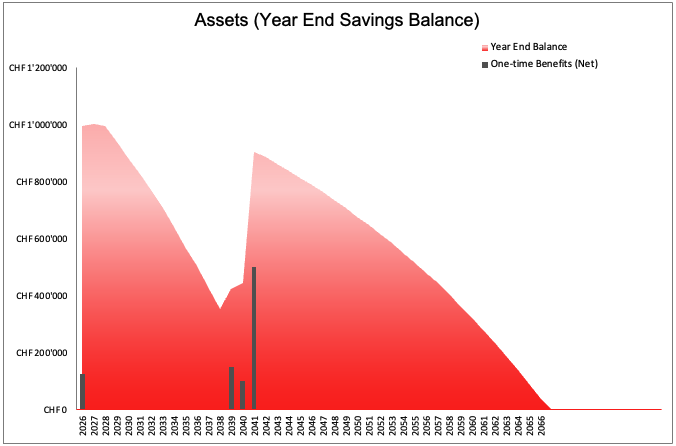
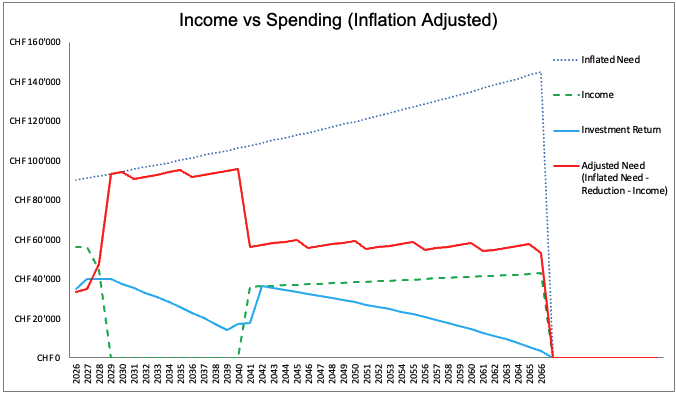
Here below the charts of my last simulations (planning not to live past 90 :smiling_face_with_sunglasses:).

2 Likes

Thank you for your perspective @TeaGhost

As mentioned in my post, I am not targeting a “safe” withdrawal rate, meaning that I am considering to gradually deplete my portfolio over time.

That said, I can still use a 3.25% (or similar) reference rate to quantify the gap that may need to be covered through additional income.

It will indeed be interesting to watch how the sequence of returns unfolds for me over the next two to three years… :slightly_smiling_face:

Thanks for your openness; your story resonates with me on quite some levels … Did you mention your current age? It’a big factor when taking the decision to pull the plug.

Do you factor in the need to put two kids through university or do you count on them making it on their own?

It is. I didn’t mention it, I will turn 50 this year

No, we are not factoring the costs of “exotic” universities. My daughter, the eldest, will attend a university in our canton, so the costs will be manageable and there will be no need to fund accommodation away from home.

As for my son: as mentioned, we still need to see whether he will decide to continue his studies. If that becomes the case, we will figure out. Knowing him, I doubt he will want to move too far away from his “circle”, anyway. Time will tell.

2 Likes

Just a quick point, the standard 4% does allow for depleting. It considers it a success if you end up with more than zero after 30 years.

3 Likes

3 posts were merged into an existing topic: SPHQ vs JQUA vs?

Wow, thanks for sharing weirded and clueless, those are some tough stories to digest. Clueless, my deepest condolenses, cannot imagine what you going through and hope you have good support/help

A few reflections:

FIRE is not everything and I dont believe it should feel like a major sacrifice nor obsession. Never ever wish time to pass away in exchange for quickly achieving that - or any - goal.

On MMM, I see a lot of FIRE drive from hating their jobs. That is sad. Work can and should be joyful - not all the time - but I do think you should demand your job to be interesting, meaningful and giving you more than money. If not, doing more of it to FIRE is not the answer! Finding a better job is!

I actually am grateful I only discovered it later in life, as earlier may have meant sacrifizing travel, experiences and that wonderful (hugely expensive) house which was an amazing frame for the family. We really did live a Die with zero life.

FIRE discovery came at time of large income lifts, in our early fourties, so we just kept similar lifestyles, making savings super easy. Sure, if the game is to retire asap/ in 30s we failed miserably. But, I feel we lucked out by spending freely in our 20s and 30s travelling like crazy and not caring about stock markets and what not. We got awesome memories from every year

So maybe for some of you younger folks: Focus on living your best life NOW. Not tomorrow or in 10 years. Dont sacrifice life experiences or time in a bad job for saving for a better life tomorrow. There is a way to do both. Keep looking, dont settle. And with time you will create savings potential to attain FIRE. Maybe not at 35, but so what?

12 Likes

For those who have no read it Id recommend the classic the 4-hour work week by tim ferris. While the actual how might be outdated the book starts with two chapters discussion „then what?“

Most people have never really thought about how to live there lifes if you dont need to work for money. Often there are vague dreams (living at sea, buying s cabin at a lake in canada, sailing around the world etc) but mostly they remain vague as most people see this as unlikely to happen anytime soon.
So tim introduces the concept of mini retirements. Where you take one of these retirment dreams and do it. Timeboxed 3-4 months but do it for real like it was for the long run.

Many people doing thus then learn that this dream iss actually not really what they are looking for so they can go for the next thing on their list, alter or create entirely new concepts. Thats helps you to learn about yourself and what you really want to do/be in life.

5 Likes

Could you explain what are the one-time benetifs in your graph? AHV? pillar 2? heritage?

Sure. The first one corresponds to the capital gain I will realise when selling the company’s shares upon my exit. The second and third relate to the withdrawal of my Pillar 3A assets in two consecutive years.

The fourth was initially intended to represent the withdrawal of the VB account(s), also supposed to be spread over two years… However, given that I will likely need to use the VB funds in 2029 to repay the mortgage when it expires (as I assume we will not qualify for a new one, and my wife does not wish to consider selling the house at this stage…), I have instead modelled it as a sale of the house at age 65 and the recovery of the tied-up equity (in practice, the amount will be higher, but I am planning to pass the surplus on to the kids).

Alternatively, I may consider a reverse mortgage at that moment, if my wife still prefers to retain the property. That scenario, however, is about 15 years away, and many factors may change in the meantime.