Portfolio for parents

Hello

My parents asked me for my recommandations about investing their pension fund money / 3a money which they will get in the coming few years. They are financially educated, but more the conventional way (working big banks etc). So my ideas would only be suggestions, they also talk to diverse banks etc about ideas and eventually they will decide on their own what to do (which I gladly accept) Also they did safe besides pension funds enough to finance the big chunck of their retirement with these savings and the AHV.

My suggestions would be a classic low cost buy and hold protfolio. mayba 60/40 Shares/Bond.

50% Vanguard all world
10% UBS SMIM

BUT: How would you cover the Bond part? Something like iShares Swiss Gov Bond? Or would you rather suggest iShares Global gov Bond or another instrument?

Thank you for your comments!

I’d say a ā€œCompte d’épargne PLUSā€ at Caisse d’épargne d’Aubonne still beats any CH bonds fund. And protected up to 100k.

I’d use a global bond fund hedged to CHF.

Like VAGX or GLAC. Gloabal aggregate bonds is the default approach with bonds in a portfolio context and hedging is important here due to the currency exposure of them. You could mix in some swiss gov bond fund (like this one https://www.justetf.com/en/etf-profile.html?isin=CH0016999861#overview) if you want to. I’d however try to keep complexity down.

Also instead of SMIM I’d use SPICHA and go for the total swiss market, not just 20 large caps.

Overall solid proposal, 60/40 is a tried and true approach, needs to be regularly rebalanced though. Once a year is a common intervall that works.

1 Like

Thank you @Tony1337 for the clarification about Bonds and @Steerpikes for the hint with Aubonne.

How is allocation calculated I mean 60/40 I understand. But there is also some part that will be in cash, right? My dad is self employed and will probably still having a revenue for some years. Is it reasonable to plan with 1 year spending in cash and the rest invested according to the 60/40 rule?

My idea behind this is, that the do not need to touch their investet money every now and then.

Given the low yields (sometimes negative post tax), I struggle to see the advantage (currently) of bond vs other asset classes.

(Maybe only if the goal is not to touch allocation for next decades, then it might make sense if we move out of low interest cycle)

A lot of information are missing.

Do they plan to receive capital only on the second pillar or a mix between capital and annuities ?

The portfolio construction will vary depending on their expenses and income. The portfolio will help reach the income portion.

1 Like

Fully agree.

To OP : IMHO, a significant portion of the ā€œ40% bondsā€ could be replaced by Swiss real estate funds with direct property ownership. They offer intermediate volatility/yield between stocks and bonds, with significant tax advantages. See this for a detailed discussion in this forum, or that from another well known blog.

I think the ā€žbond partā€œ can be achieved by:

  • compte at caisse dā€˜aubonne
  • a credit they gave me (which is covered by the value of a building)

So probably there is atm no need to think about real bonds.

They have a gap between AHV and their budget of around 20ā€˜000 p.a. Not included future revenue streams from my fathers GmbH. So for the first 5-10 years after pension I they probably wont need to touch their capital.

@Guillaume_GVA they will take all the capital out from their pension fund.

2 Likes

To be honest, no matter how financially litterate they are. If they so far didn’t invest themselves - I would no longer send them to the ETF route. Behavioral risks or execution risks are too big. Remember that many people start to decline by 70 or so, you donā€˜t want to change the setup 5 years down the line.

Hence, I would propose to go with Viac invest… and at the same time tell @VIAC @VIAC_Daniel that they need some kind of CHF hedged global aggregate Bond Index. With just cash or corporate bonds in their default strategies (and neither better bond fund nor decent way of implementing market cap weight stocks in bespoke strategies), you can’t move much money there yet but its hopefully a matter of time.

If viac doesnt implement such fund, I would then move over to Avadis. Less good but still better than a broker and/or ETF investments like at Finpension, that come with tax complexities.

4 Likes

I would say this is pretty reasonable.

@TeaGhost’s proposal is also worth considering.

Who manages the portfolio and make sure it will be executed correctly? Prevent panic selling/mistakes during downturns etc.

When I was asked the same there was interesting conversation which may be useful to you.

TL:DR decision was to put 3+ years’ expenses as pure cash and all the rest in VEVE.

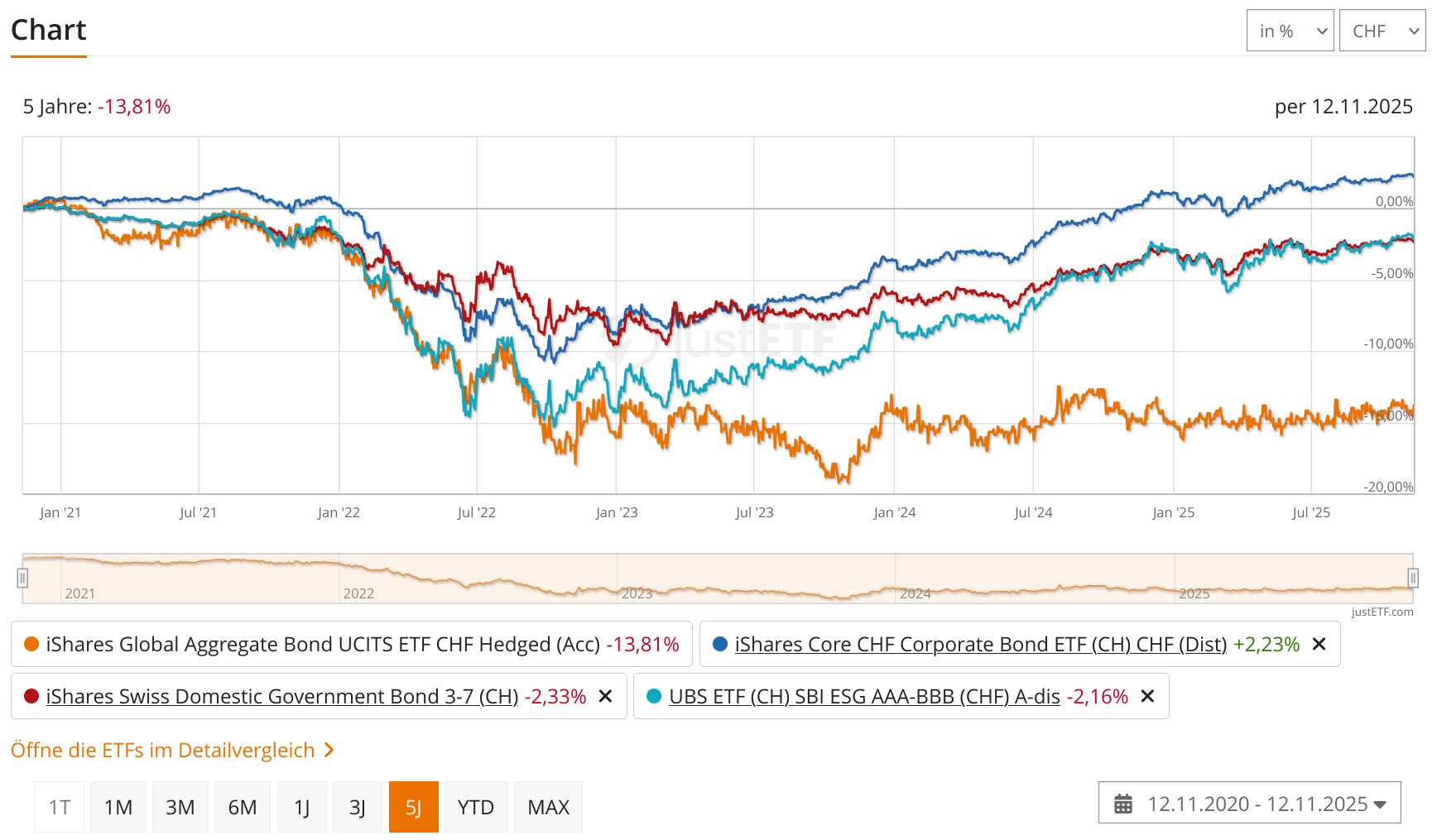
I agree with the hedging for foreign bonds but I don’t think that global aggregate bonds as default approach is such a clear case. I would never recommend investing the complete bond portion of a portfolio in a global aggregate bond fund. And the performance over the last few years confirms that, in my view. Future performance may differ, of course, but the potential performance difference between global and CHF funds is large enough that I don’t consider global aggregate bonds a clear default choice.

If I had to choose a single bond ETF, I’d rather go with a CHF Corporate Bond ETF with its lower effective duration, despite some short term correlation with stocks. A mix of CHF and CHF-hedged global funds may be reasonable, though.

I wasn’t convinced of a single fund myself, so I invest in a mix of CHF corporate bond fund, CHF-hedged global aggregate bond fund, aggregate CHF bond fund and short-term CHF bond fund (one reason was also to control the effective duration a bit). I also hold a Swiss real estate ETF and gold ETF as further diversifiers.

1 Like

I can agree to mixing CHF bonds into the allocation. Iā€˜d mix in swiss government bonds however.

But here I definitely disagree. The bond part in 60/40 should be majority government bonds that are mostly safe and uncorrelated. As that is the purpose of the bond part.

You donā€˜t want your bonds to be down a lot as well during a recession, then when you want to rebalance from your bonds into the depressed stocks.

Some small-moderate amount of investment grade corp bonds is ok. Like the classic BND from the bogleheads is about 70% government and 30% corporate.

The recommendation for global aggreate comes from trying to keep it simple for folks like OPā€˜s parents. Even 3 funds is already a lot.

VT + global aggregate is probably enough and even simpler.

Sure performance hasnā€˜t been great recently. But that was mainly due to yield curve developments. Swiss cut rates a lot faster than other governments and we are already back to zero rates. Thatā€˜s why swiss bonds recovered already, while other governments are still at higher rates (and may stay there). While swiss rates may not have much room to fall anymore.

However that is also short term thinking and shouldnā€˜t be a determining factor.

But handling a handful of bond funds or more alternatives is really not it in my opinion for someone like OPā€˜s parents. If they want that, theyā€˜d need a robo advisor or go to VZ etc.

Tops I would add the ishares 3-7 swiss government bond fund at 10-20% maybe.

Keep it as simple as possible and only as complex as necessary.

Ideally Vanguard does a swiss version of their € Lifestrategy funds for us swiss investors. That would make these topics so easy. Just put everything in their 60/40 CHF and forget about it…

Thinking about it, their € version is so good, it wouldnā€˜t even be a terrible solution for a swiss investor. € is likely to stay quite correlated to CHF I would think. Sometimes simplicity (and prevention of mistakes) beats a more optimal solution.

Closest we have to that are the Avadis solutions like their 60/40 https://avadis.ch/assets/files/private/de/factsheets/strategie_wachstum_ava_sicav_de.pdf
Which is good and the allocations are solid as well. The TER is quite high at 0.54% though.
1 Like

If you go for a single Swiss stock fund, I’d rather choose an SPI ETF. The concentration risk of SPI is not much worse than SMIM (top 5 holdings are 46% vs. 40%). However, the SMIM companies are smaller on average, which typically results in more volatility. And the vast majority of revenue is foreign in both cases. That said, the difference with regards to overall portfolio returns might not be that big.

5% each would not be unreasonable but it would make the portfolio a bit more complex.

Instead of selecting bonds with really low returns, check the conversion rate of the pension fund and take an annuity which would act as a bond with more security and better return. Most pension fund allows to take one part an annuity and an other part as capital

(Personally, I would recommend 100% stocks + no annuity.

Some interesting insight

)

I’m not actually recommending to go full in on corporate bonds (and hence I’m not a fan of the current VIAC Invest options). It’s just that I don’t really see a single bond fund that I’d be happy with for the full bond portion of a portfolio (especially if bonds make up 40% of the portfolio).

The Swiss Gov 3-7 ETF would certainly be a safer and more conservative option, and would qualify with ā€˜mostly safe and uncorrelated’, although with a negative expected return.

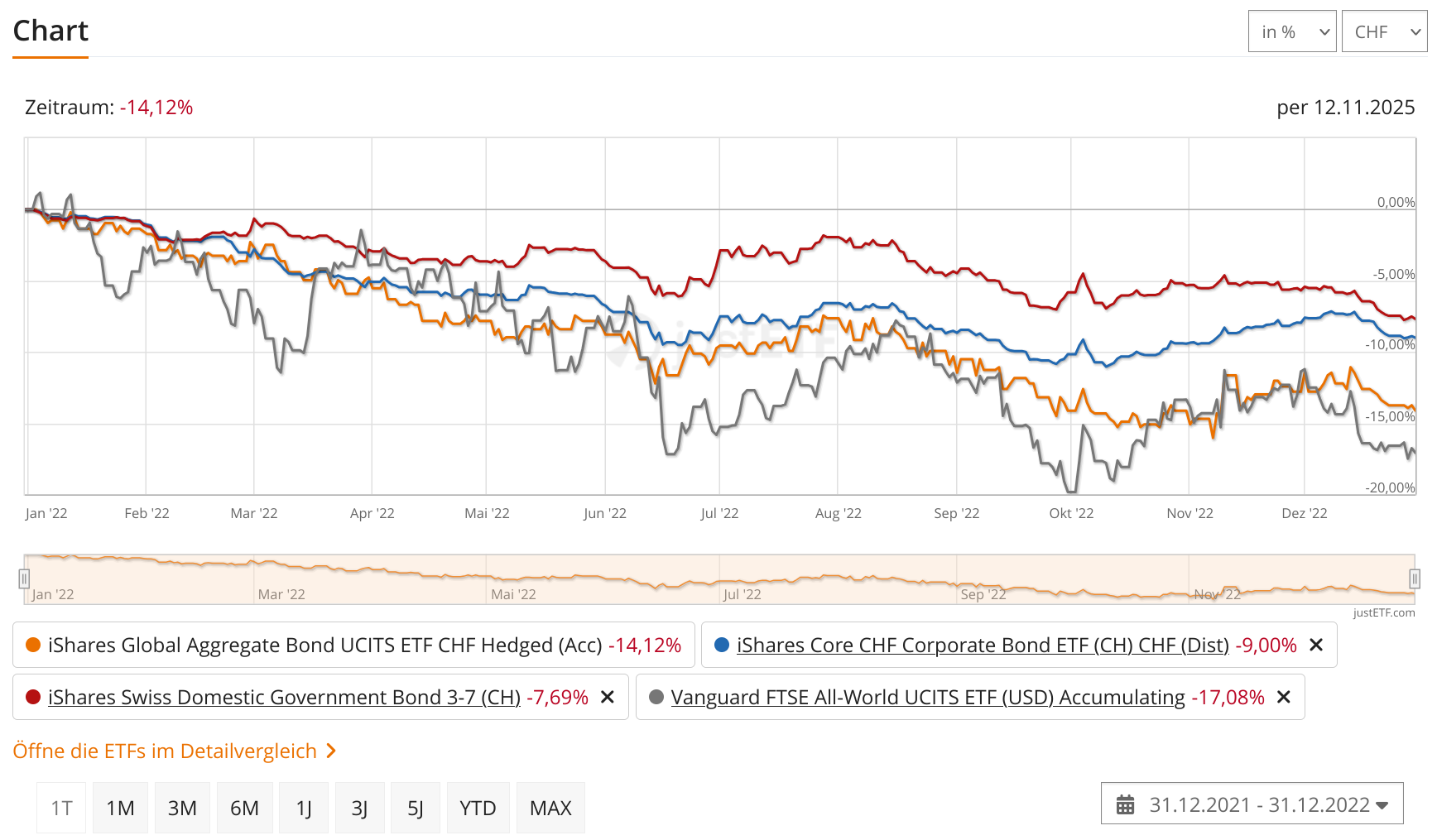
However, I don’t consider a global aggregate bond fund to really be a safe option for 40% of a portfolio.

2022 may have been an extreme case but still, I consider that too much risk given the low expected return, especially for 40% of a portfolio. A possible but still simple option to derisk could be 20% global aggregate + 20% CHF cash on a savings account.

Yes, I tend to agree with @TeaGhost that if they don’t have investment experience yet, direct investing at a broker may not be the best option, unless @newhere manages it for them.

Yes, it would be nice if more low cost strategy funds for Swiss investors were available. UBS Vitainvest Passive funds exist but that’s about the only option. And I’d prefer a Vanguard Lifestrategy fund.

It might but I wouldn’t take that gamble. I would certainly not consider EUR-hedged bonds to be a safe part of a CHF portfolio. I’d rather pay a fee to VIAC or Avadis than risk that.

3 Likes

Agreed, if you ask me - a Swiss 60/40 investor should use roughly the below for their bond allocation:

  • 20% SBI Aggregate
  • 20% Global Aggregate CHF Hedged
  • 10% Global Corporate Unhedged
  • 10% EUR Corpoorate Unhedged (to offset the USD exposure)
  • 20% SBI 1-5
  • 20% Money Market or better (if below 100k and credible segregated CHF account in own name) CHF ā€žcashā€œ account

The Problem with Viac invest is that you not just donā€˜t get anywhere close to such comprehensive setup (which is ok) but that they lack fundamental building blocks like a Global Aggregate CHF hedged. With that alone, you could already get fairl close to an ideal setup - unhedged global/europe corporates are just optional and SBI 1-5 can be solved with more money market (but for larget amounts only if they introduce a money market fund).

1 Like

That’s actually pretty close to how I invest my cash&bond portion (it’s 25% in total, though, not 40%). The only real difference is that I swap the 20% in unhedged global/EUR corporate bonds with 20% in CHF corporate bonds. I would assume similar expected gross return long term but I would expect lower volatility and also lower taxes on the CHF corporate bonds. (In 2024, taxable income was 0.98% for a CHF corporate bond ETF and 3.77% for a global corporate bond ETF).

Thank you all for your kind replys, which I will consider. @TeaGhost your point is very thoughtful. My parents started investing maybe 10 years ago, so they are not completely new to this. Also my father is very used to work with numbers and perfectly understand what is happening when he makes some changes. But sure, you never now what the future will bring.

3 Likes