Planning withdrawal strategy for parents retirement

Hello fellow mustachians.

I’m currently helping my parents set up their withdrawal strategy for their retirement, and would really appreciate your feedback. They have already received a “pension planning” of a (in my view) highly questionable “Financial Advisor” – and frankly, it is complete garbage, which is why I think we are better off thinking this through ourselves.

Their situation:

Assets:

Cash & equivalents: 184k

Bonds & equivalents: 1.1 m Pillar Lump sum from Mr. Retired Frog to be paid out soon

Investments: 3.1 m (currently invested in 85% stocks, 7% bonds and some mixed stuff)

Other: 66k

Real estate: 3.2m (primary residence + 1 commercial property which is currently rented out, but long-term tenancy is uncertain)

-> Financial assets excl. RE: ~4.5 m

Income & spending:

Combined pension (AHV): ~34k/year

Rental income: 13k/year

Expected spending: ~120k / year (generously estimated, but they would like to enjoy themselves and travel etc., later on they might be facing higher medical expenses etc. )

Taxes during retirement: estimated at ~30-40k /year

-> Total expenses during retirement ~150-160k/year

-> Total draw down from portfolio needed: ~ 110k/year

Drawdown will likely start in ~3 years (for the next three years, they will receive additional insurance payouts which will cover their expenditures).

Special considerations:

- They are currently 65 (my dad) and 69 (my mom) years old, and luckily both are in good health

- The set-up needs to be simple for them to use (easy withdrawal / rebalancing process), they value simplicity more than a set-up which is perfectly optimized for lowest possible fees

- My dad has some experience investing in ETFs and with Roboadvisors. They prefer Swiss-based broker solutions, and would probably be overwhelmed with the IBKR interface

- They are not comfortable going all-in on equities overall

Current thinking (2-pot approach):

Their current thinking is to set up a 2-pot strategy.

Pot 1: “Pension pot” on TrueWealth (they like the interface and are both familiar with it), where they would manage the outflows and re-invest any surpluses. Starting balance could be the 1.1 million to be invested from the 2 pillar pay-out.

The thinking there is to go with a 80% stocks, 20% bonds allocation. This pot would have less volatility and more downside protection thanks to the bonds allocation to avoid that they panic if markets are down).

Pot 2: Growth pot, sitting separate, in a different broker (for diversification reasons – we were thinking about Saxo). The idea is that they would not touch this until the pension pot is drawn down. Starting balance would be 3 million.

Real Estate for now is left out of the picture for now, as this adds another layer of complexity.

Questions:

  1. What do you think of the 2-pot strategy with 2 separate brokers?

  2. What do you think of the asset allocation for the first pot (Pension pot, 80% stocks, 20% bonds: and the second pot (100% stocks)?

  3. In terms of the instruments, if they go for True Wealth for the Pension pot, Instrument choice would be limited. For the bond part, True Wealth offers the iShares $ Treasury Bond 20+yr UCITS ETF (CHF hedged), as well as a USD High Yield Corproate Bond ETF. How would you rate these instruments? What would you recommend if there was unlimited choice?

  4. Do you have a recommendation for a tool that let me model the cash outflows granularly, stress test outcomes under different assumptions (to model the impact of Sequence of Return risk)? I am aware of this one, but it is heavily geared towards the US: https://saferetirementspending.com/

Thanks so much in advance!

Frog

I doubt they are going to manage to spend the natural yield off the investments. I’d just setup the portfolio with dividends and interest paid into a bank account and then monitor the first few years to see how fast the balance is growing or shrinking and adjust from there.

3 Likes

:+1: Back of paper math:
4.5mx0.02= 90k
4.5mx0.04=180k

More general advice: Make sure they can truely relax about spending by understanding their financial picture including RE and how much they could really spend, because the trap for them would be only allowing themselves to spend dividends :blush:

3 Likes

Why not just use VIAC/Finpension because they have an automatic payout-plan as well as automatic portfolio rebalancing? Combine the two pots into one which would end up being 95% stocks and 5% bonds for simplicity.

2 Likes

I would keep some funds available for bigger RE items repairs as they can happen. 1% maintenance on 3.2 Mios real estate is 32’000.-/year. That can be the cash cushion.

Don’t forget to put aside money for the taxes on the 2nd pillar withdrawal. I guess you have studied whether the withdrawal was better than the pension or can’t change that choice at this point anyway?

Their planned withdrawal rate sounds like 2.5% (110k/4.35M). They have no need to take risks.

I like the concept of the 2 pots with different brokers, meaning they don’t have to look at the 2nd pot at all if the first one sustains their needs. 4% (safe withdrawal rate over 30 years) of 1.1M is CHF 44’000. That doesn’t cover their expenses so that pot could get depleted. They’d need 2.75M to sustain the 4% rule (which would still mean that the pot could get depleted by the end of 30 years) or 3.15M for a more permanent 3.5% (note that the % withdrawal is inflation adjusted so they could draw out more as the cost of life goes up, though should also apply restrain in deflationary times).

For a 2nd “broker”, I’d take a look at VIAC Invest.

For a “quick glance” portfolio assessment tool, I like Lazy Portfolio: https://www.lazyportfolioetf.com/

Caveats: supported currencies are USD, EUR, GBP and CAD. CHF is not yet available.
I’m using the global funds as the closest comparable assets so no Swiss specific assets. In particular, no CHF denominated bonds only.
Time series only since 1970.
The future isn’t the same as the past.

So it’s more for a quick assessment with supporting graphs and data than for actual modelling or accurate numbers.

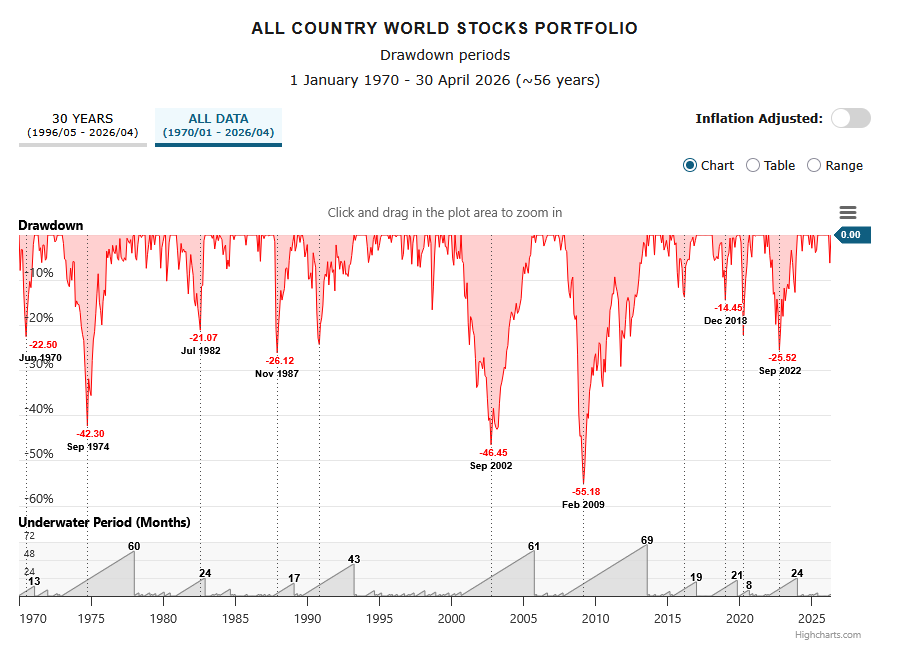
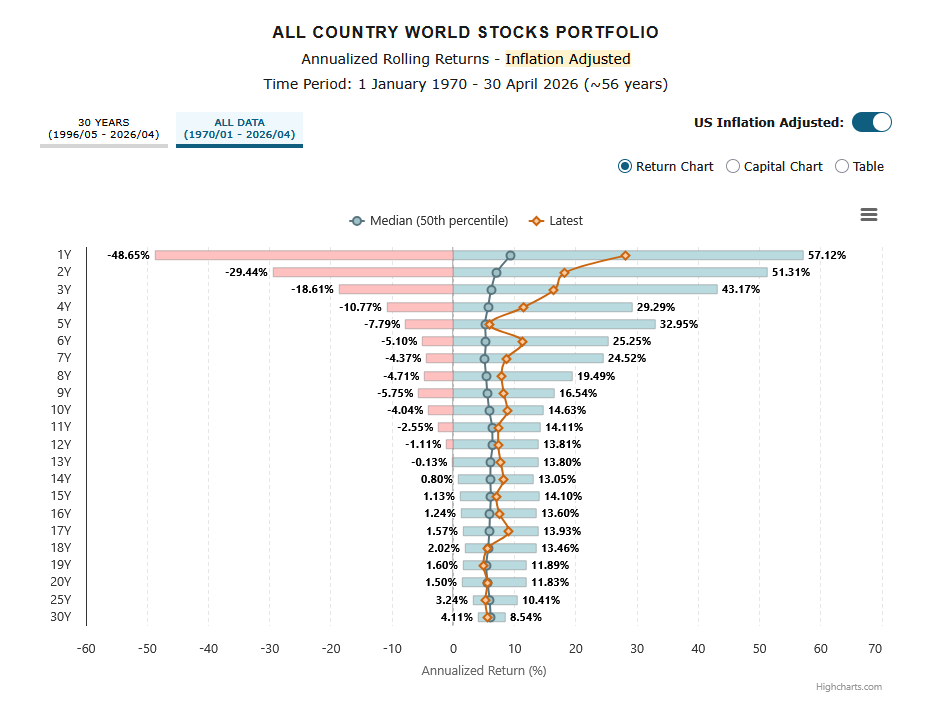
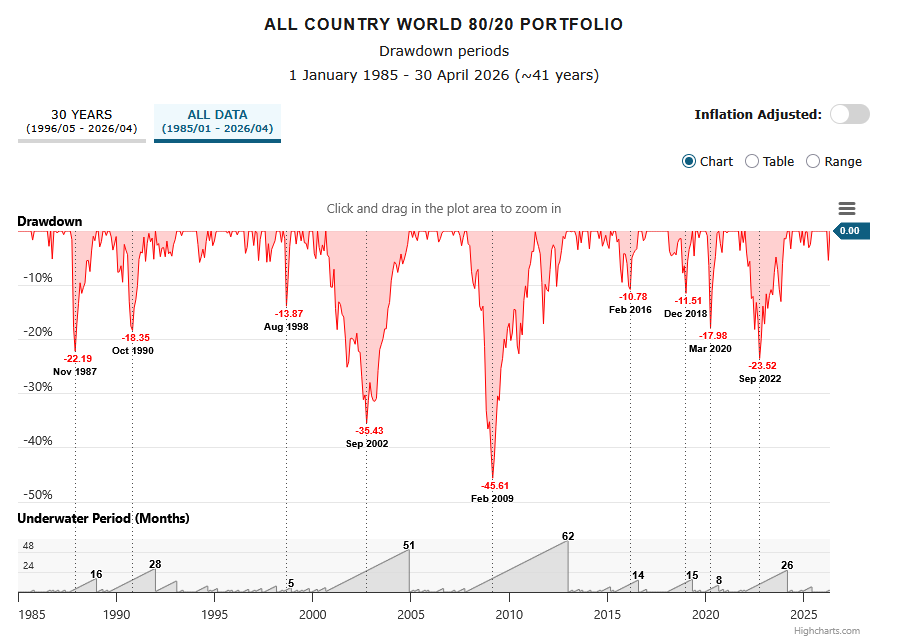
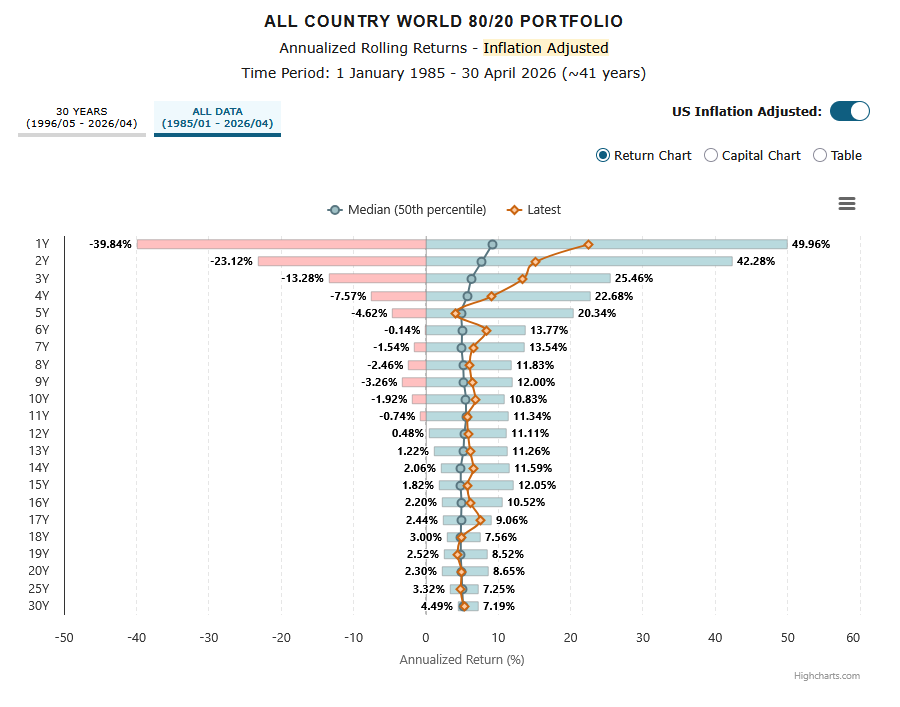
It has data and graphs on a selection of global stocks/bonds allocations: Balanced Lazy Portfolios: All Country World

80/20 doesn’t seem that different from 100/0 to me. Depending on how risk averse they are, it may be worth it to lower the amount of stocks. That being said, they’re used to a stocks heavy portfolio so may have the risk tolerance for the 80/20.

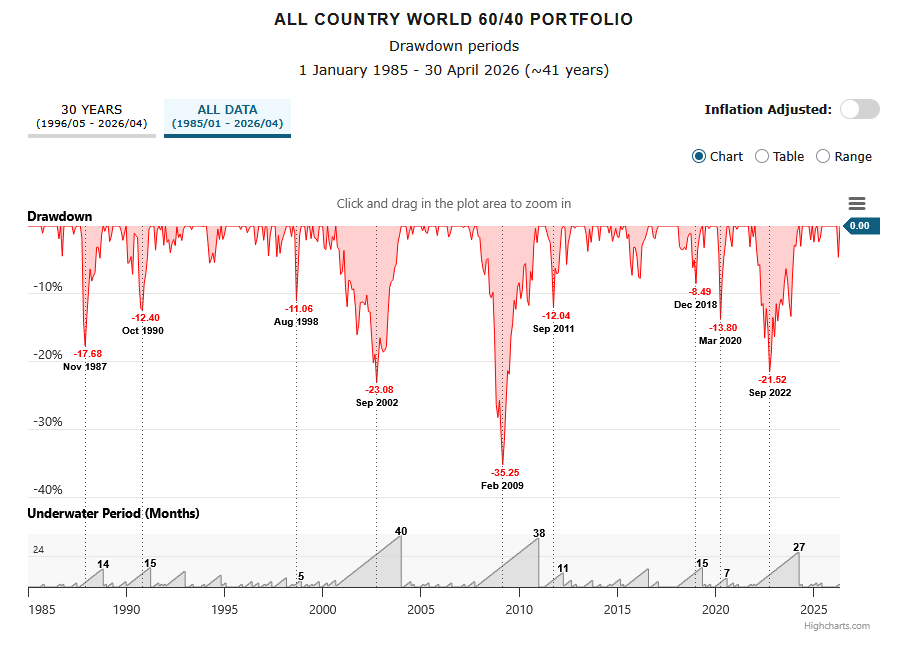
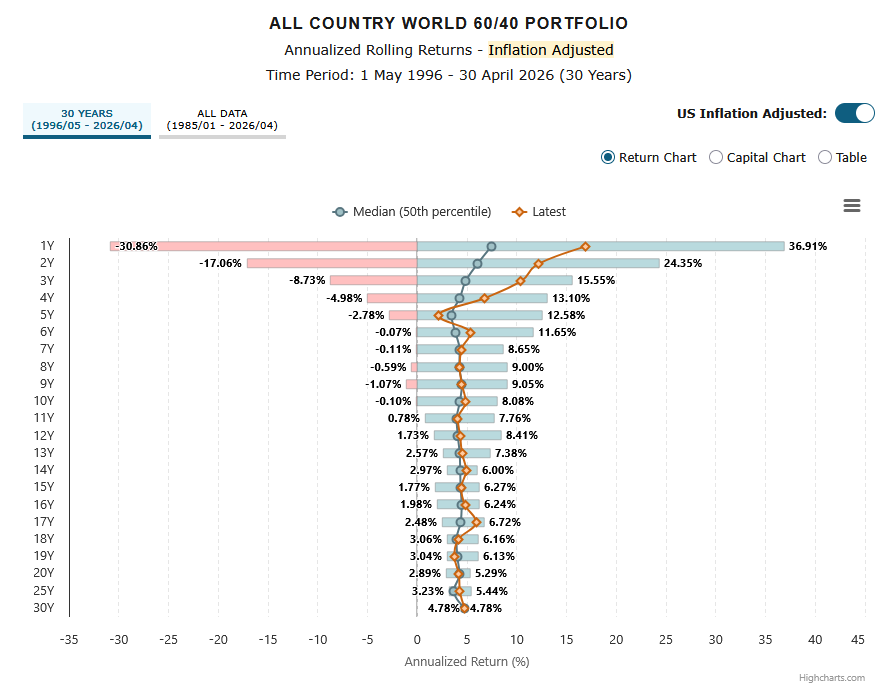
I like to look at drawdowns and rolling returns:

Extend for graphs

100/0:

80/20:

60/40:

3 Likes

Sounds to me overall like a well constructed and well thought out plan. Some minor comments:

Also mentioned by @Wolverine 80% stocks sounds too high if really wish a low volatility. I would do between 50% and 60% stocks. Alternatively, if you go for 80% stocks, I would put 20% into high dividend ETFs, since these tend to have lower volatility.

As mentioned by @logitacher and @Wolverine if you prefer simplicity, I would rather suggest Finpension invest or Viac invest for these main reasons:

  • Choice of strategy instead of ETFs. Based on your chosen strategy, Finpension/Viac select the ETFs. Optionally you can skip the strategy and choose the ETFs yourself. With Saxo you have to choose the ETFs yourself, you can’t choose a strategy.
  • Limited number of ETFs. The more limited number of ETFs makes the selection easier. Of course, the downside is the more limited choice of ETFs.
  • Withdrawal plan: you can set up automatic withdrawals.

Not sure this is the right approach. Unless you have insurance to cover unexpected large expenses or the loss of rental income, your real estate should be part of the full income & spending picture from the beginning.

Assuming the expenses are mostly in CHF:

  • iShares Core CHF Corporate Bond ETF (CH)
  • iShares Swiss Domestic Government Bond 7-15 ETF (CH)
  • Vanguard Total International Bond ETF
  • Max 100k CHF in cash (assuming there is interest)

I would not do CHF hedged. Such hedging always comes at a cost.

Take your favorite AI and vibe code it.

1 Like

Agree: include the value of the commercial property to evaluate possible max retirement spending potential because they could always sell it to free up the money.

(Also evaluate if it’s worth holding and renting it out. 13k income on how much value? Either way from a “use your money”-perspective, you would sell at some point to use the capital which would be more useful at some age point. Though your parents may never burn /want to burn through all their wealth, just make sure they know that they could and what it would mean spending options wise.)

2 Likes
  1. Are the 120k a bit overestimated? seems quite a lot with a primary residence already paid.
  2. I would go 100% stocks.
  3. Why not use margin loan instead of selling? IBKR offers automatic recurring withdrawals.
1 Like