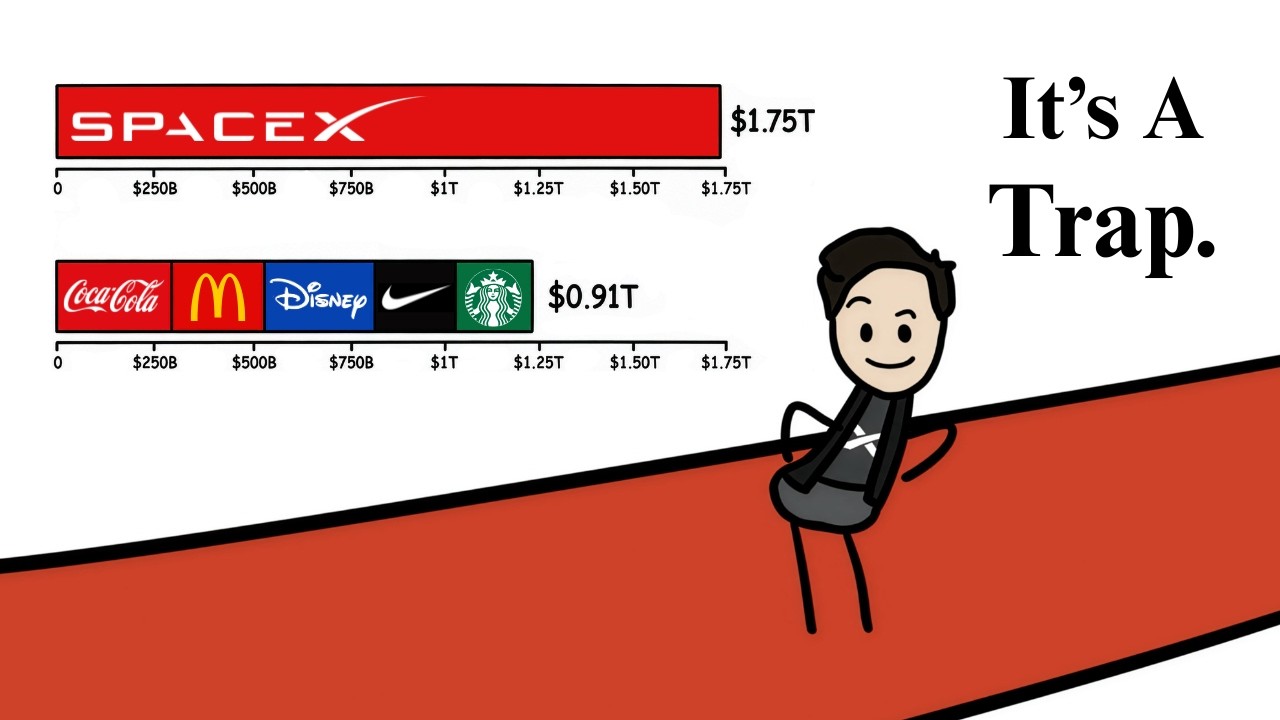
Am I understanding the seriousness of this post?
“In February, Nasdaq published a “consultation” proposing sweeping changes to how companies enter the index. The timing is pure coincidence, of course.
Just like it’s pure coincidence that SpaceX has reportedly made fast index inclusion a CONDITION of listing on Nasdaq.
Here’s what they’re proposing:
A new “Fast Entry” rule would let any newly listed company whose market cap ranks in the top 40 of current Nasdaq-100 members get added to the index after just 15 trading days.
No seasoning period. No liquidity requirements. Completely exempt from the standards every other company had to meet.
Currently, new public companies typically wait up to a year before they’re eligible for major index inclusion.
That waiting period exists for a reason. It lets the market establish real price discovery. It protects passive investors from being forced into untested, illiquid stocks.
And Nasdaq wants to throw all of that out. For ONE listing.
But the Fast Entry rule isn’t even the worst part…
The real scandal is the 5x float multiplier.
Right now, the S&P 500 uses a free-float adjusted methodology. If only 5% of a company’s shares are available for public trading, the index weights you at 5% of total market cap.
That’s common sense. You weight a company based on what investors can actually buy.
Nasdaq’s current methodology already uses total market cap rather than free-float for weighting. But for very low-float stocks, they at least had a 10% minimum float threshold.
Under the new proposal, that threshold DISAPPEARS entirely.
Instead, any stock with less than 20% free float gets weighted at FIVE TIMES its actual float percentage, capped at 100%.
Do the math on SpaceX:
If SpaceX IPOs at $1.75 trillion and floats 5% of its shares, there would be roughly $87.5 billion worth of stock available for public trading.
Under Nasdaq’s proposed 5x multiplier, the index would weight SpaceX at 25% of its total market cap. That means passive funds would be forced to buy as if SpaceX were a $437.5 billion company.
But only $87.5 billion of stock actually exists in the market.
You are forcing hundreds of billions in passive buying into a $87.5 billion float.
QQQ alone manages nearly $400 billion. The total Nasdaq-100 ecosystem represents over $1.4 trillion in exposure across ETFs, mutual funds, structured notes, and derivatives.
Every single passive vehicle tracking this index would be REQUIRED to buy SpaceX at whatever price the market dictates.
On Day 15.
With zero price discovery. Zero track record as a public company. And a float so thin you could read through it.”