I’m looking into a leveraged fixed deposit structure offered in my home country for non resident citizens in USD/EUR and wanted to double-check a specific point regarding Swiss tax treatment—specifically the deductibility of loan interest against gross income.
For context, I hold a C permit and reside in Canton Zürich.
Strategy Overview
The leveraged trade works as follows:
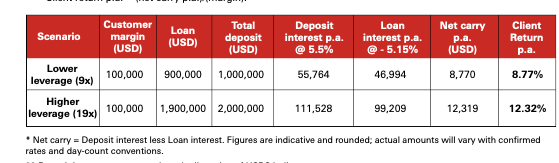
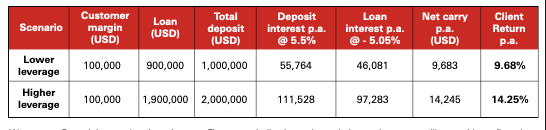
Deposit & Loan Structure: You open an fixed deposit in foreign currency (e.g., USD, EUR) with an offshore bank division with a fixed deposit rate.
Concurrently, the bank provides an overdraft/back-to-back loan against the deposit at a fixed loan rate.
Spread: Because the fixed deposit yield exceeds the loan interest rate, you capture a net interest carry on the leveraged equity portion.
Deposit country Tax Status: tax-exempt
The Swiss Tax Angle & Questions
My understanding of how this must be declared on the Swiss return :
Asset (Wealth Tax): Declare the gross deposit value under Wertschriften- und Guthabenverzeichnis at the year-end ESTV exchange rate.
Liability (Wealth Tax): Declare the back-to-back loan under Schuldenverzeichnis to offset the asset value.
Income (Income Tax): Declare the gross interest received as taxable income (converted to CHF).
Deduction (Income Tax): Deduct the total loan interest paid (Schuldzinsen) from gross taxable income.
Questions
Loan Interest Deductibility (Schuldzinsen): Can anyone (perhaps a similar lombard loan / back-to-back debt structure) confirm if ZH cantonal tax office accept the full deduction of the foreign loan interest against gross investment income without issue?
Tax Cap Limits: Under federal/cantonal rules, debt interest is deductible up to gross taxable investment income + CHF 50,000. Does a back-to-back loan against the deposit cleanly fall under this rule, or are there any nuances/disallowances regarding offshore loans?
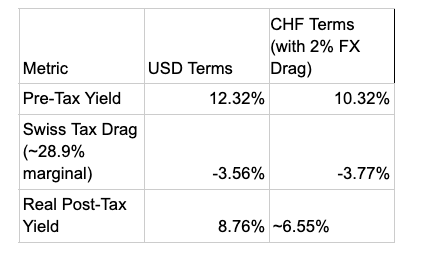
Assume the loan interest deductibility, I calculate the below yield
I don’t think they care that this is offshore. And deduction < taxable income so should be fine.
couple of notes:
the title says “deposit”, but 12% yield screams that this is far from risk free (risk free rate close to 4%)
expected depreciation over long term is likely closer to the delta of interest rates (so again more like 4% than 2% drag)
Make sure you know what’s backing the deposit and what a default or haircut will correlate with (it doesn’t seem obvious to me, hopefully the prospectus explains it).
What’s the lending rate in CHF (how competitive is it?)
(Actually I’m a bit confused is the 12% the leveraged return? or the deposit yield?)
It is indeed a deposit. Issued by nationalised banks (slightly lower yields and lower leverage 6x) or private banks (say HSBC, higher yields and much higher leverage, max 19x for the higher counterparty risk)
They do not offer in CHF.
USD, GBP, EUR, AUD, CAD, and JPY only.
I think you’re missing counterparty/default risk (I doubt those are guaranteed deposits), and are there any duration mismatch? (Is the loan and bond on the same duration?)
Thanks, 1Y or 2Y is still interesting if the loan deduction is accepted.
Counterparty risk -
if counterparty = nationalised bank = the govt (minimal risk of default) else private players like HSBC, DBS, Standard Chartered .. risk is slightly elevated
I confirmed - no duration mismatch, loan runs parallel to the deposit
Wait, the Bank pays higher, fixed interest on deposits, than i requires as a fixed, same duration interest on highly leveraged loans? Run… as fast as you can. That os too good to be true.
yes, i spent a significant amount of time trying to find the catch
What i could understand, the bank needs the depositor as it can utilize a special limited time forex swap window by the central bank where hedging costs are subsidized, the credit risk is not on the bank’s books and they get the upfront premium..
Without the depositor it will be classified as unhedged direct cross-border bank borrowing which the regulatory framework prohibits..
The central bank is in dire need of boosting their FX reserves and with this arrangement it does not incur direct sovereign debt liabilities..
gave the Bank 100k of an equity like cash infusion
The Bank using fractional reserve took this as collateral to obtain credit from the central bank (at x10-20)
They gave you this credit and you then invested this as non-secured cash deposit with them
AND we talked a country / central Bank that was clearly incompetentin kts overaight of financial institutions and/or consciously followed a financial represstion doctrine or some major cracks / soon to be colapsing local financial system
did I already recommend to run? And did I already ask for the country? Malta, Turkiie, or a comparable financial market craphole (not talking about country and people, just the financial system)
Most of the deposit won’t be protected (esp given leverage), if a bank blows up you’re screwed
Can lose a lot of money on early withdrawal due to penalties (with leverage it means you lose most of your capital)
Might have impact if you wanted to come back to India during that time period
Should be really careful about the terms of the loan, duration mismatch/terms/etc the two products aren’t really linked so in the end you’re on the hook for a very large amount of money
I guess if you trust your country of citizenship it can make sense but it’s not risk free either.
yes, trying to attach the HSBC factsheet but seems a pdf upload is not allowed..
I confirmed and have in writing there is no duration mismatch (will be in the agreement terms)
As in this news article, risks highlighted are premature withdrawal, loss of overseas residency.
I will add the counterparty risk to it, but with the nationalized banks (pseudo goverment), it is acceptable.
I am still trying to understand the leverage risk if i hold on to maturity..I was earlier under the impression that loan will be floating (linked to SOFR) and deposit fixed. But, that is also not the case.
I most likely will let this go, minimum holding is 3Y so the loan cannot be deducted but it’s quite interesting, especially in countries where it is allowed..
I suspect voters wouldn’t shed a lot of tears if NRI get a haircut in case of banking crisis. You’re also betting on 3-5y of financial and political stability here.
The Situation is even worse than the credit risk you enter. This seems to be an unofficially incentiviced move the national Bank of india (how is it actually called?), in order to attract inflow of capital. Remember that India has had a history of capital and export controls. The most famous one I remember as a westerner is their restriction on gold transfer (which lead to a situation that some dude booked an entiere A380 with folks that got one week of dubai vacation, and just had to transport their maximum allowance of 1kg gold, that could be imported (or exported?) without uplift. What if in 5 years time, you realise you faced capital export controls that either prevent you from taking the capital out of the Indian banking system, or worst case that both insists on the indian banking system and an USD account? This may not only apply to your collateral (the 100k) but the additional, leveraged deposit as well… so you all off a sudden MUST roll this over at unknown credit conditions, or simply infuse another 900k USD into India.
Not only from a professional background do I highly appreciate India, its Culture and its people. But I am fully aware that India is currently facing an extremely challenging situation, the combination of AI (what does it mean to TCS, Infosys, …), the rise of China (Tata Cars and Steel), stability of Pakistan and Global Warming… can turn a great country with currently moderately interesting government into a very different place in 5 years. I do not hope this would happen but if I all off a sudden had to top up 900k USD on top of my 100k invest; even the smallest risk was too much for me.
Mit dem Lesen und der Teilnahme an diesem Forum bestätigst du, dass du die Forum-Richtlinien gelesen hast und damit einverstanden bist sowie den Haftungsausschluss auf http://www.mustachianpost.com/de/ akzeptierst.