If you go for sell VT maybe that’s the time to let us know about your experience with the IBKR trading desk (seems like the perfect situation for this, you’ll pay a bit more fees for a lot less slippage and risk).
2 Likes
Additional question: rebuy via IBKR or SQ/Saxo?
I understand the rationale behind switching to VALL/D, but I’m still not sure I understand the reasoning behind buying through a non-IBKR broker such as SQ or Saxo.
From a cost and efficiency perspective, IBKR seems hard to beat. More importantly, I would have thought that keeping the investment account outside Switzerland actually adds another layer of diversification, especially if most of your banking, savings, pension, real estate, etc. are already in Switzerland.
So wouldn’t moving everything to a Swiss broker create another form of concentration? Not necessarily in terms of the assets themselves, but in terms of the country, banking system and legal/regulatory framework they depend on.
I understand the argument if the concern is broker risk. But as I understand it, stocks and ETFs are held as client assets and are segregated from the broker’s own assets. So if IBKR were to have serious financial problems, the underlying securities should not simply disappear and should, in principle, be transferable to another broker. Obviously there could still be operational issues or delays, but that seems quite different from having cash deposited with the broker.
This makes me wonder what risk we are actually trying to reduce by using SQ/Saxo instead of IBKR.
If the concern is counterparty/custody risk, then I would think the key question is the custody and asset segregation structure, rather than whether the broker is Swiss.
If the concern is jurisdictional risk, then keeping the portfolio at IBKR would seem to provide more diversification rather than less.
And if the concern is simply operational risk, then I can see the benefit of having a second broker as a backup. But in that case, wouldn’t it make more sense to keep IBKR as the main broker and have a smaller portfolio with SQ/Saxo, rather than moving the whole portfolio?
I’m not saying a Swiss broker is a bad choice. I’m just trying to understand what specific risk or benefit justifies giving up the cost/efficiency and geographical diversification that IBKR seems to offer.
Maybe I’m missing something in the way the custody/legal structure actually works?
4 Likes
That is exactly my plan, keep the main portfolio at IB with US products and slowly start to make new purchases on Saxo with UCITS funds
3 Likes
i am also thinking to switch to VALL. Anyone has check in what exchange is best to buy it and what is cheaper with IBKR?
Good news!
TradingView also shows CHF as currency !
4 Likes
I would say currently LSE in USD by IBKR.
1 Like
Why not the other way around - IBKR will release UCITS products in case you die.
I can imagine, that banks as SQ and/or Saxo have to inform you how to act correctly when you hold US-products.
1 Like
Other approach could be buy by IBKR, transfer to Saxo (for UCITS).
Keep US to IBKR.
But yeah, tracking and mental exercice…
Just to keep things in perspective, 0.05% means $50 fee on a $100,000 transaction. It’s not peanuts, but also not a deal-breaker. You’ll “spend” more analyzing the differences between the brokers.
Fair point, but I’d say for one scenario it remains relevant: the initial switch from one fund to another when you already have, say, 1m CHF. Then it’s 2300 CHF to sell the old one and 2300 to buy the new one. Or if you’d like to switch funds in the future.
3 Likes
You can pick VALLD and keep dividends coming in if you so wish - eliminates 1 dimension of the choice if it concerns you.
For some this is a bigger, for some a larger deal/issue - you need to choose for your self/situation.
I can see a point now for UCITS at IBKR due to competitive TERs and circumventing the estate issue, but whats the case for holding US assets at swiss broker? Isn’t it better to go full UCITS in that case?
Let me explain my thoughts in more detail why I would put UCITS with IBRK and US-domiciled products with a Swiss broker/bank, if someone wants to have US-domiciled products (e.g. ETFs or shares):
IBKR is great for UCITS; cheap tickets, decent FX, LSE/SIX lines, no Swiss custody fee for existing. And the important bit: an Irish ETF is a European share, even if the fund is stuffed with US stocks.
What IBKR is not great for is actual US-domiciled stuff when you die. Account gets flagged, trading stops, and once you’re over USD 60k of US-situs paper they want the 706-NA / treaty forms before they let anything out. That’s their process.
Moreover, and this is something, I have to dig in deeper but will already share my thoughts/infos I have: cash at IBRK could be part of the US-situs tax since it is not a bank deposit. It’s a claim on the broker - a debt of a US person. Same idea often applies to cash sitting in a US money-market fund. (CHF or EUR in that same US broker account does not save you. Situs does not follow the currency code.)
We all have an IBKR-UK account, but custody still runs through IB LLC in the US. IBKR has told heirs (according posts in the internet) that cash counts as US-situs because IBKR-UK is an introducing broker to LLC. But this probably another topic.
A Swiss bank freezes the whole relationship on death anyway. That’s just Erbschein / Erbengemeinschaft, happens whether you held Nestlé or NVIDIA. Difference is - and this is the most important part and also part of my experience, when working at the (Swiss) bank - they usually don’t run a mini IRS helpdesk. US names sit in a nominee pile. If the heirs keep it in-house, a US transfer agent often never sees it. NVIDIA shares move from your parents portfolio to yours, that’s it. But don’t take my words for granted.
Doesn’t mean the IRS vanished. Over USD 60k of US stocks/ETFs you’re still supposed to file. Swiss-US treaty usually knocks the actual tax to zero if your worldwide estate isn’t huge. The form still exists. The Swiss bank just probably won’t hold the assets hostage for it. IBKR will definitely do that.
Since I spent too much time with such a headache topic, this just gave me more assurance to stay with UCITS products. No US-domcilied ETFs or shares for me. I have plenty of Apple, NVIDIA etc. in my VALL anyway 
13 Likes
I asked for a quote, the fee is 7.5 basis point times two, i.e. 0.15%.
Can it be done without waiting for any settlement with a non-margin account? If you sell and buy in USD?
2 Likes
Thank you for your post I think it summarizes my view on the IRS part.
As you seem to have thought about it in details, let me present it from a different angle.
Lets say your broker goes belly up, commits fraud, is hacked, Trump blokes foreign assets, or etc this kind of scenario. Your account, and the one from many others around the globe, is blocked. The only way to proceed is to follow a legal claim.
Which broker to you prefer to face?
I would say PF/SQ/Saxo 100%.
Do I think the risk is high: No. Possible: Yes. Do I want to hedge it at a certain time in my life /portfolio size: Yes for sure, just like a life/iv insurance made sense at one point.
Fees, TER, etc are all valid and have their inportance, but I think there is a scenario where we look at the trees instead of the forest (it is a mustachian bias I think).
Switching to UCITS make the case easier. You can contact IBKR’s office in Switzerland or through online support and follow the guidelines they provide. Same as any other CH bank or broker, no ?
(Yes you can argue that with some, you can go to the desk to clear the situation or make an appointment.)
I think even if you trade American stocks on Six, they remain US assets. So the question would be other; trade only UCITS products or no individual US stocks.
Agree. And the question is simple :
Let’s say the probability of occurring is 5%. Would you/are you ok to pay the fees for such a low probability ?
One could say it’s a non brained. At the end of the day, it is all about managing and calculating risks and taking the decision that let you sleep at night the best.
By the way, I am not sure the orange guy as the power to block or to interfere to this level. And even if he can, I am not sure this would be the best geoeconomics decision to make…
Beginner question: if I bought VUSA on EBS (SIX) in CHF, can that be sold for USD on LSE?
Does it have to be converted first? If so, how?
Both web client and TWS show the position as “VUSA EBS” and trying to sell VUSD shows no shares in portfolio.
Sorry if it’s obvious. Searching on IBKR always explains to sell it in CHF, convert FX, buy in USD.
Does this only work for VT, not VUSA?
I’ve always wondered that. I just asked Chat GPT.
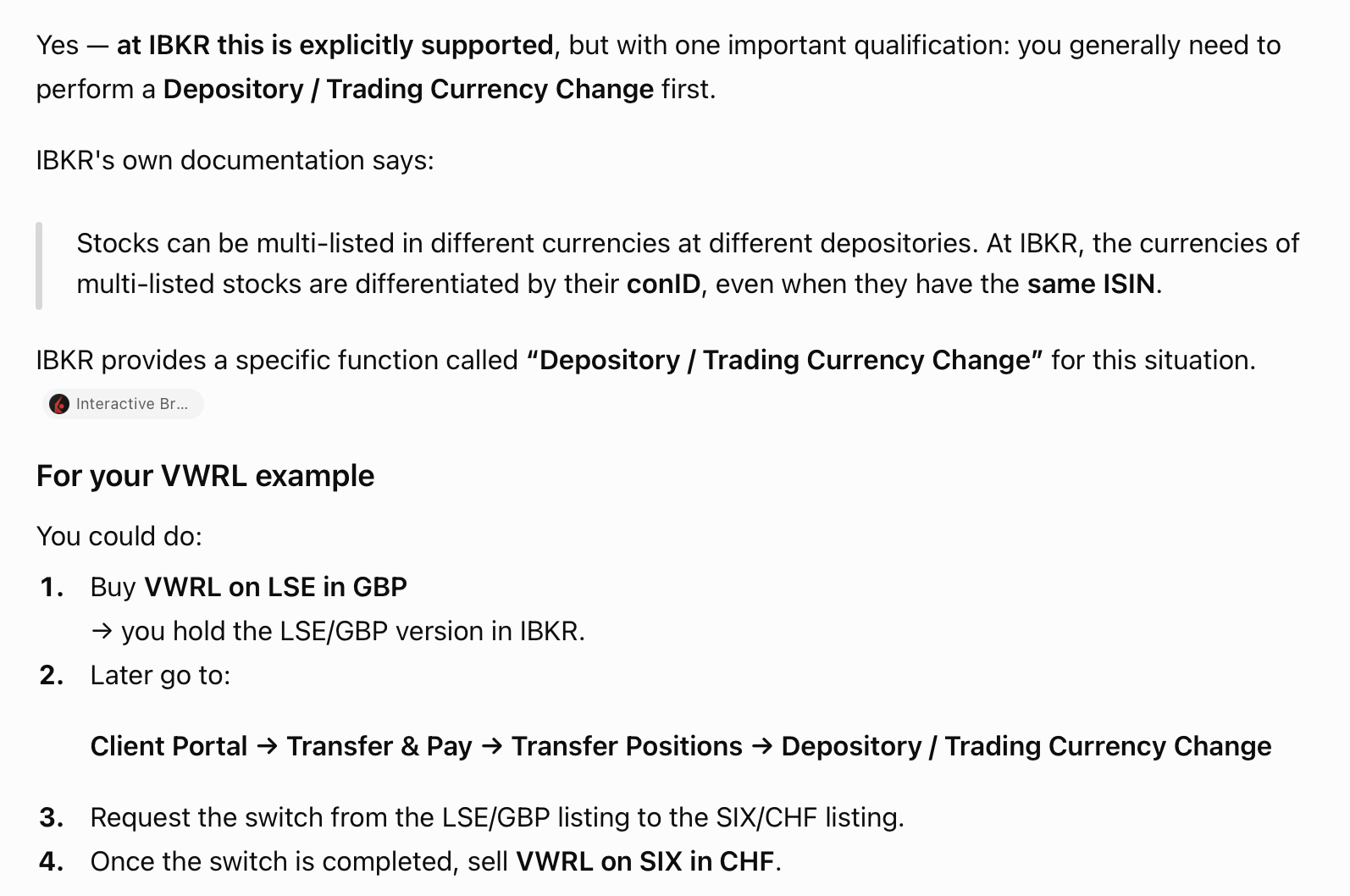
It says that all assets that share the same ISIN are fungible, which means they are replaceable with each other. However, it depends on the broker, if they offer it to retail investors to buy at one venue and sell at another one.
Apparently IBKR does not just tie your position to the ISIN, but to the venue you bought it on.
So if you want to sell it, you need to change the venue.
So much for theory, the question is how much of that is true and how much is hallucinated. I haven’t checked!
6 Likes
That feature exists and its self-description matches!
Edit: I entered the order to convert to CLEARNET(USD) (the only other choice for VUSA was CLEARNET(GBP)), and the order was rejected with:
Rejected by IB: Assets must be transferable via the same clearing house: CLEARNET. Asset VANG S&P500 USDD (contract ID 107968733) cannot be transferred via : CLEARNET. Please contact the Interactive Brokers customer service dept. at 877.442.2757 option 3
The phone number authenticates you only to tell you that you must create a support ticket first, which I’ve done now. Let’s see
Can someone confirm that you can sell TickerA for USD then buy TickerB for USD (on the same exchange) within minutes, without having to wait for any settlement? Does it also work with a non-margin account?