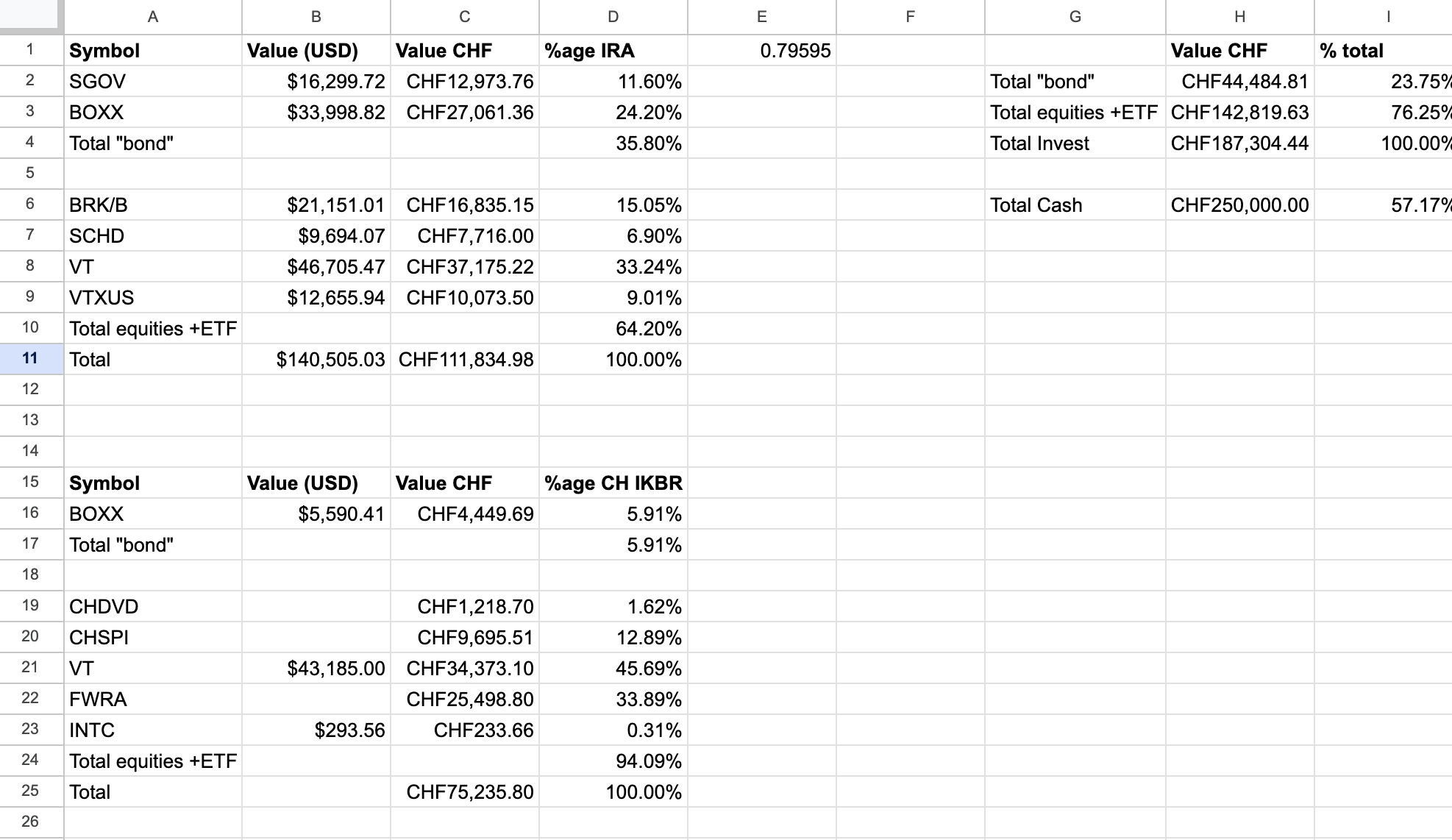
I am relatively new to investing and I am looking to rebalance my US. IRA rollover pension (I am a swiss resident and intend to retire in CH). It currently has quite a weighting on BOXX + SGOV to get about 4.5% low risk return on US treasury bonds. I wanted about 30% bond weighting to reflect traditional investment portfolios and lower volatility. But I now realise this doesn’t make sense given FX I’m largely just loosing money, and at 43 I don’t need such a weighting anyway. The rest of the IRA is in VT + VXUS + SCHD. VXUS to reduce us exposure and too much Mag7 weighting, and SCHD as my research at the time suggested this helps diversify from purely growth companies to higher quality companies.
JQUA looked good with 283 holdings with some mid and small cap, vs SPHQ 100 selected from S&P500. But looking at industry weightings and top holdings, JQUA doesn’t really seem to diversiy risk from a possible tech crunch
At the same time, these are all only US holdings and contradicts the choice I made in VXUS, which at least YTD has performed identically to VT…
I do have a separate Swiss private investment portfolio in IBKR (mostly VT + CHSPI) but again a little BOXX which almost certainly doesn’t make sense.
I guess my main question is, as a Swiss investor, what can be done to reduce risk (and returns), or do we really just have to go all in on VT and forget?
Exactly. If you see yourself as a current and future resident of Switzerland, start thinking about your finances in CHF. Short term borrowing rates in CHF are zero, 2 and 3 years interest rate swaps are slightly negative, so no matter how you slice and dice bonds, the return in CHF after fees and taxes is going to be negative.
Top left is my US Rollover IRA. There are tax penalties for withdrawing this before age 55 so I have at least 12 years minimum, but I don’t really foresee retirement before 60.
Bottom left is investments I started this year moving some of my savings and then adding monthly, in Interactive Brokers
Top right give global breakdown, and adds current cash in bank doing nothing
My plan was to slowly CDA my savings into more equities but a month after investing Trump started with Liberation day etc. and I got spooked and slowed down. For the US IRA I parked money in BOXX/SGOV, again with an intention to CDA more into equities (which I have done slowly the last months).
I have an unfortunate change in circumstances as recently I found out my wife’s cancer is not treatable. This has further reduced my risk appetite, most importantly because in a few year I will need to re-finance the mortgage on 1 salary so will rely on assets to reduce loan amount. Ergo, what to do with the 250K currently in the bank, and the first step realzing that BOXX/SGOV are not doing anything for me with the USD sliding.
That is why I was re-visiting bonds but this just doesn’t work as a Swiss investor. That is why I was wondering what else exists that has some risk but even lower volatility than VT/FWRA, with a goal of purhaps investing about 100K CHF of my savings and leaving the rest in the bank .
I guess I could also look at paying into Pillar 2 and then withdrawing later to guarantee a tiny return, but there are rules on how soon the withdrawals could be made.
As stated by @Dr.PI, 0% is the current risk free rate in CHF. If the SNB lowers their policy rate some more, 0% checking/savings accounts will be a great deal, providing more returns than banks themselves get on short term cash.
For longer term vehicles, I would look into medium term notes, possibly building a ladder of them if I wanted to preserve some rebalancing possibilities.
Pillar 2 can be used to amortize a mortgage on your primary residency so if that’s the targeted use for it, you should have no problem withdrawing it. There is a 3 years lockup period for buy-ins and you can withdraw only every 5 years so you’d have to plan how you intend to use it ahead of time in order to make it as peace of mind preserving as can be.
You may want to study the insurance part of your second pillar and that of your wife if applicable in order to best understand what they can do for you in your situation and if having more of it, or depleting it, would be a good option (I’d look at the disability and life insurance for both the partner and children (if applicable), as that coverage can also help with hardship).
Sorry for the radio silence after asking for help - I had my own medical issues with a minor operation this last week.
I had already been selling some of the SGoV/BOXX form the IRA in the last few months, but have now accelerated that . From my Interactive Broker account I have closed the BOXX and put it all into VT.
The 2nd pillar buy-in has the advantage of tax savings. If I buy-in 20-50K now, then I’ll save on the marginal tax rates which for this year will be high with the combined salary with my wife. When it comes to re-finance the house in 3 years then the income will be much lower (surviving spouse pension included) and the taxation of pillar 2 withdrawals seems to be reduced. In which case I should act before the end of the year on this.
I have contacted. my wife’s pillar 2 provider and have an estimate of the pension. I’m not worried about hardship, but need to avoid the stress of having to sell the house and potentially move. We live in small village and have a very good support network in place that I need to protect. I don’t imagine interest rates rising sufficiently to impact the mortgage affordability on a personal level, but it would be the compliance with regulations which might force me to have to reduce the loan amount.
This is my question. A lot of these bond allocations seems to be based on US citizens. Holding US bonds doesn’t make much sense due to FX, but CH bonds at 0% is not helping . Then we need to factor in not only taxes, as you say, but our Pillar 2.
I was never interested in FIRE itself because i didn’t want to live worrying about every CHF while earning, and even more so in retirement. Plus it is hard to FIRE in an expensive country, and I like Switzerland. However, some things have changed.
My wife passed away last month, I was diagnosed with cancer in November, and just yesterday I found out I have a heart condition. I have a new and somewhat contradictory goal: 1) I dont want to work until state retirement age, 2) I want to live life to the max. Unfortunately I started investing late, but on the flip side i have a well paid job and a few hundred K in savings and investments. So I am wondering about FIRE in 10 years, if I live that long. That means putting up with my stressful but well paid job.
unfortunately I learned the hard way never to rely on a long healthy life and retirement. You need to make choices that maximise current happiness IMO. That might mean RE before you are comfortable, or delay FIRE to better live in the moment.
I am truly sorry for your loss and for the health challenges you are currently facing. Your experience is for me a further reminder that the role of money in our lives must always be kept in proper perspective.
I sincerely wish you the very best, and above all, good health and as much happiness as possible.
Jesus. If I had all that happen in the space of a few months, I think I’d just say “fck it. I’m quitting now and will enjoy what time I have left and figure it out if I live longer.”
tempting but I have 2 children under 12 years old to look after, so I need a stable job. On the plus side my job is well paid, flexible hours , no forced offie hours but I go 1-2 ties a week by choice and it is only 5 minutes away. I cold quit and get something less stressful and less jours, but that likely ends up 4-5 days a week in an office and 50-80 minutes commute so I probably don’t gain much. I’m better sticking with what I have for a few years and hope I can save enough to retire early while still enjoying some nice trips with the children.
anyway, short term I am covered by insurance at 80% of full salary. Next chemo starting in an hour!
yeah youngest is nearly 10, so beyond surviving as long as possible i hope to continue to work for 10 years and build enough to FIRE at 53 but without a strict deadline so i can adjust based on health and wealth.
My wife and I somewhat fortunately or unfortunately have our mortage with a combined pillar 3 and life insurance. It is still not very clear to me how this insurance will work since at least the pillar 3 is pledged to the mortgage. E,g, will the life insurance simply be used to payoff the mortgage, or will they just take the pillar 3. AXA are not very forthcoming with the details.
Maybe you can get details from the contract documents that you have. Failing that, pretend to be a new customer and get the answers about what happens as a prospective customer.
Well, I sent them a letter and my wife’s death certificate, so i hope I get a response soon with more clarity. Basically there is a 130k mortgage that needs to be amortised (and !1M second mortgage)). My wife and I both have pillar 3 with about 30K, but a life insurance worth 160k. The 30k Pillar3 will presumably immediately go to pay the mortgage as it is pledges. But will they take all or some of the life insurance? they didn’t seem to be able to answer than by phone. I also assume they will want to take a healthy profit along the the way since they will be missing my wife’s monthly pillar 3 payments that they can scrape.
Even if they don’t take the life insurance , I might need to reduce the loan amount anyway in 3 years when the current mortgage needs renewing, and there is a risk due to lower family income. Unfortunately, since it is all with Axa they will know everything
One question might be if you really want to keep the house mid-term.
As a former houseowner - its usually much more work than an Apartment and looking at your numbers (>1M mortgage) you probably find a cheaper, more flexible solution renting a simple appartment. These also free s up capital. Allows you to travel more (bring your kids) etc..
My daughter profited most from the house when she was younger (<12) so you might consider that once once kids reach a certain age.
I haven’t really thought about downsizing, although if I do FIRE in 10 years then I would consider it to free capital, or rent an apartment and rent out the house for much.
I live in a duplex so about half the bug costs and risks are shared in 2. The thing is I see costs for an apartment with 1 bedroom less than I currently have go on the market for 100K more than I paid for the house, so they would be less affordable without throwing down more capital from the house sale.
Probably the biggest reason to stay isI live in a smallish village and the children are well settled with freinds, I wouldn’t want to be forced to move too far away and even moving 3-4k to the next village instantly means a big change for the children. And I have to be especially careful not to move school districts as my son has autism and requires a lot of extra support.
I would be more flexible in 10 years when the children are leaving the house or older enough to drive. I played with a mortgage calculator and it looks like I would be OK If I did loose my job and got something paying 20-30% less depending on my late wife’s pension.
Mit dem Lesen und der Teilnahme an diesem Forum bestätigst du, dass du die Forum-Richtlinien gelesen hast und damit einverstanden bist sowie den Haftungsausschluss auf http://www.mustachianpost.com/de/ akzeptierst.