I moved to Switzerland earlier this year and have accumulated around CHF 40000, which is currently just sitting in my bank account. I recently started investing in ETFs by purchasing a fixed amount of shares each month, but I don’t feel comfortable investing the entire amount (or a big chunk of it) at once.
I’m currently with Yuh, but their savings account offers 0% interest, which isn’t ideal.
What do you usually do with your “idle” cash? Are there any Swiss banks or platforms that offer a guaranteed 1–2% return (something similar to Trade Republic)? Or do you prefer to buy bonds or other low-risk instruments instead?
Assuming you got paid 10 times, that’s about 4k of savings each month.
I guess you could keep it as cash for an emergency fund.
Though if you don’t want it to grow bigger, you should start investing at least 4k per month to keep at the same level (or whatever your savings rate is).
You could invest in a fund like CHDVD which invests in Swiss companies and pays dividends.
Swiss national bank has the interest at 0%. So outside some special temporary offers, you‘ll not get more. Europe‘s ECB has the interest rate at 2% currently, that‘s why TR is able to offer 2%.
The CHF however is also expected to apreciate compared to €, at about that interest rate differential. (Interest rate parity theory).
Only things giving a little interest are term deposits at banks. But you need to lock you money away for a fixed term. So i.e. 1 year gives 0.3% interest currently.
For anything more you need to take on some amount of risk.
For temporary stuff, for short-term small but non-zero returns might also consider prepaying health insurance, or pre- and overpaying taxes.
Conditions vary, but you might get some 1% discount, respectively interest..
In Zurich you get 1% on pre-paid taxes, on a federal level you get 0.75% the last time I checked.
That’s about as risk-free as it gets IMO (aside from government bonds).
Demanding higher returns will require you to take higher risks.
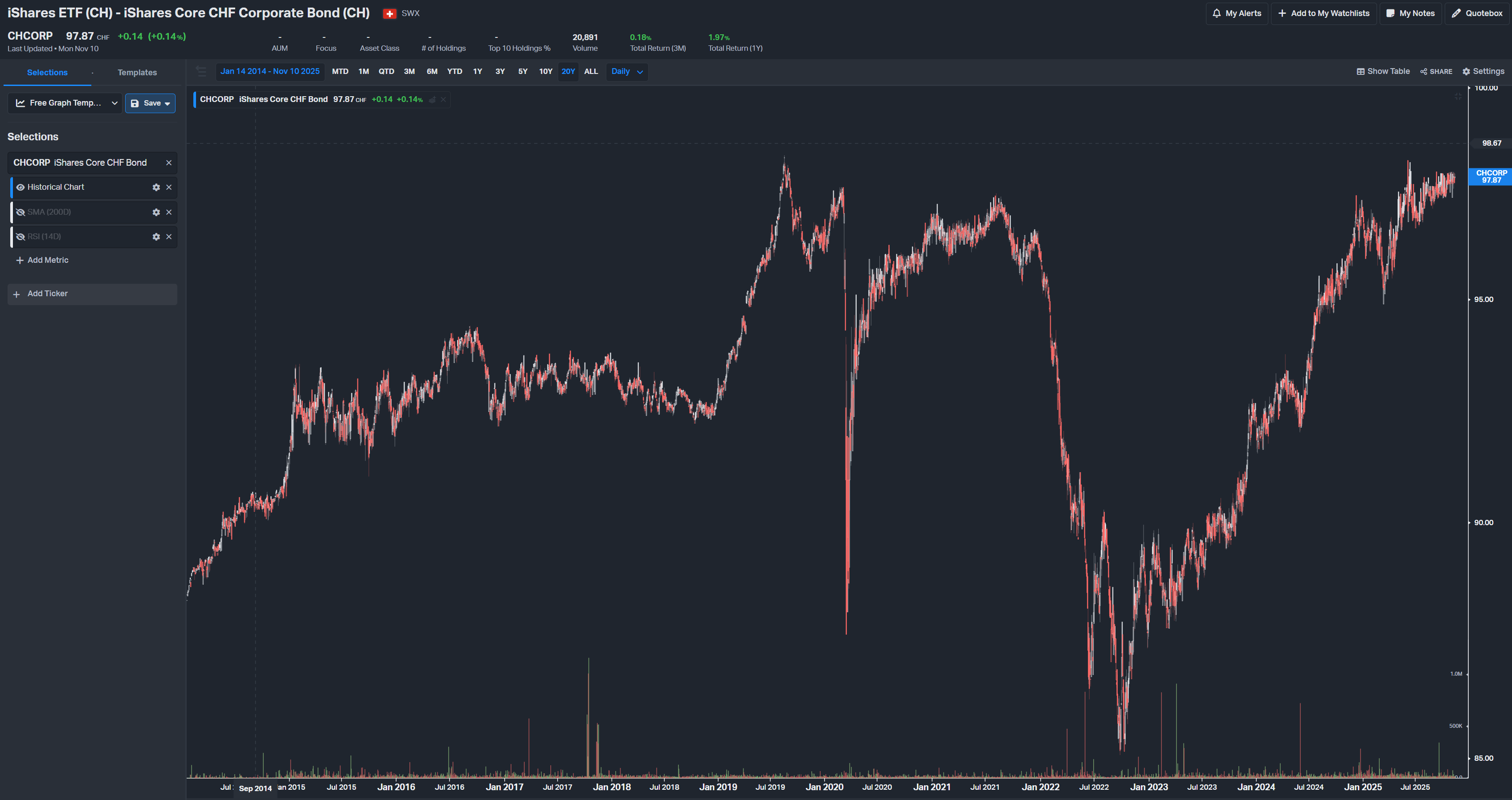
Even investment grade Swiss corporate bonds fluctuate quite a bit …
… and if you trade the ETF on a Swiss broker, they’ll probably take a nice cut via fees, too.
Discussed elsewhere on this forum in multiple corners: using backtesting it’s best to lump sum. That said, I couldn’t bring myself to lump sum, either. The psychological damage of a market drop after my lump sum investment would seriously mess with me …
Or use this weird mental trick: since you just moved into Switzerland, maybe think of your cash pile in terms of your home country’s currency. I bet the equivalent of your CHFs accumulated have grown considerably in your home country’s currency.
Edit:
You didn’t say what ETFs you invest in. If you invested into, say, VOO or some other large US exposure ETF denominated in USD, you could of course convert your CHF into USD and park your USD cash by buying US treasuries, currently yielding about 3.8% or so.
Of course, you’re not necessarily getting a higher return (in CHF) as now you are taking FX risk.
I see. I guess at that point bonds would be more appealing, although there could be some level or risk involved.
This is true, I hadn’t considered that. Good advice.
Yes, I am aware that a lump sum is a better strategy than dollar-cost averaging. However, as you mentioned, it is mentally harder, and I probably would not be brave enough to do it, also given the little experience I have in investing.
I invest in VWCE/VWRA. I would prefer to avoid non-UCITS ETF to avoid issues with taxes
Thanks a lot for the detailed explanation! I’m still a beginner at this and therefore do not fully comprehend your strategy yet, but this is all on me. I will look better into this in the near future, since it is not fun to have a lot of idle cash sitting in a bank account.
Whilst we can’t know the future with certainty, we have some history and some logic to make an educated guess. Selling options insures the tail risk of others. Anecdotes (“works for me”) are particularly ill-suited to understand such instruments and the actual expected return.
Also, most cash secured puts strategies are not tax free in Switzerland. The cash part has taxable interest. Securing USD contracts with 0%-interest CHF is an optimization with its own additional risks.
Learning is good. Please make sure you always understand well what you invest in. Those other users didn’t dogpile on “cash secured puts” because they want to maliciously keep you from arcane knowledge to get rich quick. Quite the opposite, actually.
The focus of the anti-options point is the tail risk (as somebody else put it: what if it completely collapses in price). Guess what, if you buy the stock/ETF/etc. outright (or via DCA) you have the exact same tail risk. If you are concerned about a specific investment completely collapsing then you’re probably looking at the wrong opportunity regardless of which instrument you use.
Fundamentally, when for instance writing an out of the money put, you articulate it as being paid to insure somebody elses risk. While I see some merits to that, my perspective is rather different:
I want XYZ (let’s say current price: 10)
By writing an out of the money put (e.g. strike price 8) I reduce the uncertainty about what I’m going to pay for it (regardless of whether DCA or buying it in one go)
80% of options wind up expiring with zero value and my experience is that the 20% (perhaps a bit less, in my case) where I do take delivery, the price is not that far below the strike price and I’ve almost always been able to quickly convert it back into cash (+ a premium) using a covered call option.
“we have some history and some logic” - yes, and you purposefully apply it to a case which doesn’t suit your philosophy, narrative, etc. but conveniently ignore the fact that fundamentally this point could be made in almost any situation… e.g. you could argue Warren Buffet’s returns are just luck, a coincidence, a random event (one in a billion investors) while he’d argue it’s not.
That’s fine, everybody finds their own path… incl. some apparently sitting on a high horse without being aware of it.
You would agree though that there are several steps someone not gambling must take, and document and understand beforehand, before this makes sense? Eg
what’s my goal for doing this?
what’s my risk-free rate, and how much above can I get it using CSPs or CCs?
what’s the impact of the volatility
what am I willing and able to commit?
what amount or above do I need for this to make any sense, ie does it make sense to take the trouble for $100? No, in my opinion. $1000? Borderline. $5,000? It’s now interesting, but then you need to put up 50,000+++ to get there, isn’t it, but then it goes to no 4 above etc.
I understand the theoretical part members here are pointing out, framed by total return. I also understand the point about a price crashing through your CSP and you ending up paying 8 for something worth 1: you’ve theoretically lost money, but in practice it may be that you didn’t if you were fine to own the stock for 8? Of course some of our colleagues will be incensed reading this!
Again I think the point is that these are essential and pretty complicated questions and unsuitable for someone unsure if to DCA in broad index funds in any way other than food for thought.
Edit: caveat: I find options incredibly interesting but haven’t had the guts to dip in.
disclaimer: I’m also trading options (more actively in the past, and resuming after a short break)
While I have no particular objections to your points above, it may be worth highlighting — especially for our less experienced colleague(s) — that the longer the option’s DTE, the longer you remain “locked with” XYZ.
I mean, if you place a limit order on XYZ and the stock subsequently takes a direction you no longer like, you can simply cancel the order at no cost. By contrast, if you have sold a put, you are exposed until expiry (unless you close the position). You either accept the possibility of being assigned shares you may no longer want — and then potentially try to get rid of them by selling a call — or you buy back the put, possibly at a higher premium, which could result in a loss.
Yes, absolutely correct. Hence I don’t (OK, i have been ‘guilty’ of it a few times in the past) due purely speculative options trading for premium harvesting on stocks I’m fundamentally not interested in owning. Eg. made a lucky / lucrative options trade on Microstrategy but that was stressful. 99% of these written puts are on stocks I’d want to have anyway. Note, not that I am narrowly focused on that one stock, I’ll have a portfolio of stocks that I like and write OTM options on and most don’t then come my way. It actually helps me to not fall in love too much with a single stock.
Now, if you buy the stock outright (or through DCA) you fundamentally have the same issue as you describe… you accept the possibility of being underwater. Unless of course you delay purchasing entirely because you expect it to drop but that becomes different discussion (time in the market vs. timing the market).
I see it very similar, I get greedy in the sense that I do not want to pay fees to buy a stock but actually get paid to buy a stock. At least for me I do not really make a lot of profit from the option selling, it’s more a limited buy order that I play as long as needed if I want the stock. However, there where from time to time some bets that I did for stocks that just had a massive drop and I did not really wanted in my portfolio. I do almost never do call options as I see there the problem with the limited upside. Only if I get assigned a stock that I do not longer want I work with call options but this strategy is not really well defined yet.
No need to get pissed. There are applications of covered calls and cash secured puts, but “uninvested savings” probably ain’t it. Those strategies tend to have stock like losses, but only cash like return.
Regarding Buffett’s Alpha: Buffett’s Alpha by Frazzini, Kabiller, and Pedersen (2018). Whether or not the explanation through factors and extremly cheap leverage is datamining, it is rather unlikely that the next Warren Buffett is on this forum.
Cash secured puts and covered calls beat the raw underlying on a crash, because you will have the premium in addition on top of what happens.
Of course, only if you don’t get liquidated in freak markets. Selling options means owing something. Prices can decouple, and brokers can panic.
The bigger problem, though, is more the other side: The market explodes and you are effectively in cash.
@Butch , reading the initial post again, it seems they actually do want to invest it all, just not lump sum. I revise my stance and I think your suggestion could be useful here to get some returns while waiting.
It goes down → You get it cheap.
It doesn’t or goes up → You would have waited anyways.
I’m not sure a novice can execute this correctly though. Also they probably shouldn’t space this out for multiple years. So DOTM puts won’t have much optionality premium.
Indem du dieses Forum liest und daran teilnimmsch, bestätigsch du, dass du d Forum-Richtlinie glese hesch und damit einverstande bisch, sowie mit em Haftungsausschluss, wo uf http://www.mustachianpost.com/de/ präsentiert wird.