Well, at least this mixes well with alternatives that often have US government bonds as collateral.
What do you mean by that?
CFDs are mostly used by day traders. It’s not economical to keep them overnight, as you pay the swap rate. I don’t think you can compare them to leveraged ETFs. They are more similar to Futures, where you pay also for financing the leverage.
That you signed a contract to accept their price, even if they have “technical difficulties”. But as I said, they want to keep clients so they probably give them better price than a hedge would cost.
You always pay some kind of interest for your leverage if you hold overnight. Either separate or it is included in the price. What do you think, those ETF folks are that generous that they pay it for you?
I thought it was a good idea to list all the possibilities you have for leveraging. Every method has its pros and cons…
1 Like
The interest is part of price finding for futures. You don’t pay it separately. Most brokers even accept T-Bills as collateral for the margin.
1 Like
Very early on starting investing in eToro (yes!) I realised a lot of what they offered were CFD-only. I did some reading and concluded that CFDs are indeed nothing to be held for any longer than…days. That spurred me to go to a real broker.
1 Like
You ALWAYS pay for the financing of the leverage, either directly or indirectly. Doesn‘t matter which type.
4 Likes
Sure, one can think up all kinds of reasons why they need cash and levered ETFs. Your cash just costs you more (e.g., an additional 2% annually for 2x S&P 500). That is on top of the 1% that the bank normally takes from the market interest rate.
Though, in CHF and for low amounts and if the market interest rate is negative, banks in Switzerland gave you some (fractions of) percents.
Additionally, since levered ETF normally aren’t short CHF, you get a net long/short FX position.
If that was me, I would really try and make that initial reason disappear. Especially, if we aren’t talking about real things (which mental accounting is not).
2 Likes
So the new Amundi World x2 LWLD is launched and traded. I’ll keep an an eye on it and would consider it in case of a big market crash.
Amundi (previously Lyxor) have launched these first products with perfect timing by mid 2009. Any thoughts about counterparty risks with these synthetical products?
I’m looking at it too and very interested even though I have no understanding of the underlying mechanics and costs I read about (other than the TER, which is a bit more than I am willing to happily stomach given VWRL’s is 0.22% and this one’s 0.6%).
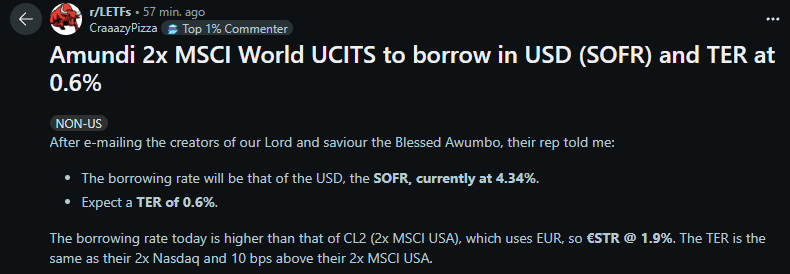
Question is how’d you buy any substantial amount in case of a market crash? It’d mean you’re holding quite a bit of cash on the side or?
Also, anything to note given it’s French?
MSCI world is developed only.
VEVE (FTSE Developed) at 0.12% or MSCI World UCITS or Solactive Large+Mid developed UCITs funds are better for comparison in terms of costs.
Yes, aware it’s a different index, just mentioned VWRL as it’s my biggest holding and VT equivalent, point remains that it’s fairly expensive to get in a large way, unless it’s after a substantial drop. I’d want to give it some time too, at least a year, to see real world function, tracking etc.
Reddit also seems to have something against Amundi but I haven’t followed.
Don´t you think taking a loan on IBKR and buying VT would be the better deal ?
Fixed.
Personally and given my allergy to debt (margin, loan, whatever) then no, but I hear the argument that you save on fees and volatility this way.
technically a leveraged ETF is nothing but a loan and a more complex product.
2 Likes
Technically yes but the worst it can do is go to zero, I am ok with that, I am not ok with it going to minus and owing money to IBKR or anyone else!
5 Likes
if you understand german in the “Marktgeflüster” Podcast the risks of the Amundi (volatility decay) are discussed https://youtu.be/zOgOFuFVI2U?t=531. The guy with the hat is a finance professor 
You sell some normal ETF and buy some leveraged one.
2 Likes
I was reading up on volatility decay years ago, get why it’s an issue but for me going to minus is a bigger issue.
Right on the Amundi product though, I agree, the difference is that here we’re not talking about a bet of a bet (something like TQQQ, SOXL, FNGU) but going 2x on all-world, which I’d aim to hold…forever and not trade at all on it, which would make volatility decay worse indeed.
That’s selling at the low, though.
Sure, you can also do some loss tax harvesting.