How AI will impact the economies, the stock market, real estate, commodities, etc. in the more distant future is a matter of speculation, though certainly an interesting one.
It’s the shorter-term impacts that are more quantifiable. For example, we have seen how the vote to give pensioners a 13th monthly payment bankrupted the AHV/AVS in one year (without the subsidies from tax money being discussed). How would an 8-percent unemployment rate affect the AHV, unemployment insurance, and occupational pension funds? That should be quite easy to model, and it surprises me that the government is not actively talking about this.
An 8-percent unemployment rate is already quite common in Europe, and in a traditionally knowledge-driven workplace like Switzerland, it wouldn’t surprise me to see unemployment rates hit that mark and hover there for at least a few years as workplaces and immigration adjust to the new reality.
Real unemployment rates in healthcare in the BS/BL area are ~25%, apparently. What the numbers don’t consider are people who’ve exhausted AHV, and hence appear lower (still bad) than reality
The efficient market theory. It mostly works but there are many situations that cannot be explained by the efficient market theory. For example momentum or trends have no logical base on information.
Markets are very efficient, market participants are not.
From the podcasts I’ve listened to and videos I’ve watched.
You will have a country-split. Countries which produce AI (USA, China), countries which leverage AI or enable it through providing energy, and the net consumers of AI. Of course I don’t need to tell which country it is better to be.
Then, AI will empower capital and entrepreneurship. You will need the means and you will need to know what you want to build, you won’t have to worry about how or who will do it. Labor will be devalued.
As for the generational clash, the boomers have the capital, are retiring now, and are hoping to get their pensions. They’re also the largest cohort, which matters in democracy. Right now they need Gen X/Y/Z to work, pay taxes, support their retirement. They also need immigrants for that.
But I suppose if AGI arrives, humanoid robots arrive, then that script flips. Boomers can invest their capital to have robots making their food, wiping their butts, etc. However, I think there are so many moving pieces in this puzzle, that it’s extremely difficult to tell what will happen.
I would imagine that being a young person in an old-people country won’t be too nice. You have no capital, no skills, no job. Perhaps the tax revenue from AI corporations will be sufficient to provide a UBI.
No, because these are likely to be US or Chinese companies and they already don’t let you tax the tech giants such as Google, Apple. You think they’ll let you tax them after they make even more money from AI?
Nope, I mean pharma, all support industries around it, healthcare comms/branding/marketing. Generally all that revolves around health and doesn’t mean an actual healthcare practitioner. These data are from linkedin trawling (not mine!).
Is this written ironically? It seems to me it is but I can’t guarantee it. The first payment won’t happen before December 2026. If any bankruptcy of AHV/AVS had happened up to now, which it hasn’t, it would have had nothing to do with the 13th payment.
Given how ahv is financed (afaik it’s not a fund), increasing spending will always drive deficit, that then needs to be balanced. Isn’t the current plan to increase vat to cover the funding gap?
(But it’s not like any of this is a surprise, I assume voters would have known that)
Fair point. But AI will enable massive value creation, so the question is where this value will go, how it will be redistributed. Even if there is a large disparity between US&China vs Europe or Africa, the World as a whole should not become a poorer place because of AI.
If US & China have massive AI-powered factories where they produce goods close to zero cost, the question is what value will Europe & Africa be able to offer in exchange? Selling land, resources, our brands? Offering tourism?
For shareholders to get anything, the companies need to sell some stuff. The buyers need to have something to pay with. I don’t like this kind of framing. AI will be a net positive, like the industrial revolution was. And some people will get very rich in the process. Plz don’t sound like a luddite.
There’s a reserve fund of about ~40B, so in that sense it could go bankrupt (although not in 1y). Well even without the reserve fund if funding doesn’t match outflows, but as you said it’s a pretty obvious thing.
increasing spending will always drive deficit
Not necessarily, there could have been a surplus that would have covered the measure without going into a deficit. There is currently a surplus of a few bilions, but it’s not enough.
Although given AHV is already far from only covered by direct contributions, surplus and deficits are a bit meaningless, I don’t really know what Daniel was trying to get to.
I asked perplexity to define me a detailed mechanical strategy with momentum and value factors.
As expected it did so by copying some mechanical indices rules. Still no danger for me, as mine works different and some of the mechanics are not standard, I could not find them in any book or other resources. Actually, when defining the rules I designed them to be original.
But I may have to stop writing about it in forums; those bastards learn from here!
A net positive can accrue to shareholders. If they make same stuff but cheaper, they have more profits. If they make more with same cost, more profit.
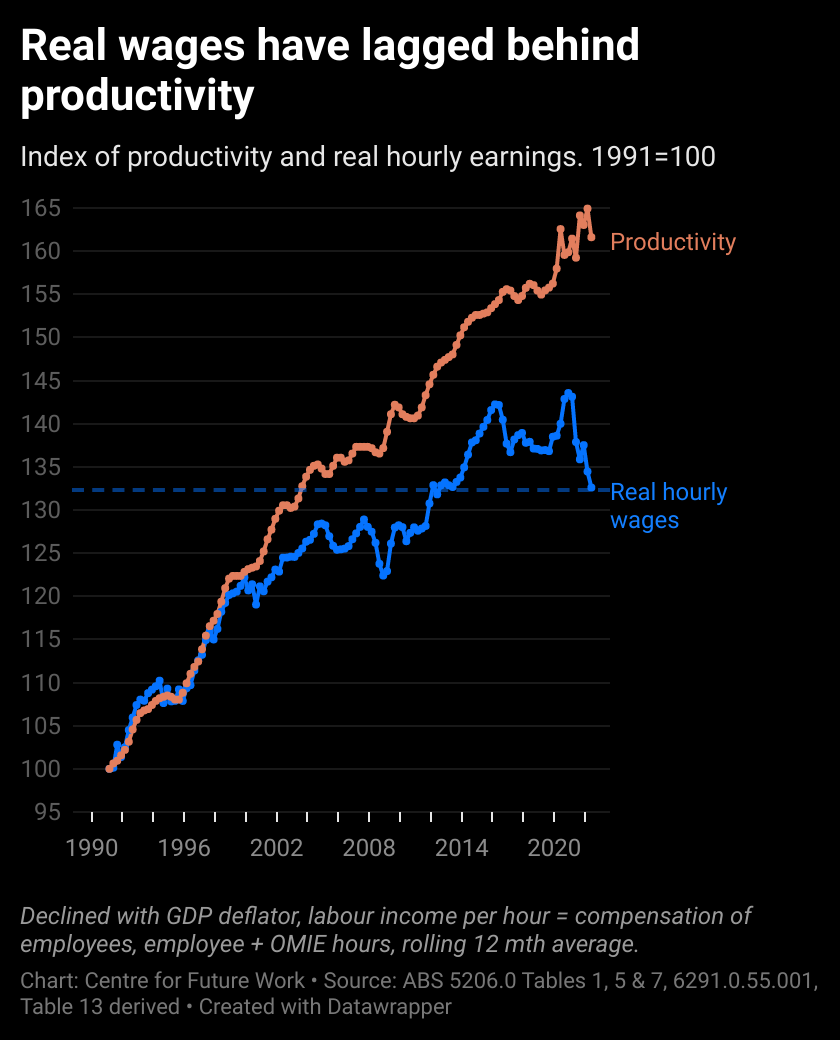
Look at productivity charts, this has grown, but the share of this growth has gone to capital, not labor. I expect the same pattern to continue with AI.
Individuals will also benefit, but maybe this doesn’t make it into GDP numbers etc. for example, I use AI to do a whole lot of stuff that would not be possible (or prohibitively expensive) without it. But I don’t directly get paid from this activity.
If Europeans don’t intrinsically increase their cumulative purchasing power, the owners of capital won’t be able to extract more value than Europeans are able to spend now. I expect them to produce more AND at a lower cost. So, Europeans will be able to afford more, and their purchasing power will rise as an effect.
OK but what has contributed to the fact that productivity has outgrown wage growth? Women have entered the workforce, immigration, globalization, moving production to China etc. This chart only shows the US, right? Not the whole World. American lower and middle class got hammered by globalization, in order for their corporations to get richer. I’m not sure if the same scenario will apply to Europe. Sure, maybe we will lose even more production due to competiton from AI-powered economies.
In the end that is what matters, not GDP.
Look, if they are producing home assistant humanoid robots by the millions, which can cook, clean and do all the chores at home, somebody needs to be buying them. They won’t get rich if there is nobody to sell to. I wonder how that’s gonna play out.
The AHV is a pay-as-you-go pensions scheme. Without subsidies (or an increase in contributions), the AHV’s outflows will exceed its inflows from 2026 (the first year in which the 13th payment will be made), meaning the scheme will de facto be bankrupt and will have to be bailed out with tax money (barring a hike in required contributions, which is not planned as per today).
“Ohne zusätzliche finanzielle Mittel werden die Ausgaben der AHV laut Finanzperspektiven ab 2026 die Einnahmen übersteigen.”
So we have a situation in which a popular vote that was long in the making - and with a fairly predictable outcome in a country of pensioners - was not accounted for in the planning of the scheme. Now, at least from my perspective, there’s the same lack of discussion around the impacts of AI on employment (and subsequently, social and occupational insurance schemes).
Mit dem Lesen und der Teilnahme an diesem Forum bestätigst du, dass du die Forum-Richtlinien gelesen hast und damit einverstanden bist sowie den Haftungsausschluss auf http://www.mustachianpost.com/de/ akzeptierst.