Hi everyone,
I’m posting here to share a cautionary tale about the Swiss 3rd Pillar insurance model, especially the so-called “Plan de Garantie” I signed with Helvetia in 2015. I was in my mid-20s, just starting to work, and looking to reduce my taxes. A financial advisor presented me a product that sounded safe and smart: capital guaranteed at maturity, tax savings, long-term investment. I signed without fully understanding it.
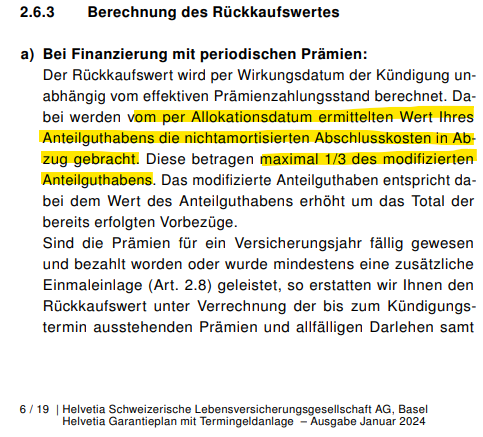
Fast forward to 2024 — after paying over CHF 65,000 in premiums (around CHF 6,800/year for 8 years), my portfolio was worth just CHF 28,000. That’s over CHF 37,000 in losses. Worse: the final capital they “guarantee” for 2051 is CHF 179,550 — even though I would have invested CHF 247,000 by then. That’s a guaranteed loss of 27%. They call this a “safe product”.
I asked if I could increase my contributions a few years ago — they simply said “yes” by phone, without ever warning me that the product was losing value or that increasing payments would only increase my long-term losses. I feel misled — no one explained the real performance mechanics or even the impact of interest rate changes on the bond-heavy allocation. They gave me a false sense of security.
Only now, after analyzing all my yearly statements and consulting experts, do I understand how much I was losing. I’ve canceled the contract and filed a complaint with the Ombudsman, but I don’t expect financial recovery. My goal is now to warn others.
Please, if you’re in Switzerland or considering a 3a insurance-based solution: Do your homework. Compare with a 3a bank account or ETF-based product. Understand the fees and what “guaranteed capital” actually means. Don’t just trust the salesperson.
I wish I had just paid the taxes — it would’ve been far cheaper. Don’t fall for the same mistake.
I assume there were also insurance benefits included, such as disability insurance? That’s never free. But yes, it’s usually expensive and not worth it. At least not in this setup.
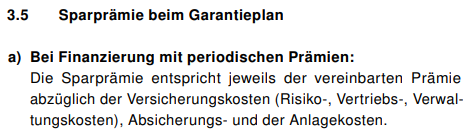
I remember from other threads here that insurance fees eat at least ~45% of the annual 3A contributions, so that plus the finder’s fee for the jackal who sold it to the mark, plus that insurance 3A plans are dogshit it somewhat adds up.
This is the whole issue. The cost of insurance and commissions is the main problem in these policies as most investors are not explained properly about them.
I think there is at least one other thread on this topic. Sadly, this is a constant story. But in almost every case it comes down to someone signing a contract for a complex product that they do not really understand. I by no means mean that in a condescending way. I have a lot to do with insurance, and I still find cash-value life insurance policies difficult to dissect.
The consensus here, and my personal advice to anyone who asks, is: leave cash-value life insurance be. It is never an optimal way to either invest, save, or get insured.
In most cases, the commission for the agent is calculated as:
[(Retirement age (65) – your current age) × agreed 3a premium] × 4%
This commission is paid regardless of whether you are self-employed or employed by the insurance company.
If you, as a client, cancel the contract within the first three years (sometimes the deadline is two years), the agent must repay this commission to the insurance company – ouch! Essentially, your early premiums are used primarily to cover the agent’s fees. That’s why, if you cancel in the first year, you’ll get back almost nothing.
For most people, such a 3a insurance policy is not a suitable product. However, there are certain situations where it can make sense. For us mustachians though, a pure term life insurance is usually the better option, especially if the goal is to protect your family when taking on a mortgage. In that case, look into a decreasing term life insurance: you probably don’t need CHF 500k of coverage for a full 20 years. As your savings grow each year, you can choose a policy that starts with CHF 500k and decreases linearly by, say, CHF 50k per year.
Sorry for this hard lesson and thank you for sharing !
Strange calendar alignment, I was wondering what was this company selling in the street. They had a stand today in front of Manor with 3 youngsters approaching pedestrian walking near them.
Hopefully they were not selling them pillar 3a in the street !
I was lucky in 2011 when I have joined Switzerland. A colleague from mzy previous company encourage me to meet his insurance broker. It was an honest sale person and told me at 27 y.o. I was too young to subscribe to a 3rd pillar life insurance. Instead he sold me private crossborder health insurance…
I din’t even look at registring to a bank 3rd pillar at the time … I just moved on and lost 7 years of contribution but at least it was not a life insurance.
Yes, they do, the “surrender value”, but in my case the agent brushed it off “ah, that’s no relevant, you’re in it for the long run, right?” - of course my fault but it’s part of the predatory way these agents work.
Mit dem Lesen und der Teilnahme an diesem Forum bestätigst du, dass du die Forum-Richtlinien gelesen hast und damit einverstanden bist sowie den Haftungsausschluss auf http://www.mustachianpost.com/de/ akzeptierst.