Federal savings measures - Potential tax increases

Yes, flat tax rates make sense when seen as “cost of entry”, like the cost of entry to an all-you-can-eat buffet, sure some beastly people will eat the place out, but most will not and they’ll have basically overpaid a bit so the house comes out a winner. Or a concert, or road tax - we all get to enjoy the same once we’ve paid, and we don’t get money back if we leave early, eat less, or drive less.

I don’t think flat rate tax is a great idea personally at a state level…

The Bundesrat have sent their proposal to Vernehmlassung (to get voted on by parliament), for new tax regime for 3rd pillar withdrawals.
(it is not clear to me from the text as to whether this proposal also covers the 2nd pillar withdrawals)

Up to 100k 0.1 to 1%
Till 250k = 3%, then climbs more steeply than before.

The gestaffelter Bezug still is allowed, so that I suppose middle-class Bezüge of 3a, gestaffelt, would not be taxed above 1%.

source https://www.blick.ch/politik/bundesrat-gibt-ein-wenig-nach-doch-nicht-so-hohe-steuern-beim-bezug-der-3-saeule-id20539769.html

Am Mittwoch hat der Bundesrat seine definitiven Sparpläne in die Vernehmlassung geschickt. Und er ist nochmals über die Bücher gegangen. Zwar sollen die Kapitalbezüge höher besteuert werden. Der Bundesrat will damit immer noch pro Jahr 200 Millionen Franken mehr einnehmen, aber nicht 280 wie zuvor angekündigt. Das Alterssparen während des Erwerbslebens soll nämlich wie bisher durch Steuerprivilegien gefördert werden. Insbesondere tiefe Bezüge, wie sie für die Säule 3a typisch sind, werden weiterhin zu sehr gemässigten Sätzen besteuert. Umgesetzt werden soll dies über einen neuen progressiven Spezialtarif, der die bisherigen Tarife ablöst.

Mildere Steuersätze
Die Grenzsteuersätze sollen mit Sätzen von 0,1 bis 1,0 Prozent bis zu einem Kapitalleistungsbetrag von 100’000 Franken milde ausgestaltet sein, schreibt der Bund. Oberhalb dieser Schwelle sollen sie zunächst auf 3 Prozent, oberhalb von 250’000 Franken auf 5 Prozent zunehmen, oberhalb von 1 Million Franken auf 7,5 Prozent und oberhalb von 10 Millionen Franken auf 11,5 Prozent.

Das Beispiel: Ein Ehepaar, bei dem ein Ehepartner 100’000 Franken Kapital bezieht, würde statt heute 372 künftig 595 Franken bezahlen. Eine alleinstehende Person, die 1 Millionen Franken bezieht, würde rund 42’600 statt 23’000 Franken zahlen.
«Diese Tarifgestaltung hat zur Folge, dass die typischerweise tieferen Bezüge aus der Säule 3a weiterhin zu sehr gemässigten Sätzen besteuert werden. Dies gilt selbst für grössere Guthaben, sofern diese gestaffelt auf mehrere Jahre verteilt bezogen werden können», schreibt der Bundesrat. Somit trifft die Reform vor allem grössere Kapitalbezüge aus der 2. Säule und in einem deutlich geringeren Ausmass Kapitalbezüge von Selbständigerwerbenden ohne Pensionskasse, bei denen die Säule 3a Ersatz für die fehlende 2. Säule ist.

7 Likes

Source with link to pdfs: Bundesrat eröffnet Vernehmlassung zum Entlastungspaket 27

4 Likes

Technically, the Vernehmlassung (consultation) is the process where interest groups (outside parliament) are invited to give their opinion on the Vorentwurf (“pre-proposal”). Even if not invited, interested groups or individuals can give their opinion. The process typically lasts 3 months.
The Bundesrat looks at all opinions and then puts together a Vorlage (“template”) that they’ll send to parliament.
Parliament then debates. Typically the template is pre-discussed in a commission first (commission composed with (self-proclaimed) experts in the field, in this case the finance commission, with party members according to party weight in each chamber). Commission then makes a (possibly) adapted proposal that is debated by parliament and finally voted on.
Typically, one chambers goes first with this process, and once they have a proposal that has a voted majority in the given chamber, it goes to the other chamber where the same process takes place. It can go back and forth more than once.
Or something like that. :wink:

2 Likes

Finally, an actual proposal and not some speculation :grin:

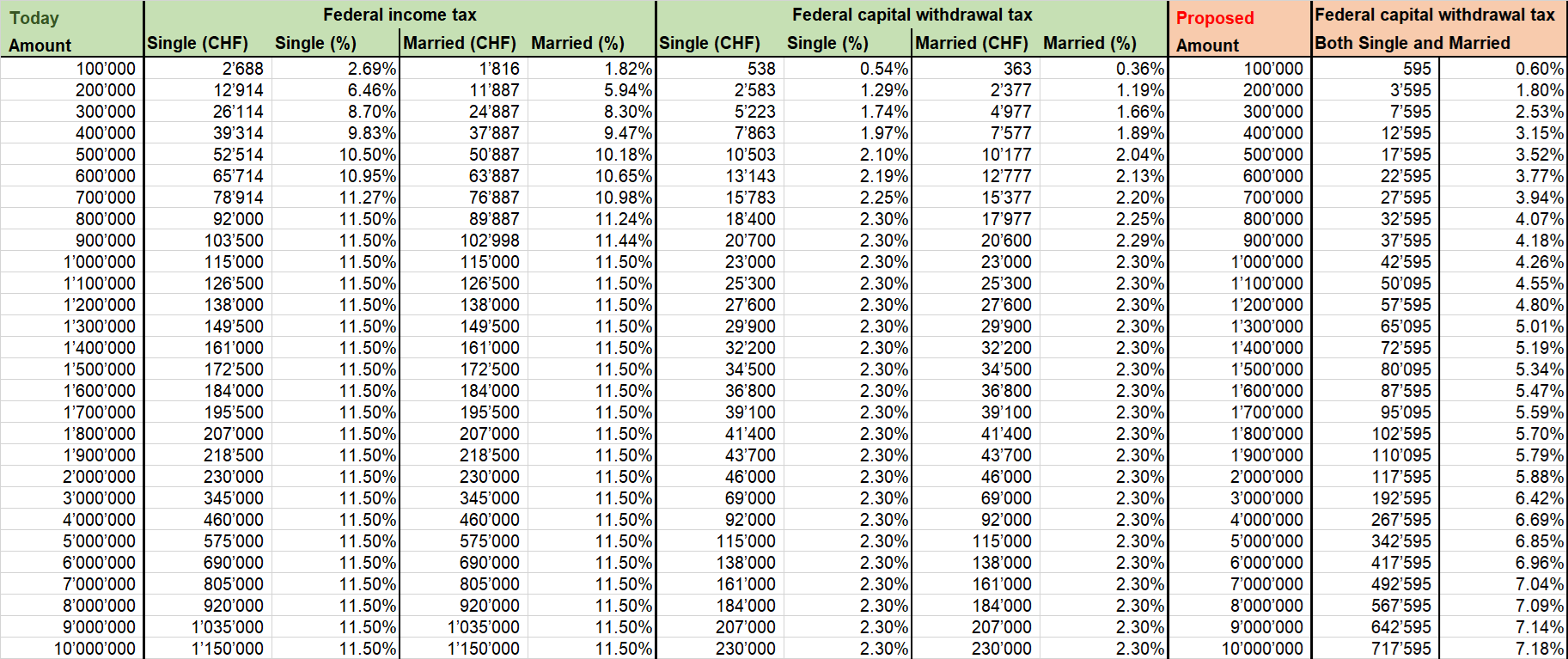
Here is the math, old and new taxes (federal only, your cantonal/communal taxes still come on top):

Other changes and notes:

  • No difference between single and married
  • Withdrawals within one calendar year are cumulatively taxed at the progressive tax rate
  • No tax advantage anymore above CHF 10 Million capital withdrawal, and only 4% tax advantage above CHF 1 Million.

Timeline: Vernehmlassung until May 2025, planning to finalize a Botschaft until September 2025, with deliberation in parliament in winter session 2025. Earliest enactment by January 2027, tough might be delayed given that a referendum (and therefore a public vote) seems likely. Interestingly, the proposed taxation change is the only element where their own papers expect savings only beginning in 2028 anyway.

Based on this proposal, my expected tax bill more than doubles, costing me around 30k extra. Even so, I find this quite a reasonable (proposed) change. Edit: Maybe not, see next two posts with @nabalzbhf observation.

7 Likes

in the “income tax” column, is that income tax based on if you had this amount of income in a given year?

(I think 1M capital you’d get with a << 1M yearly income)

1 Like

Yes you read that correct: Income tax in the table is for taxable income in any given calendar year (I could have left this out, but needed it to calculate the old tariffs which were defined as one fifth of the ordinary tariffs).

And you make an excellent point I didn’t consider! You can have an income of 200k/year for decades, paying roughly 6% of federal income taxes, and buying into a pillar 2 with 20k/year. Your 20k/year, and your ordinary contributions and interest may amount to above CHF 1 Million at 65 when you withdraw it. You then used to pay 2.3% of income tax, now facing a proposed 4.3%. That does indeed eliminate much of the tax savings you used to expect (and there are scenarios where you in fact face a higher overall tax bill).

1 Like

SVP and FDP are against higher taxes, FDP announced a referendum, so I guess we’ll vote on it. Higher taxes on pensions will have a hard time currently, as the last few years have shown.

2 Likes

I don’t expect this change to survive the parliament anyhow. The past months have shown that this is way too contested (in any form whatsoever), and would likely be a killer for the whole package if they kept it in.

2 Likes

Thanks for the correction, @Your_Full_Name !

1 Like

@1742

I have a question.
In your table the maximum rate is less than 8%
But in text above I see that tax is supposed to increase by 7.5% for 1 Million CHF withdrawal and increase by than 11.5% for 10 million

Is it because you are showing an effective tax rate and the text above is talking about tax rate for a given slab?

In my view, the proposed change was fair and just for second pillar withdrawals - but it is a terrible idea to apply it for 3rd pillar.

Since people anyways distribute 3a money in different accounts, I believe the effective tax on 3a withdrawals would normally be in lower tax bracket. Isn’t it?

1 Like

Things can accumulate fast and its a fairly new trend (5-10 years) that people open multiple 3a.

I see. I also heard that there was a proposal somewhere to let staggered withdrawals from 3a to be allowed from same account to eliminate the need to open multiple accounts

Not sure what happened to that regulation

1 Like

Correct, my table shows effective tax rate. The 11.5% is the marginal tax rate applying above CHF 1 million (which means you save nothing as this equals the maximum ordinary tax rate).

1 Like

No, that’s the good thing that will kill this proposal politically. If they remove pillar 3a taxation it might actually pass a public vote.

1 Like

Thanks for doing the math.
It would be interesting to see how Cantons react because the marginal wealth tax rate (Cantonal + federal) in ZH can be quite high for higher withdrawal amounts.

This can make 2a voluntary contributions very unattractive for some given the lower returns they generate.

The motion has been assigned to a commission.

3 Likes

As has every other part of the proposal. So why should this part be cut while all others remain?