Thanks - I’ve gone down the rabbit hole and I think that what makes most sense is
stay in CHF to avoid exposure on currency risk
take advantage of the Banque WIR offer - 1.8% saving plus account until feb. 2025, then 1.3% - max withdrawal is 20K per year, which is what I have in my saving account right now.
Do you agree on the approach or do you see another saving account/investment that would make sense ? I like the fact that Banque WIR is simple, I just need to open an account, do a transfer and I’m done.
A money market fund is pretty straight forward and they don‘t deviate much from each other. You‘ll always roughly get the overnight central bank rates. So the usual suspects like XEON are still valid.
Only thing that you can do, if you accept a little more risk and slightly more volatility, is to park cash in something like ultra-short corp bonds.
If you want to hedge currency movements of future known big expenses in €, it can be smart to invest in € fixed income. I wouldn’t do it for other reasons.
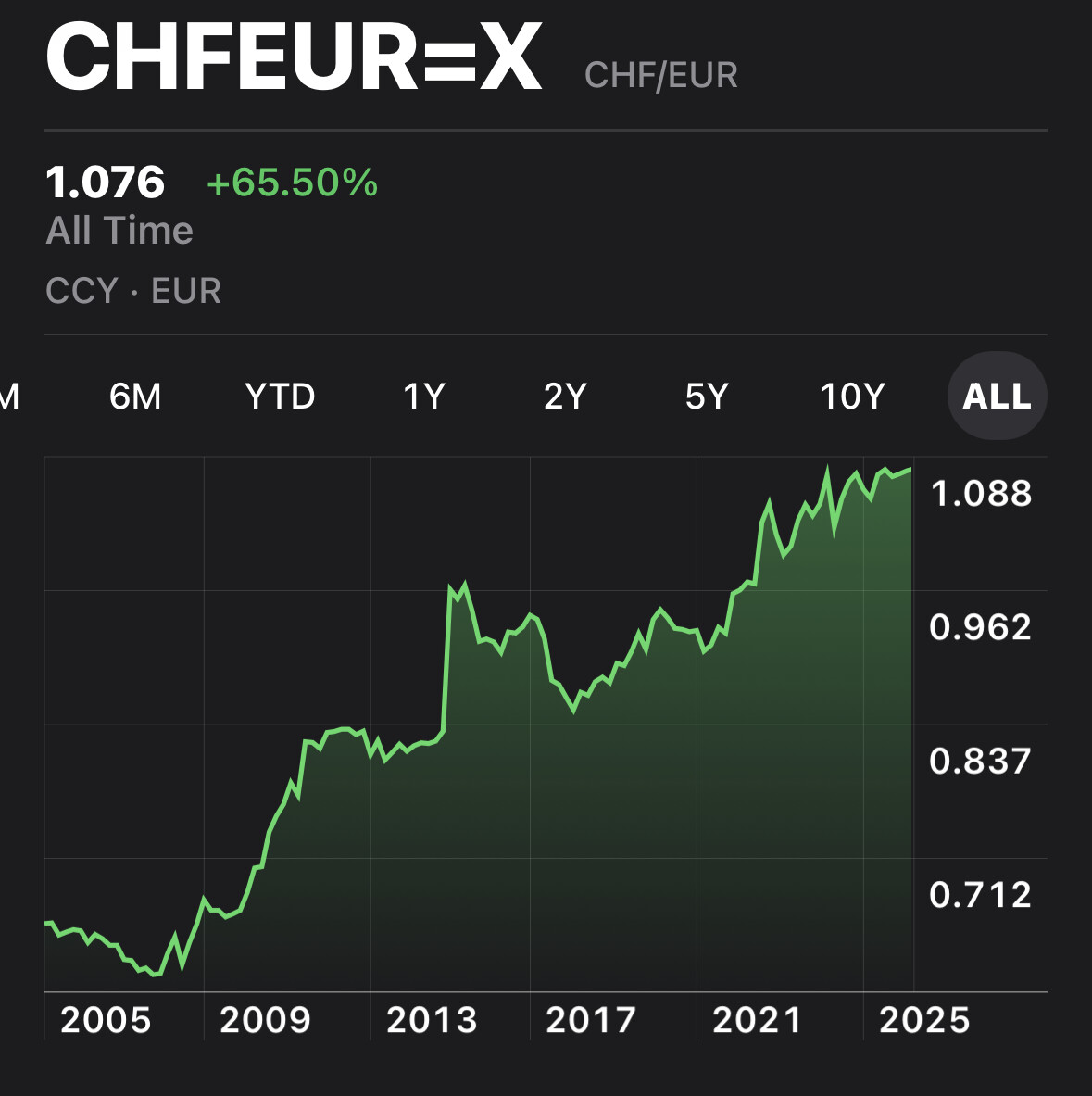
I mean sure, but will that trend continue in that matter? I would think so yes, but I don’t know. Also we need to look at total returns. The only rational prediczion you can make is the one with interest rate parity in mind. Which woudl mean at current rates a 2% devluations of € per year. And of course from a pure performance point, take the route with no taxes here. However ther eis also carry as well with higher yielding currencies. Although € rates are already low again, so not much difference here.
However this is not about predictions, this is about risk management.
You’d have to factor in interests accrued on both currencies to reflect assets held during the period, though. I have not done the exercise and have no idea what results it would yield.
Edit: also, the trend went in the other direction from 2015 to 2018. 3 years is a significant amount of time for money kept in cash and cashlike products, which presumably could be needed on the short term.
Mit dem Lesen und der Teilnahme an diesem Forum bestätigst du, dass du die Forum-Richtlinien gelesen hast und damit einverstanden bist sowie den Haftungsausschluss auf http://www.mustachianpost.com/de/ akzeptierst.