I have a conceptual question about currency hedging in bond ETFs.
I’m considering a global government bond ETF such as Vanguard Total World Bond ETF (BNDW). From what I understand, the non-U.S. bond exposure in the fund is hedged into USD.
My question is: does this make sense for a Swiss investor whose reference currency is CHF?
Intuitively, it feels inefficient to me because:
my spending will be ultimately in CHF
I would still retain USD/CHF currency exposure on the hedged portion
So I’m wondering:
Is USD hedging still beneficial for a CHF-based investor?
Am I misunderstanding the purpose of currency hedging in global bond funds?
Unless you are absolutely 100% convinced the USD will do better than other currencies in the future (beyond what interest rate differentials that are known today have priced in), you shouldn’t hedge to USD.
It also creates an additional layer of inefficiency, without practical use for you.
There are CHF hedged versions of global bond etfs available. If at all, you should pick on of those. Like VAGX. But these are super tax inefficient, due to the low yield of CHF and the fx hedging costs it creates. You pay full tax on the whole yield, but hedging it back to CHF ends you basically at close to 0 yield (hedging cost = interest rate differential), while you still pay the tax.
Thank you. I’ve only recently moved to Switzerland and I am not fully informed about the tax system. Given what you are saying about the tax-inefficiencies of CHF-hedged global bond ETFs, what would be an alternative then? Just keep the money in cash?
They can still make sense for diversification benefits. You could make a blend of funds here.
There are also CHF government bond funds with various durations. A CHF bond portion in Switzerland is a bit of a pain, due to no single fund doung everything you want.
A good intermediate solution could be just using a moderate term swiss government bond.
Like this one:
I would keep an eye on yields though, 2022 we came out of a decade long negative yield environment. If we enter that again, the case for CHF government bonds gets thin at that point.
Also I would avoud going much longer duration for the same reason.
What’s your target portfolio? What do you want the bond portion of your portfolio to do?
The section for Bond funds → global ETFs only lists hedged ETFs. Does this mean that hedges bond funds are recommended over non-hedged ones if you are looking for a global bond ETF?
IMO yes for traditional portfolio construction. Fixed income without hedging defeats the purpose.
Eg:
Bonds serve as a ballast to equity risk or growth assets in an investor’s portfolio. As such, Vanguard’s position is to fully hedge the currency exposure of international bonds, thereby minimizing volatility, increasing diversification, and preserving the portfolio’s fixed income profile.
I’m not trying to get some fixed income from it, I just want to add some diversification. I have most of my assets in stocks, and I would like to add a (small) portion in bonds, just in case. I’m not even sure that would be necessary, since I’m planning to keep these assets for the long term (>20 years), and therefore I may even think of keeping them 100% equities. I just like the idea of adding some bonds to it, even just for the sake of experimenting a little bit.
Hedging reduces (currency) diversification but it aligns the behavior of the bonds with the currency you expect to use them for (the one in which your expenses are), provided the maturities match (long term bonds are not “safe” to cover short term liabilities, for example, you’d need short term bonds for that - that is part of the surprise that caught some people flat footed in 2022).
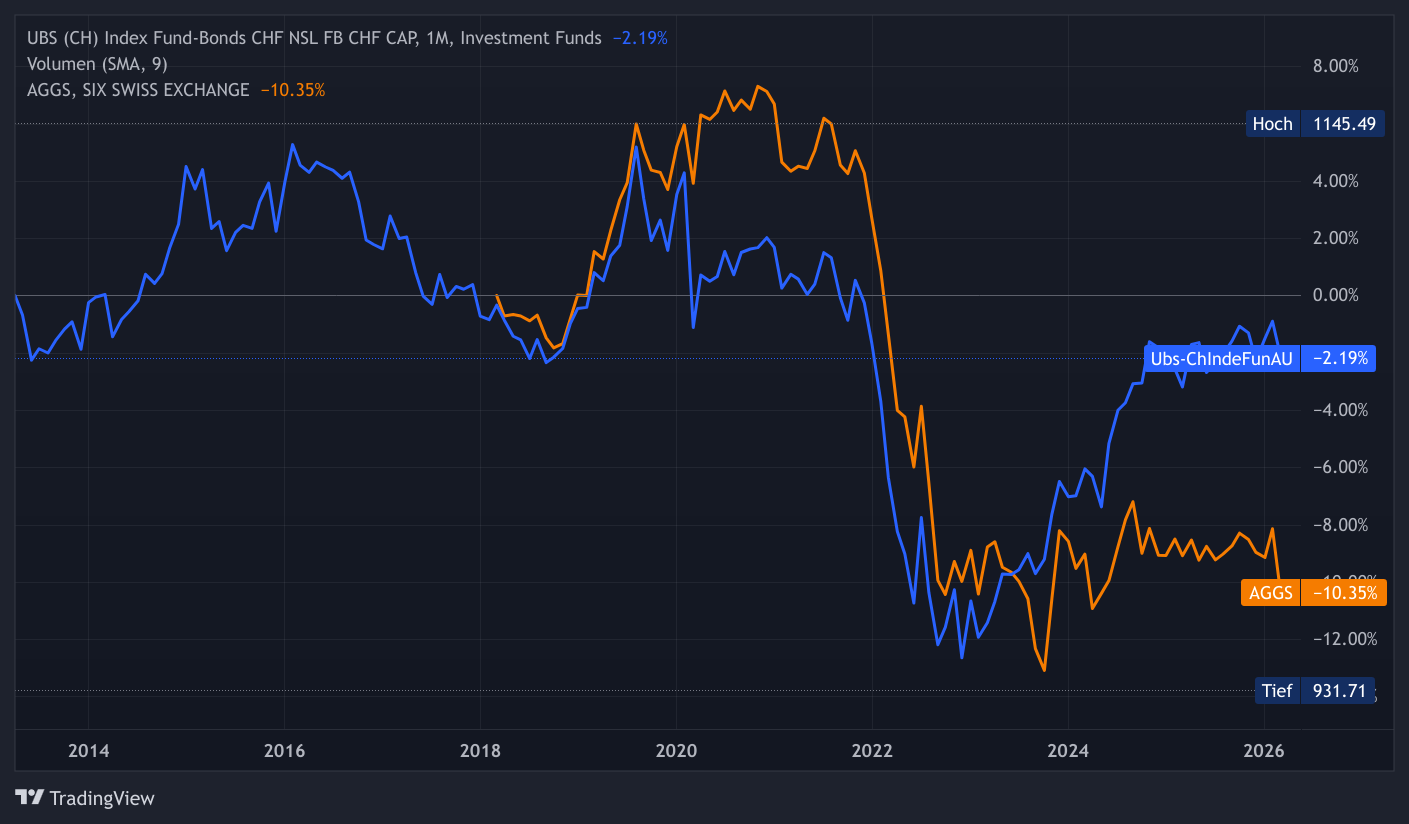
To illustrate that a CHF-hedged global bond fund and a Swiss bond fund (SBI AAA-BBB) can perform quite differently (before considering the tax effect of the former):
Mit dem Lesen und der Teilnahme an diesem Forum bestätigst du, dass du die Forum-Richtlinien gelesen hast und damit einverstanden bist sowie den Haftungsausschluss auf http://www.mustachianpost.com/de/ akzeptierst.