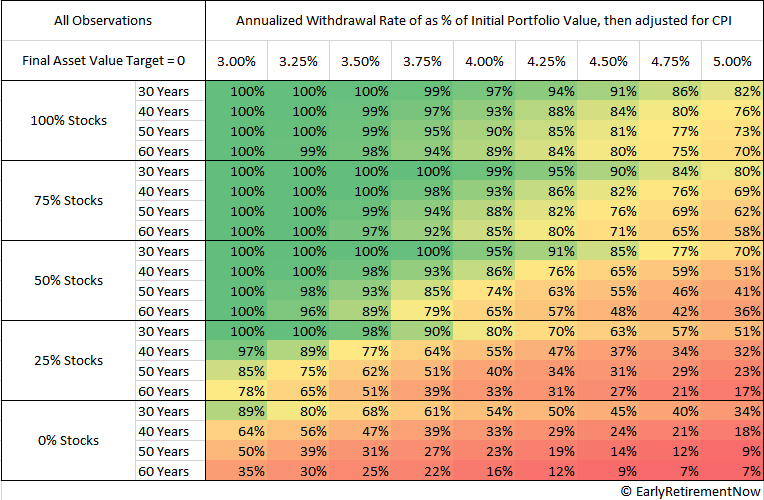
Yes, but that’s the same. 100% is 100% (to be fair it’s not exactly in that table as there is rounding).
As I understand your question from an investment (not psychological) perspective, it is “once you have reached far above that 100% threshold, shouldn’t you squirrel that 100% away to make sure you don’t fall below it anymore?”
Edit: It’s a pretty long post so I’ll use dropdown headers. /Edit
The financial side of things
The answer I get from the table is: if you do, stocks are a legitimate way to do it (i.e. squirrelling away doesn’t necessarily mean using assets traditionally considered as safer - though you can and maybe should use them anyway as they may match your ability and willingness to take risks) and if you do use stocks, it allows for that amount squirelled away to be lower.
Now, you may consider that historically backed 100% isn’t safe enough and that you want your assets to guarantee your future financial wellbeing due to their inherent characteristics alone. It may get close to it but you can’t reach 100%:
-
fully paid off real estate is subject to taxes, some non insurable risks (war among others), insurance premiums which can rise and changes in legislation. It can’t be used to match your consumption beside the big part consituted by lodgings.
-
longer term bonds are subject to interest rate risk, inflation and default risk (even sovereign debt has been historically defaulted upon in some extreme cases).
-
shorter term bonds and cash are subject to inflation so there’s no guarantee that the amount you’ve squirelled away actually covers your expenses for the time you expect it to. You’d have to significantly overshoot the target (which if you’re far over the “enough” line, you can but hyperinflation can erode your buying power very quickly).
Which leaves me with my personal conclusion that having significantly gone beyond “enough” doesn’t change the equation on a pure financial level. What used to work is still what works, you still have only one big bag of assets and compartmentalizing it (putting aside what feels like allows you to cover your needs) is mostly a psychological endeavour.
Caveats could be diversifying political risks by holding assets in different countries (flag theory) and legally segregating assets by puting them in other legal entities, protecting them against bankruptcy (though personal bankruptcy would still have your holding of these entities at risk, it mostly allows for bankruptcy from what one of your companies is doing not to expand to your other assets).
The psychological side of things
I don’t think there are high chances the psychology would actually change.
Someone getting 100M all of a sudden has it happen for a reason they are likely to attribute to their own skill. From that point, that skillset should both allow for them to get more and getting away from it would actually constitute a risk as it would be terra incognita and would not benefit from the experience they have built throughout their life.
Getting a huge inheritence is probably the “easiest” to deal with, though not necessarily easy either. The heir may have expected the inheritence coming and then again, their own personality, upbringing and temperance would probably be the deciding factors. Someone grounded would probably make plans for what to do with their assets when they’d get them and avoid overspending them or throwing them all in risky ventures. Someone on the entitled or overconfident side of the spectrum may not use any time to try to preserve some of the wealth and loose it all anyway.
People with huge incomes, most notably successful athletes or rockstars, are experiencing a huge change in their life when their career shifts from providing a lot to not providing that much if any. They’d benefit from early planning but when that would occur, they are 150% invested in their career that demands everything they have out of them and money is plentiful. Moreover, success draws people who want to benefit from you around yourself and bad advice may abound.
People who get it on gambling (lottery tickets, betting, yoloing on leverage on that one asset that went to the moon) both are subject to the thrill of gambling and probably have a very hard time changing mentality once they have achieved way more than enough. If they set part of their assets aside, gamble the rest, loose all but the assets they have aside and can’t gamble anymore, are they likely to think “alright, I’ve had a good run, time to live a good normal life from now on” or “hey, I bet I could 100x that amount I have aside if I just put it on that one horse I have information is likely to win its race” ?
One exception would be the people who have overextended their risk tolerance while growing capital and would benefit from tuning things down to sleep well at night. For these people, I think the damage to their mental wellbeing that may result from being overexposed may be a significant risk and I’d advise they revise their allocation upon reaching “enough” rather than after having let it ride to way, way more than enough. If the way, way more than enough part happens all at once, then yes, your need to take risk has fallen, revisit your asset allocation.
Bottom line
My bottom line is it’s more about building temperance and a poised outlook than stricktly asset allocation or setting assets aside.
With temperance and a poised outlook, one would adjust their investing strategy as it goes, at all stages of life, and be better set to take good decisions as to what to do with their assets if they reach way more than enough level.
Without them, it’s very unlikely one would be able to set aside assets when reaching way more than enough level and to leave them untouched if they suddenly lost their other assets.
The wise man still wants to revisit their risk tolerance regularly, in particular:
- their need to take risks;
- their ability to take risks;
- their willingness to take risks;
and adjust course whenever necessary, after having taken a broad outlook, revisited why they had chosen to take the course they have taken until then and pondered upon it.
Focus point: Invest in wisdom, knowledge of yourself and temperance above anything else.