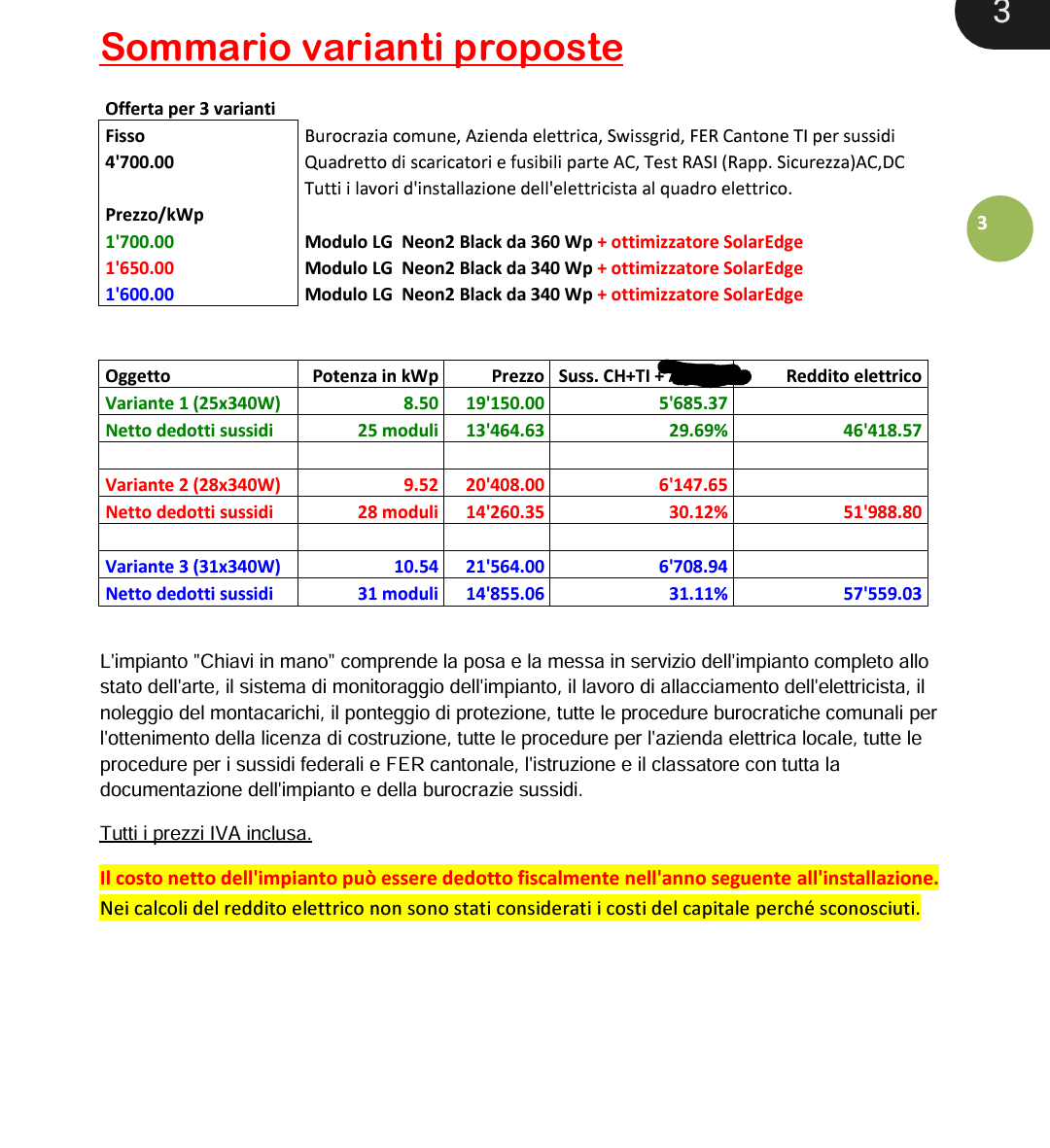
I went back to check, my memory faulted me; 19k was the cheapest option 8.5 kW. He went with 10.54 for 21’564 chf
It’s in Italian but here it is: small independent installator.
Crazy long wait, this offer was in November 2020. He was swamped with orders.
For what I can see and what my father said, the job was very good. Zero problems after 4 years.
This is “all included” key in hand, including electrician at the end.
He was calculating 4700 fix cost, then around 1600 per kWp variable costs.
Yes and no. It’s more predictable only if you have large consumers you can control like an electric car. The washing machines for two hours at lunch isn’t going to have that big of an impact.
Basically without an electric car and time to charge it when the sun shine, the load is basically predetermined by your schedule and routine. In real life you don’t really have that much flexibility tbh (without big consumers eg heat pump, electric car).
So yes self use become predominant but again only if you have these big consumers.
We ordered ours in Dec 23 and it was installed in Aug 24.
12.2 kWp, CHF 31’000.- total cost minus 4’000.- subidies = 27’000.- (incl. VAT, all fees, Sicherheitsnachweis, Pronovo registration, scaffolding etc.)
The subsidies were subtracted from the total price and the PV firm will claim it.
Our house is only one full floor, so scaffolding was probably not as expensive as it would be if you had two or three floors.
Battery would have cost around 7’500.- for 10 kWh. I was told that its life expectancy / amortization should be only 7 years, so economically not worth it.
We however installed a bidirectional inverter, just in case batteries should get much cheaper in the future …
Has anyone looked into roof tiles made out of solar panels? If you’d need to replace existing tiles anyway, is that an alternative where you’d reach ROI much sooner?
I guess it makes sense when aesthetics are required e.g. protected roof. Though some of them seem to require each individual tile to be manually wired up which seems a bit inefficient.
It’s both, I guess.
Generally, self-use is driving the business case due to the difference in price and lack of grid fees. In my area, it’s roughly 2x.
I do have a heat pump and smaller, regular consumers. EV charging for now is free at work However, it’s quite efficient, so there’s only so much you can save. Average annual output would be maybe 60-70% higher than total consumption, so maybe 40-45% own-use are feasible without battery?
However, especially on sunny summer days, it matters if the remuneration for selling back is 10 or 20 Rp for now. Could as well become 0, as mentioned above.
Roughly, yes. Not financially attractive, at least used to be ridiculously expensive. It’s more of a design feature, was my impression.
I guess it depends on how much you use and how big the solar installation is. If self use is more lucrative, then an alternative is to store the energy. e.g. use it to heat a water tank. Or even battery (normally not economical unless you DIY the battery). But you could be limited in use/storage-capacity on very sunny days or if you have a much bigger installation than your use case needs.
Theoretically, you could also convert electrical energy into cash via crypto-mining or selling AI capacity if you really have a lot of spare electricity.
I hope we’ll have things like hydrogen, pumped hydro, etc soon enough to handle excess load from renewables.
The problem is that usually stuff that benefits from cheap energy is very capital intensive, and only make sense at close to 100% utilisation.
Batteries can smooth out the day/night cycles, but the summer/winter cycles are just too long.
Somewhat related to a “big” PV: I can really reccomend a 600W “balkonkraftwerk”, which you can install yourself anywhere (even onto your roof, if you feel like it). No electricn needed, you only need to send the conponents certifications to your power supplier.
You can also use 4 panels on both sides of your roof in order to improve during winter or shadow, you just need to limit your inverter to 600W and plug it into any normal power sockets. You can either buy a complete set of componets or buy them seperately (cheaper, but needs some knowledge and some power suplier probably do not like seperate certifications).
With such a setup, you should be able to cover your base load and safe 20-40% of power costs. It costs CHF 300-700, so it should be amortized after at least 2-4 years.
I’m not saying hydrogen or pumped hydro don’t help, just that they only go so far at using the excess energy before they become unprofitable. For every new one you build, you reduce the utilisation rate for the next one. My understanding is that this critical point leaves a lot of excess energy on the table.
The Nant de Drance pumped-storage plant cost 2.5B to build. Last year, which was its first full year of exploitation, it made 12M. That’s 200 years to pay back the original capital. Now, it will probably get better as kinks get worked out, and as solar skew the production even more, but that’s not amazing.
Hydrogen is similar. Apparently, an hydrogen generator needs around 4k hours/y of utilisation to be profitable. The sunniest city in Switzerland, Lugano, has around 2.5k hours of sun per year.
All of this to say that’s it’s not easy to use that low/negative energy price profitably if it happens just a few hundred hours per year.
I would love to install them. My problem is that I have an old roof. And if I install solar panels then it’d be better to change the roof first. And if I change the roof, at that point I can raise the house by 1 floor. And there it goes 1-200k.
I’ll look into installing some of the small DYI ones on the veranda roof though.
200k would be pretty cheap. If you want to go full future proof around 400k is more realistic nowadays because when you are already raising the house by 1 floor which might require scaffolding it would make sense to also better insulate/renovate/paint the facade etc etc
Mit dem Lesen und der Teilnahme an diesem Forum bestätigst du, dass du die Forum-Richtlinien gelesen hast und damit einverstanden bist sowie den Haftungsausschluss auf http://www.mustachianpost.com/de/ akzeptierst.
 However, it’s quite efficient, so there’s only so much you can save. Average annual output would be maybe 60-70% higher than total consumption, so maybe 40-45% own-use are feasible without battery?