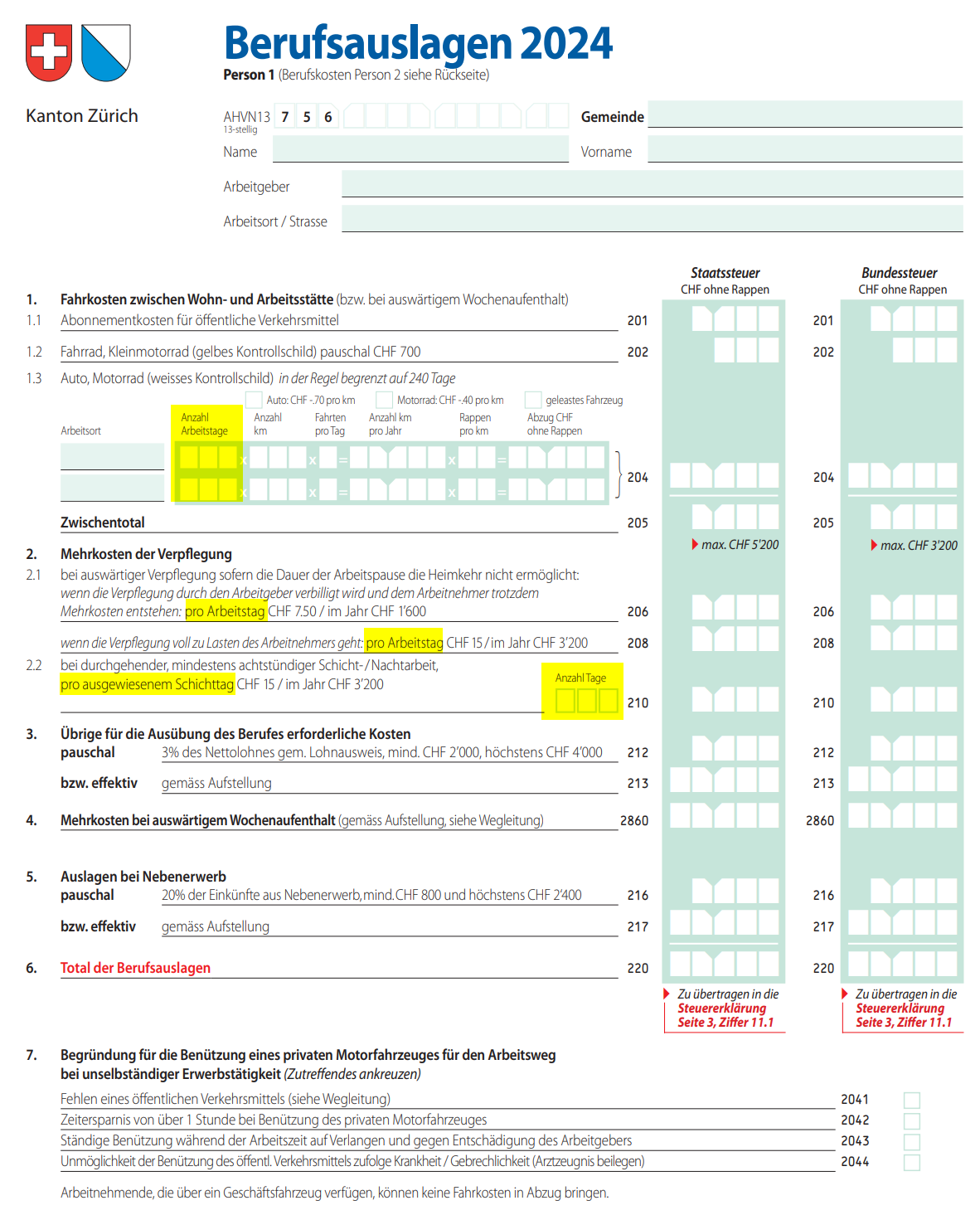
I am wondering what are the consequences of starting part time mid-way through the year on the taxes. Beside the fact that the income will be lower obviously. I guess in practice the question boils down to: which deductions are prorated to the average % worked through the year and which ones are prorated to the % of time working at the end of the year? (With the idea, the more deductions are applied looking only at the end of year working %, the worse it is to start part time late into the year)
Really? So, for example, someone who is working at 50% is still able to deduct the same total amount of commuting and meal cost than someone who is doing 100%?
Only meals, typically. All others are flat or based on income, if I’m not missing anything.
For meals, I had no issues with a mixed calculation for the year when changing hours during the year. I wonder if I could still silently deduct 100% if I hadn’t “tipped them off” with that.
Transportation is typically the monthly pass, no issue to deduct fully. Maybe some discussion if you work like 20%, though, or deduct car usage.
You want to go part-time and actually consider tax deductions for the timing?
No. In the first case, the deduction is 50% of the deduction in the second case.
But that’s not what you asked (or what I understood you asked). If you work first 6 months of a year or last 6 months of a year, it won’t make any difference with respect to your tax deductions.
So, the best strategy is to split your absence between two years as equal as possible (to reduce the taxable income for each year). I think I even read it somewhere on a website of a moneyland.ch type.
Technically, yes. In practice, this assumes 100% = max amount, 50% = 50% of that. Sure, you could split 50% over 5 or 6 days a week. But then it could be argued that you don’t need any lunch at work. Or they could have a closer look at sick days, maternity leave or home office.
I understood the question as
a) if / where this is correct and
b) what happens if you have, for example 6 months of 100%, then switch to 6 months of 50%.
In my experience, a) only applies for meals. And b) is where the mix calculation based on days comes in: It wouldn’t be 50%, but rather weighted 75% for meals. Yet still 100% for transport, double-income deduction or max 3a amount.
In response to rez: No you won’t lose the valuable full deduction for a full year if you’d switch to part-time in, say, December.
The wording of the meal-deduction says that you qualify for the deduction only if you cannot go home for lunch. Sounds to me that if you work 60%, you would qualify for 3 x 7.50 / week if you work 3 days a week, but nothing if you work only long mornings every day.
I believe most tax authorities are pretty lenient with the bike, public transport and meal deductions, but not with the car-deduction.
This also aims at time, i.e. would you have time to go eat at home. Minimum break for a 9-5 job is 30 min, so it’s propably only fringe cases where that becomes an issue, unless you litteraly work next door. But true, if you only work half days, there’s no need to have a break and meal in between work, hence no additional cost to deduct.
That’s the standard interpretation according to my (only personal) experience, once they notice the 60% hours. I haven’t challenged it and begrudgingly accepted their correction to not invoke their wrath. And yet, no one wants to count work days, the whole thing is set up to be simple with flat rates and %.
Maybe I carefully inquire for the 2025 return to get the full 1’600 again each (we both have subsidized meals)
Mit dem Lesen und der Teilnahme an diesem Forum bestätigst du, dass du die Forum-Richtlinien gelesen hast und damit einverstanden bist sowie den Haftungsausschluss auf http://www.mustachianpost.com/de/ akzeptierst.